
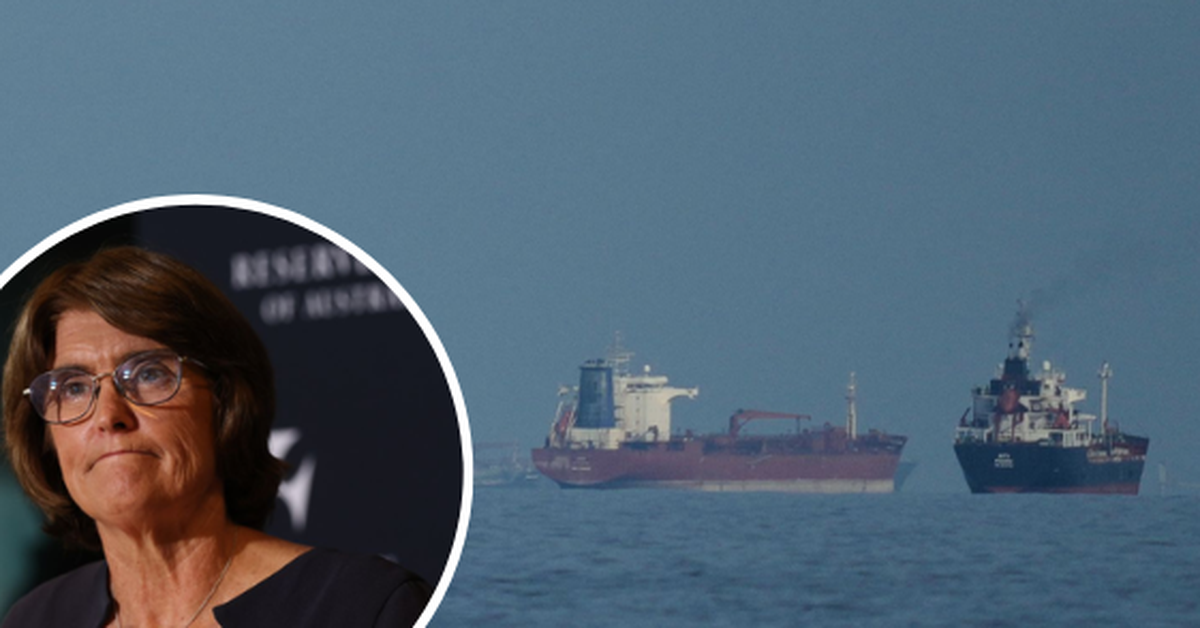
Inflation could be driven into the mid-sixes as early as June, economists predict, as soaring oil prices caused by the Middle East conflict triggersa price hike ripple-effect across commercial enterprises. Oil tankers and cargo ships line up in the Strait of Hormuz as seen from Mina Al Fajer, United Arab Emirates, Wednesday, March 11, 2026. (AP Photo/Altaf Qadri) (AP)
But economists now fear inflation could soar higher than that – in spite of any prospective end to the war.
“Even if some resolution to the conflict is found quickly, a material cost shock has already been felt,” NAB senior economist Taylor Nugent told the Australian Financial Review (AFR).
“We expect the impact of the conflict to show up across a broad range of prices consumers face quite quickly.”
If the global benchmark price for oil, Brent Crude, floats around $US120 a barrel until June before dropping to $US80 over the next few months, headline inflation would hike to 5.4 per cent in June, Commonwealth Bank of Australia head of Australian economics Belinda Allen predicts.
But if Allen’s prediction proves conservative and the price of oil leaps to $150 and takes double the amount of time to fall, headline inflation could peak at 6.4 per cent in June.
 All four major banks predict the RBA to pass a third-consecutive rate hike in May, which would lift the cash rate to 4.35 per cent in a bid to combat (Louise Kennerley)
NAB economists anticipate headline inflation to reach five per cent in the middle of the year.
“The macro-economic outlook appears to be transitioning towards a more treacherous phase, presenting downside risks to growth,” NAB Chief Economist Dr Sally Auld said.
“While this primarily reflects a retail fuel price impact, we are also cognisant that other impacts will accumulate relatively quickly.A More Treacherous Phase read.
“For example, higher airfares will flow through into official price data from April for domestic and May for international flights. “
But the economic outlook remains “highly uncertain”, Allen said.
 Sky-high fuel prices are prompting industries to hike service costs across the board. (9News)
“The Strait of Hormuz is unlikely to reopen quickly, despite ongoing reports of US-Iran talks … however, it is difficult to have conviction on the path of the conflict, “she told AFR.
The most recent ABS data, in which the consumer price index eased slightly to 3.7 per cent for the 12 months to February, was down from 3.8 per cent the previous month and slightly lower than what economists were expecting.
But those figures only covered February, and therefore didn’t capture any of the inflation caused by skyrocketing oil prices and other flow-on effects from the war in Iran.
All four major banks predict the RBA to pass a third-consecutive rate hike in May, which would lift the cash rate to 4.35 per cent in response to rising inflation.
CBA economists expect inflation to moderate in 2027 as demand slows and unemployment edges higher.
NEVER MISS A STORY: Get your breaking news and exclusive stories first by following us across all platforms.