
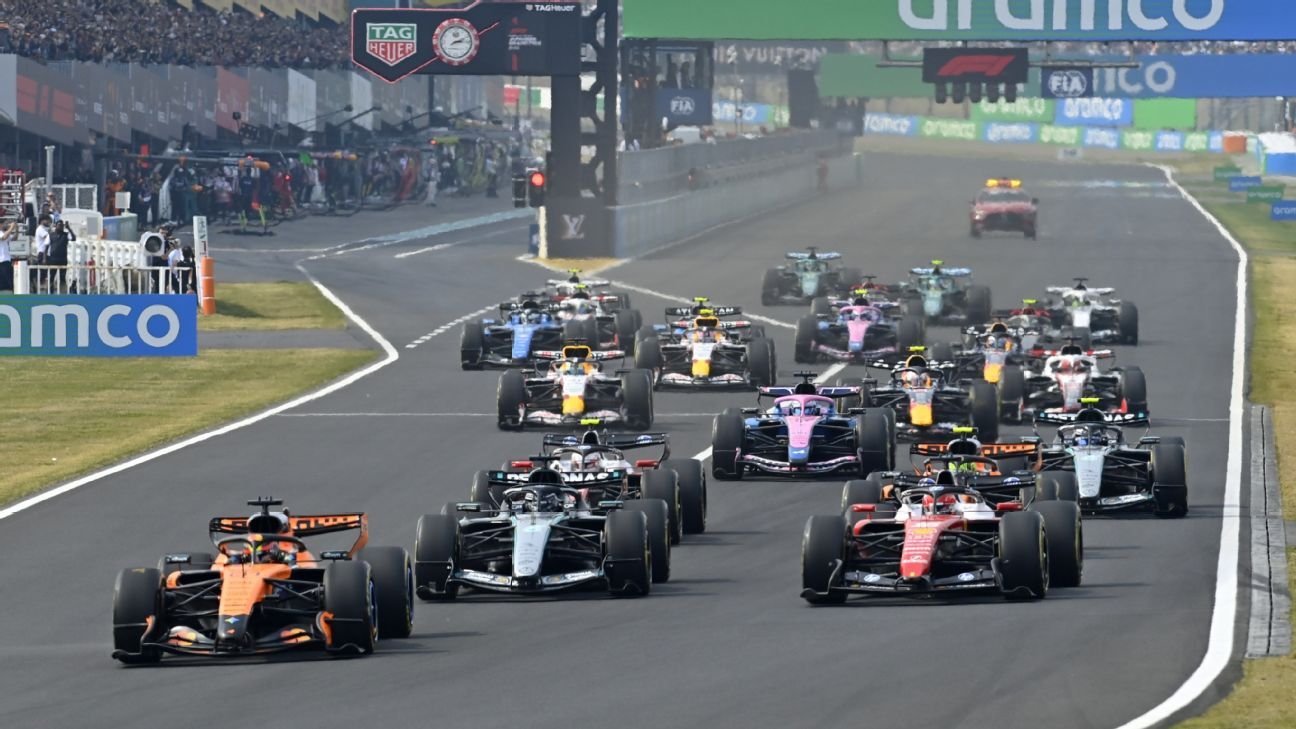
Three races into a new season and an all-new era of regulations, the Formula 1 2026 season has hit an unexpected pause.
F1 fans, teams and drivers now have to wait five weeks until the next race after events in Bahrain and Saudi Arabia were cancelled due to the war in Iran.
After the Japanese Grand Prix — won by Kimi Antonelli — we’ve looked into what’s next, and why F1 is set for an unusually quiet April.
Why did F1 cancel the races when it did?The Japanese Grand Prix was the last race until the beginning of May. Photo by David Mareuil/Anadolu via Getty Images
The decision was driven by safety concerns, with the situation in the region deemed too unstable for the races to go ahead.
Confirmation came on March 14 — just under a month before F1 was due to head to Bahrain — in part because of the sport’s complex logistics, including deadlines for teams to ship freight to the Middle East.
Sources told ESPN the call to cancel Bahrain was straightforward, but the decision around the Saudi Arabian Grand Prix was less clear-cut.
When is the next F1 race?The next Formula 1 Grand Prix will be in Miami on May 3. Photo by Glenn Dunbar/LAT Images
The Miami Grand Prix is now next up in the calendar, taking place on May 1-3, held around the Miami Dolphins’ stadium.
The Bahrain Grand Prix was due for April 12, followed by the Saudi Arabian Grand Prix on April 19.
It means there’s a five-week, or 35-day, gap between races.
Why is there such a long gap? Couldn’t F1 have filled it?The complicated logistics of scheduling a Formula 1 season make last-minute rearrangements practically impossible. Photo by ANDREW CABALLERO-REYNOLDS / AFP via Getty Images
In reality, there was little scope to plug the gap.
F1’s calendar is built months in advance, with complex logistics underpinning every race.
Staging a replacement race at short notice would require a venue ready to host immediately — along with all the necessary operational and organisational support — while having little to no time to sell tickets. That was not achievable within the timeframe, leaving F1 with no viable alternative events to insert into the calendar.
– Max Verstappen considering retiring from F1 at end of 2026 – reports
– Carlos Sainz: FIA ignored driver warnings before Oliver Bearman crash
– Japanese Grand Prix: Kimi Antonelli seals second straight win for Mercedes
Why can’t the races have just been rescheduled?F1 bosses remain hopeful that the Qatar and Abu Dhabi Grands Prix will take place as scheduled. Photo by Mohammed Dabbous/Anadolu via Getty Images
Rescheduling was not a practical solution.
The calendar is already tightly packed, with limited flexibility to move races later in the year without causing wider disruption. Finding space for two additional grands prix would have required significant changes elsewhere on the schedule.
There is also no certainty over how the situation in the region will develop, making it difficult to guarantee that postponed races could take place safely at a later date.
In the end, cancelling the events outright provided the clearest and most stable option for the remainder of the season.
There are further planned races in the region: in Qatar on Nov. 29 and the concluding round of the season in Abu Dhabi a week later. F1 chiefs remain hopeful those two races will go ahead as scheduled.
Will the break have an impact on the title race?Two fewer point-scoring opportunities could sway the F1 title race. Photo by Norvik Alaverdian/NurPhoto via Getty Images
Two fewer races increase the likelihood of a tighter points spread between the top teams and drivers — so in theory, yes.
The five-week break also gives teams an opportunity to delve into the data from the opening rounds and get to grips with their 2026 cars.
That could benefit those at the front, like leaders Mercedes and the chasing pack led by Ferrari, as well as those further back, like Aston Martin.
With additional reporting from ESPN’s Nate Saunders.