
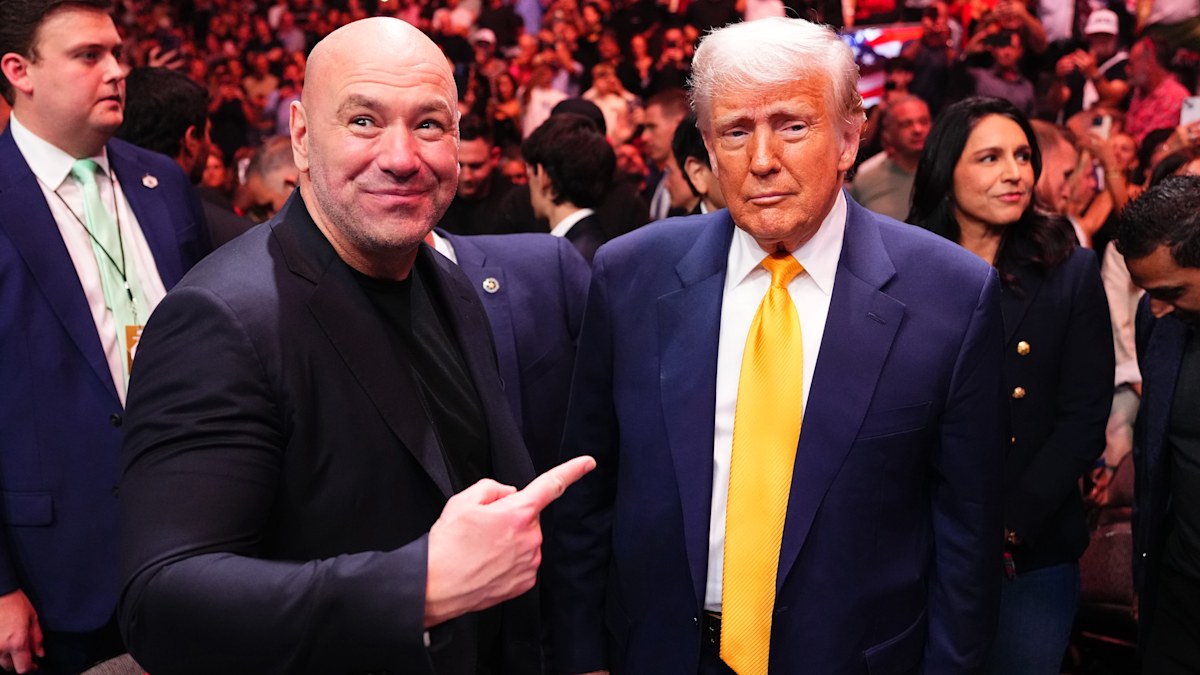
It’s the fight that has dominated the boxing world that does not involve fighters.
There’s not much of a chance it will happen, but Eddie Hearn and Dana White have been at each other’s throats for months, with both promoters teasing a stoush in the ring.
The beef stems from White spearheading Zuffa Boxing and lobbying for changes to he Muhammad Ali Boxing Reform Act, which provides protection for fighters and forces promoters to be transparent about revenue among a raft of measures designed to ensure fighters aren’t misled.
READ MORE: Demoted Bronco seals victory, Madge praises ‘true character’
READ MORE: Thurston tips Seibold sacking to ‘derail’ Manly as hot candidate emerges
READ MORE: Seibold sacked by Manly after awful start to season
Much to the displeasure of Hearn and other prominent promoters including Oscar De La Hoya, the Muhammad Ali Boxing Revival Act is one step closer to becoming law.
The US House of Representatives passed the Revival Act earlier in the week and it now heads to the Senate.
If it gets the green light there, it would then go to President Donald Trump to potentially sign and turn into law.
If that happens, the creation of Unified Boxing Organisations, better known as UBOs, will serve as another option for fighters.
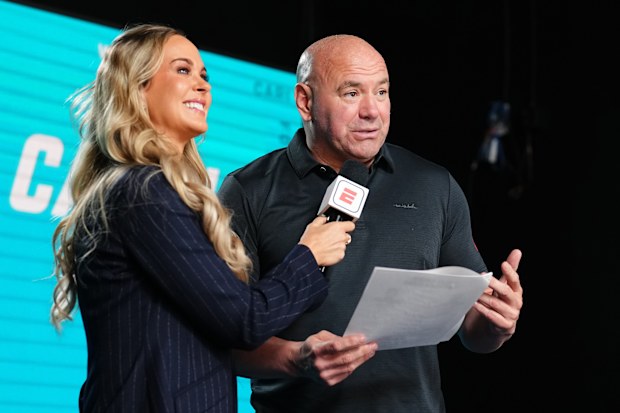
Dana White has ruffled feathers in the boxing world. Zuffa LLC
Supporters of the bill, including White, former boxing heavyweight champion Mike Tyson and the Association of Boxing Commissions, praised it as another choice for fighters.
It’s not stripping away the existing system, they argue, rather creating another path outside of it, where an organisation takes full control of matchmaking, rankings, titles and the contracts, similar to the UFC.
Critics of the bill say it could harm fighters because it may shift the balance power from fighters to promoters.
Detractors of the Revival Act point to the UFC and the two anti-trust lawsuits brought against it from fighters who allege wage suppression and monopolisation tactics.
The organisation settled one lawsuit for $US375 million.
Under boxing’s current system, the law calls for a separation between promoters and sanctioning bodies, with the latter handling rankings, titles and matchmaking.
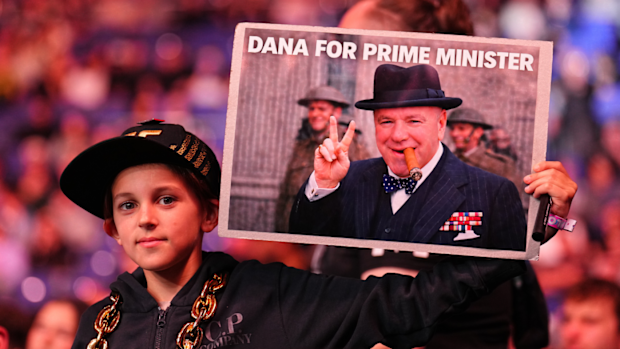
A fan at a recent UFC Fight Night. Getty
Tyson, a close friend of White’s, supported the new Revival Act revisions, saying the mandatory health insurance requirements are of benefit.
He said while the meaning of the Ali Act was to protect fighters, some promoters have used loopholes in the current legislation to “regain monopolistic control over fighters’ careers.”
In the current system, top fighters can make hundreds of millions of dollars and have opportunities to receive large shares of the revenue from their fights.
Jake Paul is a beneficiary of such a system, as is Tyson following their exhibition fight, while Sportico reported Tyson Fury and Oleksander Usyk earned over $US100 million each for their two fights in the ring. Several other big stars like Floyd Mayweather, Manny Pacquiao and Canelo Alavarez have also been paid handsomely under the current rules.
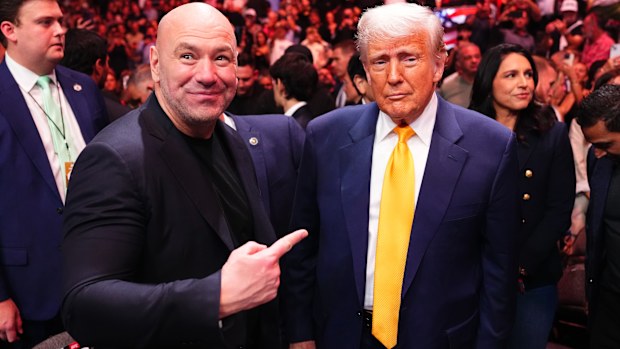
Dana White poses with Donald Trump during the UFC 314. Zuffa LLC
And that’s what every fighter – within both MMA and boxing – is aiming for.
However, in this structure, fighters also pay a percentage of their purse to one of the sanctioning bodies.
A UBO would not be allowed to charge sanctioning fees.
The vast majority of female fighters may find a form of protection under a UBO, with the act raising the per round minimum for lower-end fighters to US$200 per round.
The new law would see a UBO compensate a fighter $US2000 if they haven’t had a fight over a six-month period.
But that would not be permitted if he or she is collecting insurance money from an injury or if the fighter turns down a fight.
The Guardian’s Thomas Hauser obtained a contract for a Zuffa fighter and reported the contract gave the organisation the ability to use a fighter’s “identity” to promote Zuffa and products of Zuffa’s sponsors.
In the current boxing structure, fighters often sell sponsor space on their fight trunks, T-shirts and hats, and keep the proceeds.
According to The Guardian, Zuffa fighters can wear only Zuffa-approved equipment and gear, which could cost fighters money in lost sponsorship opportunities, similar to the UFC.
Boxers now pay for their own health care, unless it is written into contracts with promoters for their fights.
Promoters must have a minimum of $10,000 in health insurance and $10,000 in accidental death benefits for injuries suffered during fights.
The Association for Boxing Commissions recommends $100,000 in health and accidental death benefits per fighter.
Fighters must pass a pre-fight physical exam certified in writing for the state commission to green-light an event.
Women must also provide documentation confirming they’re not pregnant less than two weeks before a fight.
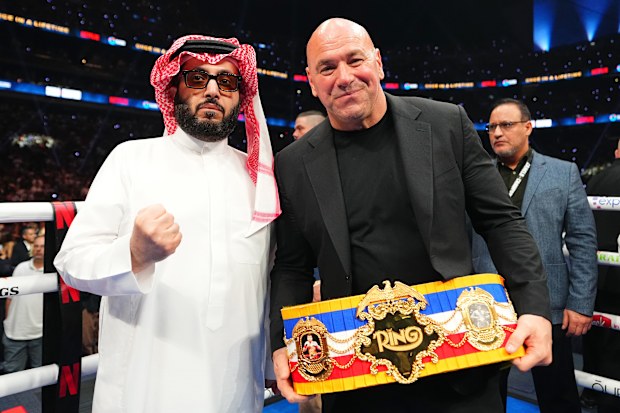
Turki Al-Sheikh poses with White during the Undisputed & Ring Magazine Super Middleweight Championship at Allegiant Stadium on September 13, 2025 in Las Vegas, Nevada. (Photo by Chris Unger/TKO Worldwide LLC via Getty Images) TKO Worldwide LLC via Getty Imag
Yet under the Revival Act, all fighters would be required to have annual medical examinations, including a yearly physical along with brain, eye and heart exams and blood work every six months.
On top of that, the law would force fighters to undergo brain MRIs “at least every three years” and regular testing if a fighter is knocked out, which would be covered by the UBO.
Additionally, fighters over 40 must have blood tests yearly and a chest X-ray at least once every six years.
State boxing commissions have their own over-40 rules, including neurological tests.
All costs relating to rehab facilities for fighters, health insurance during training periods and medical staff to help with requirements, is covered by the UBO.
It must also pay for any anti-doping program testing during training for a fight.
However, the fighter is still responsible for health insurance deductibles from the UBO-provided insurance.
There are several other details included in the bill that have been pushed by both sides to suit their agendas.
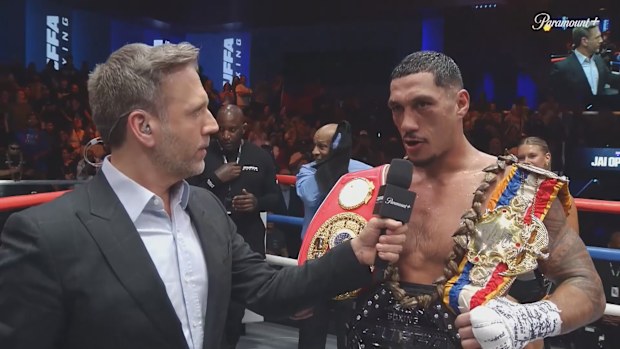
Jai Opetaia speaks after his Zuffa debut. Paramount
Top Rank founder Bob Arum criticised the bill in a December letter to Congress, calling for UBOs to operate under the same compliance rules as non-UBOs.
He also pointed to the stripping away of fighter protections if a boxer joined a UBO.
Hearn has been critical of the Zuffa model.
“In boxing, the majority of the revenue from the show goes to the fighter,” Hearn said.
“In MMA, the majority of revenue from the show goes to the promoter. Good luck to [White]. I wouldn’t moan. But that’s not how we work in boxing.
“And I’m not interested in a fake belt. I’m not interested in changing the Muhammad Ali Act.
“I’m not interested in changing the shape of the ring or the rules.
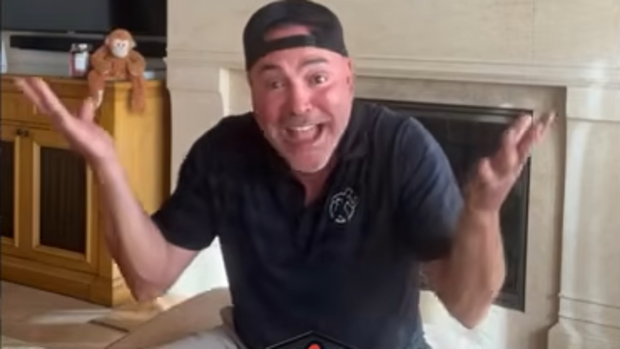
Oscar De La Hoya. Instagram
“What I’m interested in is the greatness of the sport of boxing. Our belts matter.”
De La Hoya has perhaps been the most vocal critic of Zuffa Boxing, taking shots at White at will.
In response to the vote in the House, the former champion said he wants to speak to lawmakers.
“What’s mind-boggling to me is that nobody’s reporting on it, nobody’s talking about it,” he told the Ariel Helwani show.
“It feels like I’m fighting this fight alone. They’re always sneaky. They had a hearing a couple of days ago where they passed it.
“It was all under the radar, nobody knew about it. Hopefully, with me showing up and being prepared, talking to the Senate, and hopefully convincing them, it gets derailed.”
He said he has been in conversations with several politicians and has been invited to Washington in the coming weeks to testify.
Reports from the US state two House members who voted yes, Bobby Scott and Ilhan Omar, called on the Senate to bulk up on anti-monopoly protections before the anything is finalised.
Regardless of what anyone says, all the talk around Zuffa has actually paved the way for a genuine rivalry – not between fighters – but those signing the dotted lines.
It’s unlikely a fight would spill from the House of Reps in Washington to a boxing ring in Las Vegas, between two middle aged men, in Hearn and White.
But if it did – it would be arguably one of the most watched fights of all time.