
The sport keeps catching itself in unflattering moments, raising questions about tennis sportsmanship, and then pretending it isn’t looking. Let’s start with what actually happened, because the details matter.
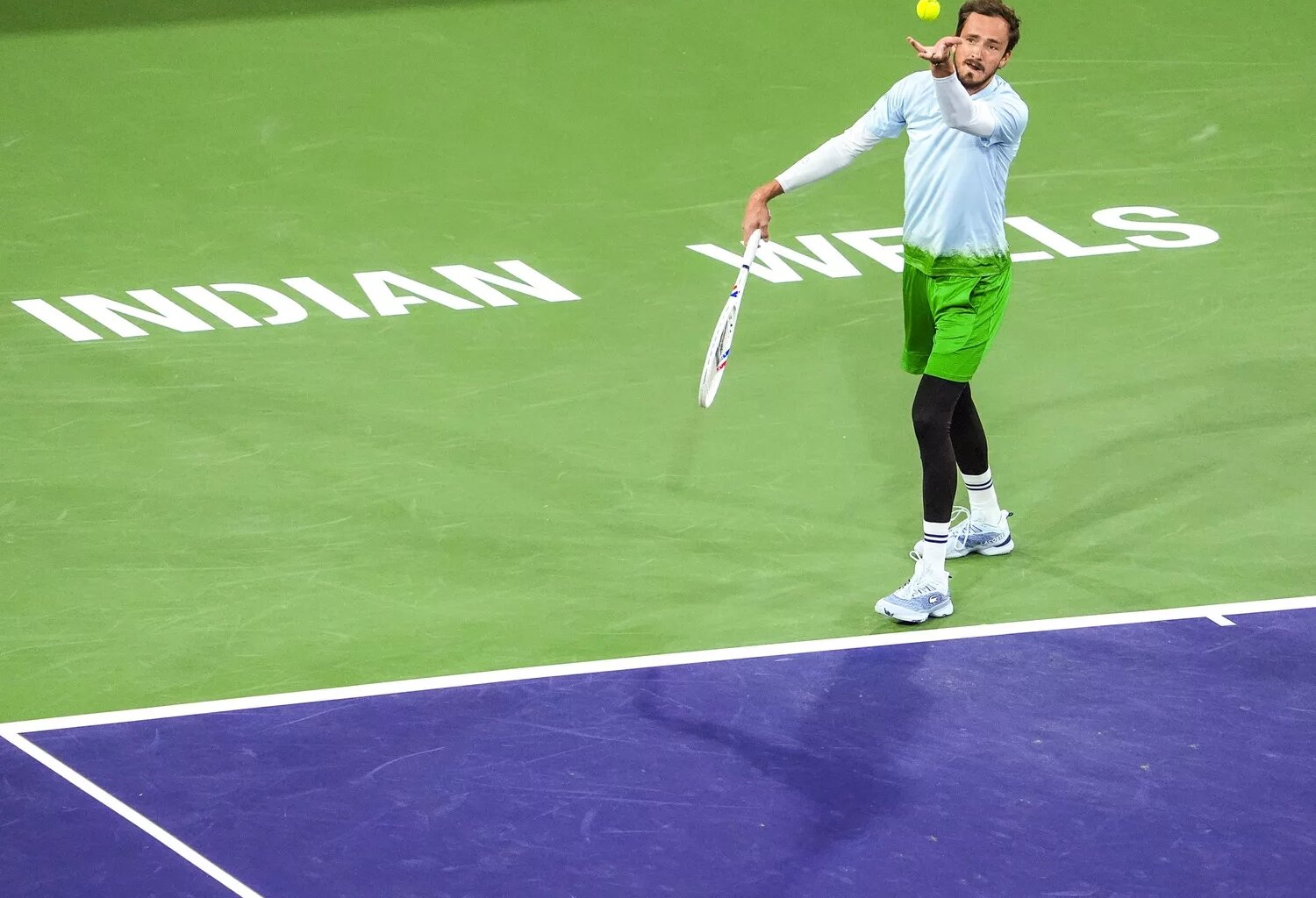
Mirra Andreeva smashed her racket multiple times during her third-round loss at Indian Wells, then left the court, trading words with the crowd. A week later at Miami, Katerina Siniakova, the same player Andreeva had lost to, walked to the net after her own defeat to Camila Osorio, delivered a handshake without eye contact, picked up her bag and walked off. At the same time, Osorio stood there, visibly confused, unsure what she had done wrong. And sandwiched between these two moments, Daniil Medvedev waited until he had lost a rally before requesting a video review on a hindrance call against Jack Draper, a move that won him the point, broke Draper’s serve at 5-5 in the second set, and effectively ended the defending champion’s tournament.
Each incident, taken alone, has an explanation. Taken together, they raise a question the tennis world keeps trying to look away from: is the sport creating conditions that make these moments inevitable?
Is there a tennis sportsmanship problem?
The case that nothing has changed
The honest answer, one that gets drowned out in the noise, is that bad behaviour in tennis is not new. It is not even particularly rare.
John McEnroe built an entire mythology around his relationship with officials and opponents. Lleyton Hewitt was fined repeatedly throughout his career. Serena Williams’ confrontation with the chair umpire at the 2018 US Open final remains one of the most debated moments the sport has produced. Nick Kyrgios spent the better part of a decade as a walking sportsmanship controversy, and the game survived, thrived, and was in many ways more compelling for having him in it.
The argument from this corner is that sport is emotional, tennis uniquely isolating as an individual discipline, and that expecting players competing for their livelihoods under enormous pressure to behave with perfect equanimity is both unrealistic and, frankly, a little dull. Andy Roddick publicly defended Andreeva’s Indian Wells meltdown, arguing her intensity and competitive fire will become genuine assets once she learns to channel them. He is not wrong. Some of the sport’s greatest champions were absolute nightmares to compete against. That edge, that refusal to accept losing gracefully, is often the same engine that drives extraordinary careers.
The Siniakova moment also benefits from context that the camera cannot provide. She had fallen on court at match point and left in tears shortly after the handshake, visibly drained from a brutal stretch of scheduling. A player walking off quickly in genuine distress is not the same thing as a calculated act of disrespect, even if it looks identical from outside. The camera does not distinguish between rudeness and anguish. The audience frequently fails to as well.
The case that something is shifting
And yet the counterargument is not so easily dismissed, because what has changed is not the behaviour itself but the frequency with which it is being weaponised.
The Medvedev hindrance situation is the most instructive example. Draper raised his arms during a rally he believed was ending, the exchange continued for three more shots, and only after Medvedev hit the ball into the net did he turn to the chair umpire to request a review. The rules permitted this. The umpire upheld it. But the reaction from across the sport was almost universally uncomfortable, including from Medvedev himself, who acknowledged afterward that he had not been significantly distracted and did not feel good about the outcome.
That is a curious set of feelings to have about something you had no obligation to pursue.
The problem the sport is confronting is not that players are behaving badly. It is that the rules, in certain cases, are actively rewarding behaviour that most observers recognise as contrary to the spirit of the game. A hindrance rule that allows a player to complete a rally, assess the outcome, and then retroactively claim distraction is not a rule that prioritises sportsmanship. It is a rule that creates incentives for gamesmanship, and the most tactically intelligent players will always find and use those incentives. That is not a character flaw. That is competitiveness operating rationally within the system that the sport has designed for it.
Then there is the question of how the tours themselves are framing these moments. The WTA included Andreeva’s racket-smashing in its own official match highlights package. Think about what that means: a governing body treating a code violation as a content opportunity, packaging a player’s worst moment and distributing it across its own channels as marquee entertainment. You cannot monetise the spectacle and then lament the behaviour that produces it. That contradiction sits at the heart of almost everything uncomfortable about the last two weeks.
Where this actually lands
Tennis does not have a generation of uniquely bad actors. What it has is a set of structural conditions creating more visible friction than the sport is accustomed to admitting, and institutions that are, at best, ambivalent about whether to fix them.
An increasingly brutal calendar is producing players who arrive at tournaments exhausted and emotionally depleted. Rules designed for rare edge cases are being used as tactical instruments. A media environment that can make a cold handshake viral within hours means that moments that would once have dissolved into the background now carry days’ worth of oxygen and manufactured outrage. And the tours themselves, caught between their roles as regulators and content businesses, are discovering that those two functions do not always point in the same direction.
The incidents at Indian Wells and Miami are not evidence of a sport in moral decline. They are evidence of a sport whose rules, scheduling, and governance have not kept pace with the pressures it is placing on the people competing in it. Fix the calendar. Fix the hindrance rule. Give players the structural support they need to arrive at tournaments in a condition where their worst instincts are not constantly being triggered by fatigue and frustration.
The sportsmanship will largely take care of itself.
Main photo credit: Andy Abeyta/The Desert Sun / USA TODAY NETWORK