
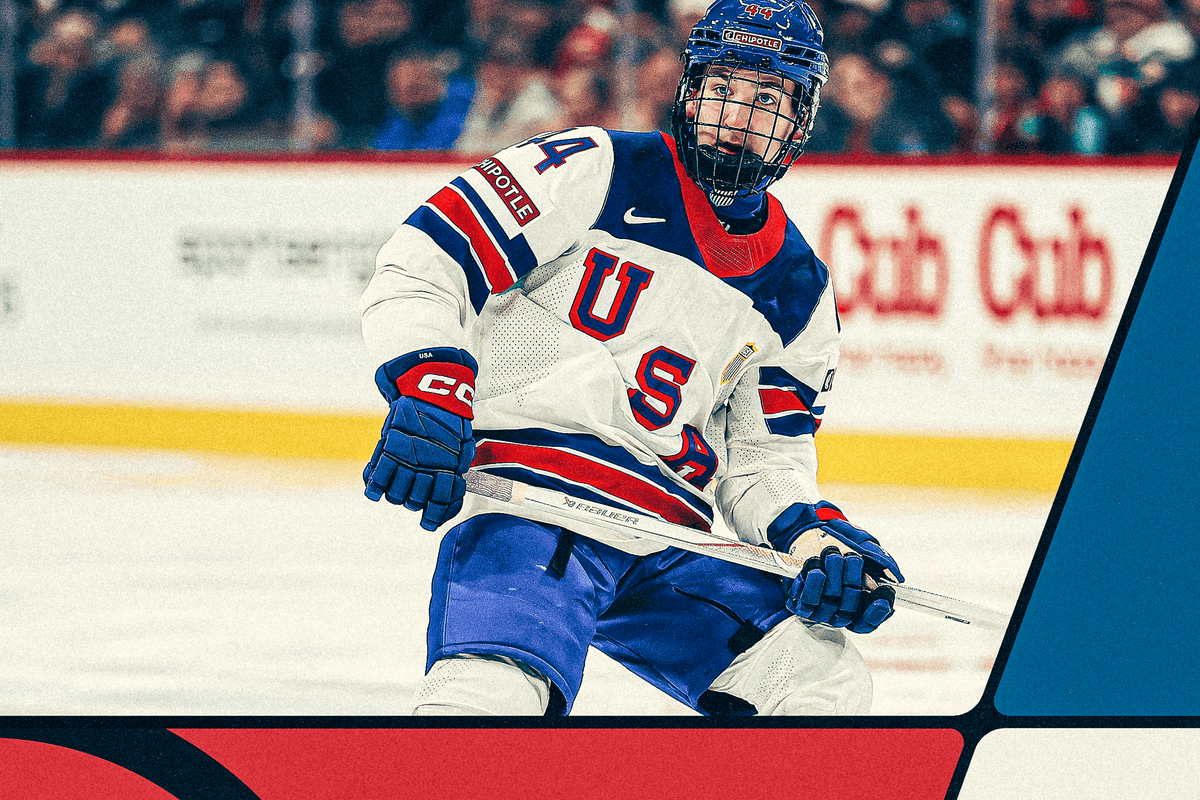
Welcome to Scott Wheeler’s 2026 rankings of every NHL organization’s prospects. You can find the complete ranking and more information on the project and its criteria here, as we count down daily from No. 32 to No. 1. The series, which includes evaluations on nearly 500 prospects, runs from March 9 to April 8.
The Capitals’ pool is missing a legit prospect at two premium positions (center and goalie), but they have five legit wing prospects of different shapes and sizes and one of the most talented young D in the sport.
2025 prospect pool rank: No. 9 (change: -2)
Tier 1 1. Cole Hutson, LHD, 19, Boston University/Washington (No. 43, 2024)
The most productive defenseman in NTDP history and the first defenseman to lead the World Juniors in scoring (he also led the tournament at plus-11 and was named to the media all-star team), Hutson is a highly talented offensive defenseman who has a star-level statistical profile already. Last year, he played to a point per game as a primary play creator with Team USA at the World Juniors and BU as a freshman, finishing second on the Terriers in scoring with 48 points in 39 games, winning the NCAA’s rookie of the year award and leading the Terriers to the Frozen Four final. This year, he led the Terriers in scoring and, in the games he played at the World Juniors before and after an injury scare, was USA’s best player. He has looked himself in early NHL action after signing a couple of weeks ago, too.
He’s a 5-foot-11, 175-pound left-shot defenseman with dynamic on-puck movement, impressive handling and an NHL release (he has a wicked release and pre-shot adjustment). His point-per-game U17 season (and well above point-per-game U18 team production) set the single-season D points record at the NTDP, and he set the all-time mark at U18 worlds, doing it while four and a half months younger than his big brother Lane was at the same age (he was the most talented defenseman on either of the NTDP’s teams in his two years there, which says something considering what Zeev Buium has since become). He was also the most impressive defenseman as an underager at a previous U18 worlds. In his draft year, though the points didn’t come quite as easily for him early on and some scouts felt he had a disappointing first half, he was excellent late in the year, and it was clear all season long that he was trying to really dial in his game defensively. His NTDP team also didn’t have a great blue line around him, which required them to pull back on him a little.
His offensive gifts are extremely impressive but Cole has more of a physical element to his game than Lane does as well, and plays opponents really hard so that his size is less noticeable (Lane is plenty competitive, but Cole delivers more hits if you will), gluing himself to them in order to be as disruptive as possible and really outwardly battling along the wall. He quickly identifies second and third options, often a step ahead of opposing structures. The way he shows one thing and does another is pretty unique. His little hesitations in control into quick, decisive attacking moments grab your attention and allow him to make plays past the first layer and walk off the line as well as any D prospect in the sport. He has the puck on a string at times. I think he’s a better skater than his big brother was at the same age (he snakes his way through gaps in coverage so effortlessly, and his lateral agility on cuts is a major strength). He executes some beautiful stretch passes. He has great touch and feel on his backhand as well as his forehand. He has the shakes and head fakes that Lane has. And while some questioned whether his style would translate against pros, he defended really well with his feet, anticipation and timing both in college and at the World Juniors (I thought his play defensively in Ottawa and Minnesota was as notable as his playmaking offensively). His teams have been better with him out there on the back end in each of the last four seasons than without him. The consensus, despite the production, is that he’s not quite as dynamic/smart as Lane, but I’m still a big believer in the talent, ranked him 34th when he went 43rd, and think he’s a star prospect.
2. Ilya Protas, LW, 19, Hershey (No. 75, 2024)
Protas was one of the biggest risers in the prospects world last season in his post-draft season with the OHL’s Spitfires. He had a very respectable 51 points in 61 games as a rookie in the USHL in his draft year (that’s not an easy league to produce in as a 17-year-old, especially when your highest level of hockey previously was playing for Belarus’ U18 team), finishing second on Des Moines in scoring and eighth in the league among U18 skaters. That season — considering his profile as a 6-foot-5 forward — probably should have sent a stronger signal to me than it did (he wasn’t in my final top 100, and I considered him more of a late-rounder than a third-rounder). But nobody, the Capitals included, expected him to have the kind of season he had as a summer birthday 18-year-old OHL rookie last year, finishing second in the league in scoring and registering 55 goals and 149 points in 73 combined regular-season and playoff games. In Windsor, he featured prominently on the power play and penalty kill, played 20-plus minutes per game as a first-year forward and did it all after making the move from the wing with the Buccaneers to center with the Spits (though he has some work to do in the faceoff circle). He has built on that with another strong rookie season in a third league in three years in the AHL this year, producing just under a point per game as one of the top young players in the league and the Bears’ leading scorer.
He has great hands for a big man, with an ability to balance on his heels and pull pucks through and across his body to make plays both one-on-one and around the net. He understands how to hold onto and protect pucks and has a good feel over them as a passer who sees the ice well. His skating is below average by NHL standards, but passable for his size. He’s not a mean power forward type, but he has the required skills on the cycle/on tips and redirects. It’s his skill level that is ultimately what stands out for his size. He’s quite talented and makes a ton of higher-end skill plays with the puck on his stick. It’s not hard to imagine him as a second-line forward in the NHL or a talented and one-of-one third-liner.
Tier 23. Andrew Cristall, LW, 21, Hershey (No. 40, 2023)
Cristall was one of the WHL’s top scorers over each of his last three seasons and was a final cut by the Capitals and Canada’s World Junior team (after a four-point game at this World Junior Summer Showcase and a primary assist/several chances against U Sports, it should be noted) last year. He registered 44 goals and 126 points in 73 combined games in the regular season and playoffs two years ago to lead the Rockets in scoring by 27 points over 2024 top-10 pick Tij Iginla. Last season, he was the most productive player in junior hockey, split between Kelowna and Spokane, toying with teams alongside Kraken first-rounder Berkly Catton after a trade to Spokane and registering an incomprehensible 69 goals, 104 assists and 173 points in 76 combined regular-season and playoff games. Though his first-round WHL playoff series and U18 worlds underwhelmed many and combined with concerns about his skating and size (5-foot-10 winger) to result in a second-round selection at the 2023 draft, Cristall has since proven to be one of the most creative, crafty playmakers outside the NHL. This season, as a rookie in the AHL, he has had a very respectable year as Hershey’s second-leading scorer.
Cristall isn’t afraid to try things and possesses a rare ability to play in small areas, pull eyes and bodies toward him and then expose opposing structures to the weak side of coverage. A quad contusion cost him five weeks as his stock was on the rise in his draft year, but it shouldn’t have taken anyone watching the Rockets long to realize just how much offense he creates for himself and his teammates while being a marked man every game. Outside of Connor Bedard, he had one of the most productive draft-eligible seasons in recent WHL history. He has also played with more pace since, and his stride has cleaned up a bit.
Despite his diminutive size, he’s also a smarter player off the puck/defensively than he has gotten credit for and is often in the right position above the puck to hold play inside the offensive zone. He’ll make effort plays defensively to stretch out and knock a puck out of the zone or work to gain inside body positioning on the forecheck and surprise people with the number of pucks he wins. He’s a ton of fun to watch with the puck on his stick. When you think you have him trapped, you usually don’t, and not because he’s faster than you but because of how clever he is (he’ll often make plays past you with the puck even if he doesn’t skate it through you). He’s just a natural creator for himself and others who manufactures offense in a variety of ways inside the offensive zone and has developed his rush game to create at his own pace and find ways to enter the zone in control as well. And while his speed in straight lines still isn’t a strength and has some kinks, I’d say it’s NHL average now, and his footwork is adjustable in tight spaces. He can also stickhandle himself into trouble at times, but he does such a good job holding onto pucks until his options open up that you’re OK with the odd offensive-zone turnover, especially because he can always fall back on his finesse and touch on the puck to put it into space for someone else if he gets cornered. Despite his size, he’ll also track pucks to the net so that he can be opportunistic. His skill, touch, problem-solving and spatial awareness are legitimately high-end, and I believe in his ability to become a top-six winger in the NHL. There’s some risk, though, that he becomes a AAAA type with his profile.
4. Lynden Lakovic, LW, 19, Moose Jaw (No. 27, 2025)
Lakovic is a 6-foot-4 winger who can really fly and blends good handles and scoring touch into his movements nicely. However, injuries have impacted his last two years of junior. Last season, he was a standout of one of the CHL-USA Prospects Challenge games and was on a 13-game point streak when he went down with a fractured collarbone that sidelined him from the end of December to the middle of February (he heated back up after returning to a Moose Jaw team that had entered a full rebuild post-deadline). This season, he’d scored 18 goals in 22 games when his season was ended late in 2025 by a shoulder injury (he was likely to be traded a month later at the deadline to a contender had he been healthy, though he wasn’t expected to be invited to Canada’s World Junior selection camp).
He protects pucks well, can get off the wall and has taken strides to keep his head up on the puck and survey/use his linemates better and better. He still has room to improve his scanning, off-puck play and decision-making, and his physicality needs to be more consistent, but his ability both in transition and protecting pucks in the offensive zone can really pop, and he has clear top-nine projectability with good coaching. When he’s on pucks and up and under sticks and winning inside body positioning, he can be really noticeable in a game with his skating, strength, power and skill. He has quick hands and can take D one-on-one as well. He also reportedly really impressed at Caps development camp.
5. Terik Parascak, RW, 19, Prince George (No. 17, 2024)
Parascak was a fourth-round pick in the WHL Bantam Draft who played at Edge School in his 16-year-old season and went scoreless in five WHL games before bursting onto the scene in his draft year, quickly climbing the lists of NHL scouts. He broke 40 goals and 100 points and finished top 10 in the WHL in goals, assists and points while also finishing tied for second in short-handed points with eight. He also had a respectable playoffs for the Cougars, producing over a point per game to finish his draft year. And while he certainly benefited from playing primarily on a line with veterans Ondrej Becher (drafted as an overager by the Red Wings) and Zac Funk (the league’s goal-scoring leader who has since signed with the Capitals), he fit in perfectly with Funk’s power-scoring game and Becher’s playmaking. Last year, after both of those players turned pro, Parascak continued to produce as well, though not quite at the same clip, finishing with 92 points in 66 combined regular-season and playoff games (second on the Cougars in scoring). And this year has been more of the same, leading a good team in scoring but not quite as productive as his draft year.
Parascak’s off-puck timing and spatial awareness define his game. He regularly gets into the right spots at the right time to bang home rebounds, tap in backdoor passes or get out in transition to give his D a stretch option on outlets (without really cheating for it). He anticipates play offensively and defensively at a very high level, knows how to get open and play to his linemates’ strengths, has a great wrister and one-touch shot from midrange, goes to the net when the play funnels there instead of hanging out wide and has skill around the net and in tight to his body when challenged by defenders. He also uses his linemates extremely well, has shown nice touch as a passer and has easy handling ability. He’s not a flashy skater, but he’s fast (I think he’s a better, more controlled skater than I realized after early viewings last year — I’ve seen him pull away plenty), or an individual play creator off the rush, but with timing and good skill, he makes things happen offensively. He always seems to be around chances and certainly knows where to be and how to get lost in coverage/use spacing to his advantage. He has had some big point-total/shot-total games the last two seasons, where he has gotten or set up looks on a shift-to-shift basis with his timing and game sense. He’s lean still, but he’s now listed at 6 feet and 187 pounds, which is up half an inch and more than 10 pounds from his draft year. He has smart-and-skilled middle-six upside, but there is some wonder about what his next step is after two years of stagnant progression. I’ll be interested to see him in the AHL next season.
6. Ivan Miroshnichenko, LW, 22, Hershey/Washington (No. 20, 2022)
Miroshnichenko’s progression has been positive without necessarily taking off since returning following his Hodgkin’s lymphoma diagnosis a few years ago. After playing across Russia’s three levels to decent results considering his lost time, he looked fine-to-good in my AHL viewings as a 19- and 20-year-old rookie (he wasn’t dominant at the AHL level, but he played to strong on-ice results and contributed at a good clip offensively for his age, earning his NHL call-up). Last year, he took another step, producing more with Hershey and playing a more prominent role when there (his minutes rose 13 and a half per game last year to 16) while still spending some time with the NHL team and holding his own on a top-of-the-league Caps squad. This year, his production has again risen modestly, and his minutes are now up to 17 per game in the AHL. But he’s also now 22 and hasn’t held down an NHL job yet.
Miroshnichenko was widely regarded as Russia’s best prospect in the 2022 draft before the cancer diagnosis, even after the start of his draft season had pushed him from the top-five conversation into more of a top-10 projection (before I learned of the diagnosis, he slotted 11th on my list, which was a smidge lower than most). As a player, Miroshnichenko had an illustrious international track record as a captain and first-line player in his age group (often alongside Matvei Michkov) and a good, though less inspiring, domestic track record.
There are some translatable attributes to his game, and it’s well-rounded, so it’s never been hard to understand the appeal. He has an athletic pro frame. He shoots it hard (both his wrister and his one-timer/off one-touch shots). He’s a strong skater through his edges and crossovers (though he can at times lack quickness from a standstill). He has good offensive instincts off the puck. He’s a dexterous player who catches bad passes, manages to keep control when the play breaks down or the ice is choppy and gets his stick on tips, etc. And he’s noticeably engaged shift to shift with and without the puck. My big hiccup with him is that I don’t find him to be a great problem solver or high-end skill guy, limiting his upside to a bottom-six projection for me (though he could become a middle-sixer if everything goes well). While he can make the first play he sees on instinct, he doesn’t do a good job breaking down the play to think it through.
Tier 37. Milton Gastrin, C, 18, MoDo (No. 37, 2025)
Gastrin has been the captain of the ’07 Swedish age group and centered Sweden’s very successful top line with fellow Viktor Klingsell (Jets) and top 2026 talent Ivar Stenberg across multiple events (though he missed the Five Nations due to injury and they were eventually spread out during U18 worlds) coming up, making waves with an eight-point game against Switzerland at the Hlinka Gretzky Cup. He played well in my viewings with MoDo’s J20 team last year as well, driving his line and contributing in different areas. This year, he then took a step to the second-tier HockeyAllsvenskan, where he led all U19 forwards with 24 points in 39 games. He also played a depth role at his first of what will be two World Juniors, coming out of Sweden’s lineup for the gold medal game and having a muted impact as an 18-year-old (he’ll feature more prominently on next year’s team in Edmonton).
Gastrin has size, he’s a natural center, he’s a strong enough skater (it can look a little sloppy, but he generates decent power with it regardless) and he plays well off his linemates, offering a responsible and heady two-way game. He protects pucks and gets in and out of stops and starts below the goal line well. His habits and details are there at an early age. He’s not a dynamic offensive player, but he handles it well, makes plays around the net and below the goal line, and seems to really understand timing and spacing. He also has a natural shot and release that I expect him to show more of as he learns to attack for himself more. Add in a good stick around the net, a willingness to drive and play in the middle third, an ability to go get pucks, and a lot of the little plays he makes, and there’s a likable and projectable NHL player there. I do wonder a little about his upside, but he looks like a projectable bottom-sixer, and I felt his early-second selection was the right range. He’s also a June birthday, so he has lots of time.
8. Ryan Chesley, RHD, 22, Hershey (No. 37, 2022)
Chesley was one of the more universally well-liked prospects in the 2022 draft among NHL folks and was a top prospect in the 2004 age group for years. Three years ago, he defended mostly well for the Golden Gophers in a depth role on a deep team, but also faced some challenges as he adjusted to the college level (he was also moved down USA’s lineup at his first World Juniors) as a freshman. Two years ago, though his production was stagnant, he took on a much more prominent role, going from playing 17 minutes per game as a freshman to 22 minutes as a sophomore (he also played on USA’s top pairing at his second World Juniors). Last year, he continued to play that important role while also contributing more offensively and wearing a “C” before signing and turning pro following a 20-point season in 40 games as a junior. After playing well in a brief stint with the Bears in the spring, he has also played nearly 20 minutes per game as a rookie in the AHL this year, logging harder minutes than fellow prospects such as Leon Muggli and Cam Allen.
He plies his trade as a well-rounded, hard-shooting, honest and consistent two-way defender. I like him defensively in neutral ice, where he has a great stick and gaps up really well. His stick and sound positioning help him on blocks and breaking up plays. He does need to release from his spots with a little more urgency to get to pucks and close on plays sooner in the defensive zone at times, though (he can lose some races that he should have more of a jump on).
There’s a lot to work with, though. He can really rip it when he takes the five-to-eight feet available off the line and looks for his own shot. He has balanced skating mechanics, good posture and an ability and willingness to defend with the body and stick, which help him defend at a very high level man-to-man. He’s effective, and there’s still some aggressiveness and secondary talent to his package, though his game can lack creativity. He has No. 5-8 potential.
9. Leon Muggli, LHD, 19, Hershey (No. 52, 2024)
Muggli generated interest from NHL teams in his draft year for his strong results in third-pairing minutes in Switzerland’s top pro league, which has become one of the better leagues outside the NHL these days and is debatably stronger than the top levels in Finland, Germany and Czechia. His first World Juniors in Gothenburg (one bad game and a suspension mixed in with some good ones, including a leading role in Switzerland’s quarterfinal loss), his U18 worlds (missed Switzerland’s last couple of games due to injury) and his second World Juniors in Ottawa (where he led the Swiss in average ice time at 20:17 but struggled with the role at times, turning pucks over and not executing) were all a little up and down but he has also played well domestically for a teenager, especially given his pro experience in the context of his summer birthday. This year, he then played in his third World Juniors in Minnesota, where he wore the “C” for Switzerland, hit a couple of posts and was imperfect at times but a big part of a Swiss team that overperformed and a contributor offensively with his balanced slap shot and poise against his peers atop the blue line. He also has played 16-17 minutes per game as a young rookie D in the AHL and held his own in his usage (while dealing with an AC joint issue throughout).
He has good puck control and will move his feet to beat the first layer. He’s confident skating pucks and defending with his feet. His skating is balanced and controlled, and he has shown more pull-away in the last year. He has some four-way mobility and a forward stride that has really lengthened out. When he’s dialed in, play can steer his way. He can run the top of the power-play umbrella (though he won’t run a PP in the NHL). His outlets are usually crisp and leading. He will block shots and compete for body positioning, though he has at times struggled to win those battles and box out at the front of the net. He keeps his head up and understands the game, though I’d like to see him execute more consistently.
His tools are more average than high-end, though, and because he’s also average-sized (6-foot-1, 180 pounds), he projects as a two-way five-on-five/depth defenseman in the NHL at best, and I do wonder if he has another developmental milestone to reach. He’ll probably play some games, though.
10. Petr Sikora, C, 20, Trinec (No. 178, 2024)
Sikora has been a top player with Czechia’s ’06 age group internationally, leading them to a bronze and a silver at back-to-back World Juniors with 16 points in 14 combined games. He was also the team’s captain at this year’s tournament, and one of the best players on the ice in the semifinal win over Canada (he also scored big goals against Canada and USA in the 2025 event), earning him consideration for my all-star ballot. He has been a regular contributor for the last two years at Czechia’s pro level as well, and while he hasn’t yet been signed, I think he warrants a contract and a look in the AHL. He’s an excellent penalty killer who has played in all situations internationally. He has shown some skill in stretches of his career. He’s consistent and plays the right way. He’s competitive and became public enemy No. 1 after drawing a bunch of penalties in the 2025 World Juniors. He has good hands. He’s a good athlete and decent skater. He doesn’t have high-end tools for a 6-foot player, but I could see him playing his way into a call-up in his mid-20s.
11. Eriks Mateiko, C/LW, 20, Hershey (No. 90, 2024)
Mateiko really caught my eye as Latvia’s captain at U18 worlds three springs ago, to the point that I found myself texting sources about him after each game. Though he only registered two points in five games, he could have had a couple more, and the Latvians only scored six goals in all. And while he didn’t leave the same impression on me at his first World Juniors in Gothenburg, that wasn’t unexpected given his age — he was probably owed more there as well and impressed me enough in Saint John to remain a constant on my lists. He finally broke out internationally for the Latvians at last year’s World Juniors as a returnee, scoring half of the team’s 10 goals (five in five games) as one of the standouts of the tournament and an all-star team candidate (he wasn’t ultimately named to the team, though) in Ottawa. This season, as a rookie pro in Hershey, he hadn’t been super productive, but he’d played to positive results in his 13-14 minutes per game before his season was ended in January by a skate cut that tore his Achilles tendon.
He has good skill and hands for being 6-foot-5/6, and while his stride can look a little choppy out of the blocks, he can actually really move out there. I think he actually surprised some people with a pretty strong showing at the CHL/NHL Top Prospects Game’s on-ice testing in his draft year and in Ottawa at this year’s World Juniors with his strong skating stride because it looked a long way from where it is today a couple of years ago. It quickly went from being awkward to arguably above average (every time I see him play, his skating seems to fall in line a little better than the last time, which is what matters at his size). When he first got to Saint John, they called him “Moose” because of how awkward he was. Now he looks like a full-grown one. He gets after it and uses his pro frame well, he has shown he can attack defenders one-on-one and protect pucks in possession, he stays above pucks defensively and he has just made a ton of progress from the start of his time with the Sea Dogs to where he is now with the Memorial Cup hosts in Rimouski, developing a more layered game. He’s also starting to play more physically without sacrificing his commitment to staying above pucks defensively. Before the Sea Dogs traded him this year, he was named their captain, and I know he was considered for the “C” the year prior as well. He’s not a natural facilitator/creator for others, but he’s big, he’s competitive, he has some skill, pucks come off his blade hard, he protects it well, he gets off the wall and plays to the guts of the ice, and I’ve seen him look calm and even-keeled in big moments. He can look like a future bottom-sixer, and I think he plays some games in the NHL.
Tier 412. Cam Allen, RHD, 21, Hershey (No. 136, 2023)
Viewed as one of the better D prospects in the 2023 class coming out of his 16-year-old season after winning the OHL’s Rookie of the Year Award with 13 goals and 37 points and captaining Canada to gold at the Hlinka Gretzky Cup, Allen’s draft year got away from him and he looked like he was in a crisis of confidence the more it wore on, resulting in an eventual fifth-round selection by the Capitals. He’s a pro-built, strong-on-his-skates defenseman who was still named Canada’s captain at U18 worlds but really struggled throughout his draft year with his decision-making on and off the puck. Then he underwent shoulder surgery after the draft and was sidelined until the end of January, and looked like he was still figuring out who he was when he got back. Last year, after getting off to a strong start on a poor Guelph team, he was then invited to Canada’s selection camp for the World Juniors, only to really struggle there with some familiar problems: He looked hectic, he chased the play, he committed a ton of sloppy turnovers in the neutral and defensive zones, his passes and execution were off and into feet, he bobbled pucks and he spent most of his shifts hemmed in. He was better after a move to the Knights, but after playing 24-30 minutes per game immediately after the trade, his minutes were reduced to the 10-15 range late in the playoffs and into the Memorial Cup. He was also charged with impaired driving following a single-vehicle crash in London last winter. This season, he has played to decent results in 17-18 minutes per game as a rookie D in the AHL, which I would qualify as a positive season for his development.
When he has to be the guy or tries to do too much, he has always struggled with reads, decision-making and the hockey IQ piece of the puzzle. When he plays within himself, he looks like a pro.
With the puck, he can look like he’s not processing the paths of opposing players with the proper speed. Without it, he can burn himself by mistiming pinches and close-outs. And while he’s strong in battles and he’s a good athlete who can get up and down the ice and skate pucks (he often looks better transporting them himself with his bullishness than moving them), his skating can look a little choppy and stomping, and the hiccups can be hard to ignore. The tools are there. He shoots it hard. He can command play when he’s really dialed in and playing simple. But the execution hasn’t always been there. The Capitals are likely hoping that they can mold him into a more refined player.
13. Maxim Schäfer, LW/RW, 18, Chicoutimi (No. 96, 2025)
Schäfer caught my eye at both the 2025 World Juniors and U18 worlds. After the latter, I decided to sit down and watch some of his tape in Germany last year, where he dominated the junior level and played more than 30 games in limited minutes in the DEL. This year, he made the move to the QMJHL with Chicoutimi and played to around a point per game. I thought he had an OK second World Juniors as well (he was effective but only played 14 minutes per game).
Schafer is big, and he can skate and shoot it. I like his instincts. He gets the first touch on loose pucks. He wins 50/50s and then picks up the next play quickly. He’s not a physical player for his size, but he’ll work smartly, and he has some of the other tools you look for in terms of the size, the skating, the shot and some of the game sense and feel. He’s a solid player and should be a go-to guy next year in both the Q and at a third World Juniors.
14. Nicholas Kempf, G, 20, Notre Dame (No. 114, 2024)
Kempf has been an .890-something goalie across two seasons at the program and Notre Dame, but he has also played behind an age group that leaked chances and a Notre Dame team that has lost more games than it has won in a difficult Big Ten conference. Kempf is an unremarkable but ultimately just fine goalie prospect. He has fine size (6-foot-2), fine technical and positional play, decent athleticism and good but not standout feet and movement. But he’s not a freak athlete, and he’s not freakishly talented, and he’s not freakishly-sized, and I find his hands (low glove and low blocker in particular) can get exposed. He’s a C-plus goalie prospect who could become organizational depth someday.