
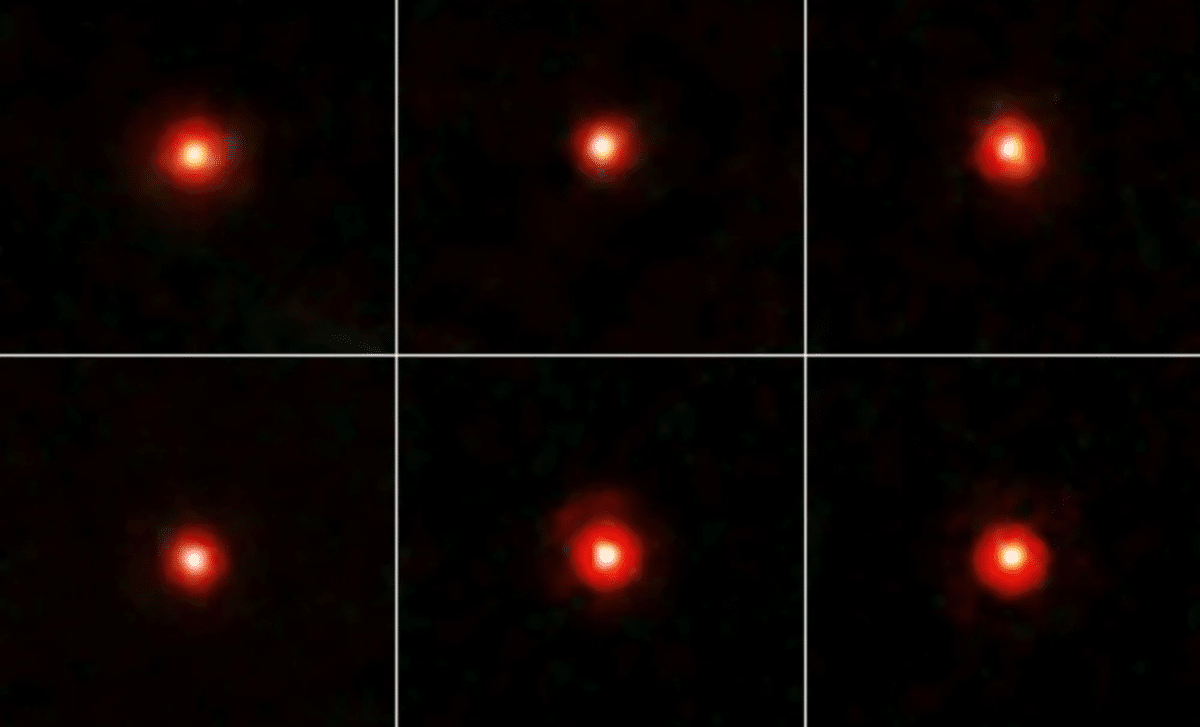
The James Webb Space Telescope (JWST) has uncovered a pair of dwarf galaxies with black holes that defy conventional understanding. These black holes, located in galaxies with masses far smaller than those typically associated with supermassive black holes (SMBHs), challenge long-held beliefs about how galaxies and their central black holes evolve. The discovery of these “overmassive” black holes pushes the boundaries of our knowledge, suggesting that early galaxies may have developed black holes far faster than previously thought.
Unexpected Discoveries: Pelias and Neleus Defy Expectations
The study, led by Eduardo Iani and his colleagues, and available on arXiv, reports the discovery and analysis of two dwarf galaxies, Pelias and Neleus, located at redshifts of z ~ 0.71 and z ~ 0.75. These galaxies, despite their small sizes and young ages, host black holes with masses up to 60% of the galaxies’ total mass. This discovery is remarkable because, in typical galaxies, the ratio of the black hole mass to galaxy mass is only about 0.1% to 0.5%. The fact that these dwarf galaxies house such overmassive black holes suggests that their central black holes grew at a much faster pace than their surrounding stars.
Both galaxies were observed using JWST’s powerful infrared capabilities, which revealed unusual spectral energy distributions (SEDs). “We report the discovery and characterization of two compact galaxies, Pelias and Neleus, at z ~ 0.71 and z ~ 0.75,” the researchers write. These galaxies exhibited very blue rest-frame UV-optical emissions, indicating young, hot stars. However, their SEDs also showed a steep rise toward near- and mid-infrared wavelengths, suggesting the presence of a hot, dust-enshrouded active galactic nucleus (AGN) at their cores.
The Mystery of Dust-Embedded Active Galactic Nuclei
The presence of an AGN at the heart of these galaxies was further supported by the mid-infrared observations made by JWST’s MIRI instrument. These observations revealed an excess of mid-infrared radiation that could not be accounted for by stellar populations or star-formation-heated dust alone.
“JWST/MIRI photometry reveals a strong mid-infrared excess that cannot be explained by stellar populations or star-formation-heated dust alone, requiring a hot-dust component most naturally associated with a deeply embedded active galactic nucleus (AGN),” the authors explain.
This is a crucial finding because it suggests that the black holes are rapidly growing in a phase hidden behind thick layers of dust, making them difficult to detect with other methods.
Interestingly, the research also points out that despite the clear evidence of an AGN, no X-ray emissions were detected from the central regions of these galaxies. “The lack of X-ray detections suggests that the accretion may be either heavily obscured or intrinsically X-ray weak,” the researchers write. This lack of X-rays could indicate that the black holes are in a Super-Eddington accretion phase, where the black holes are consuming material at rates far exceeding the standard limits.
Super-Eddington Accretion: A Closer Look at Rapid Black Hole Growth
The concept of Super-Eddington accretion helps explain the rapid growth of these black holes. In this scenario, black holes can grow much faster than what is typically thought possible because they are consuming matter at extraordinary rates. According to the researchers, Super-Eddington accretion might have been a crucial mechanism for black hole growth in the early universe, especially in small, low-mass galaxies like Pelias and Neleus. “Super-Eddington phases are thought to enable rapid early black-hole growth, particularly in low-mass galaxies,” they note.
This phase is especially relevant to the study of dwarf galaxies. These galaxies, with stellar masses as low as 10^7 solar masses, are among the smallest known to host active galactic nuclei. The rapid black hole growth seen in Pelias and Neleus shows that even the smallest galaxies can host supermassive black holes. “Overall, Pelias and Neleus demonstrate that rapid, dust-enshrouded black-hole growth can occur in galaxies with stellar masses of only ∼ 107 solar masses,” the authors explain.
What’s Next? The Future of Black Hole Research
The discovery of these overmassive black holes in dwarf galaxies has opened up new avenues for future research. The next step is to find more examples of galaxies like Pelias and Neleus to understand how common this phenomenon is. The researchers hope that upcoming space missions, such as the Roman Space Telescope and the Extremely Large Telescope (ELT), will allow for more systematic searches of low-mass, obscured AGNs. These advanced telescopes will be able to resolve the internal structure of these galaxies, providing crucial data to test the theories of black hole growth during the early stages of galaxy formation.
The discovery of these galaxies highlights the power of the JWST, which continues to unveil new mysteries of the universe. “At longer timescales, facilities such as the Roman Space Telescope and ELT-class observatories will enable systematic searches for similar low-mass obscured AGN and resolve their internal structure, providing crucial tests of whether the embedded accretion phase inferred here represents a common pathway in DG evolution,” the researchers conclude.
In the coming years, we can expect many more revelations about the enigmatic connection between black holes and galaxies, potentially transforming our understanding of cosmic evolution and the very fabric of the universe.