
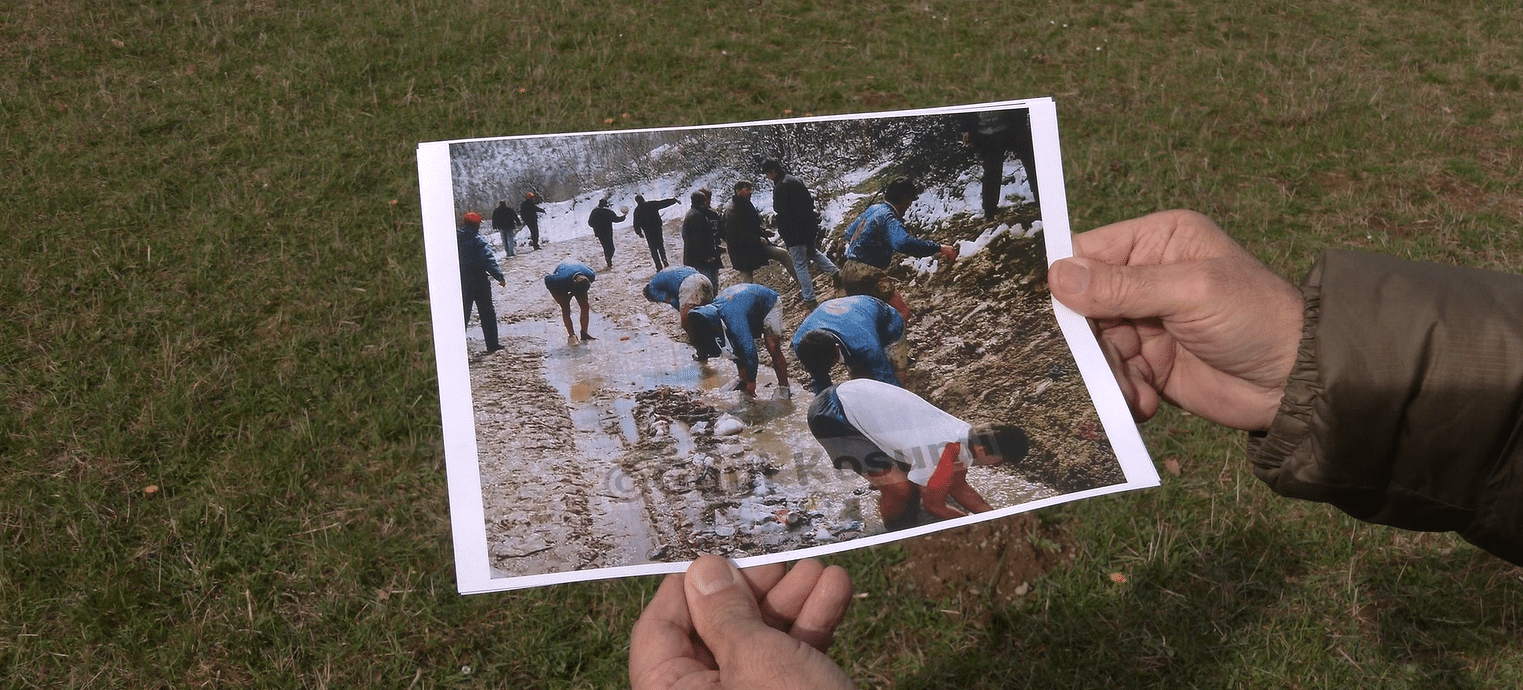
The match in 1997 in Llukar was a competitive game in what was Kosovo’s top league at the time. Kosumi, now 70, can remember only one of the teams playing. “It was Llapi. I don’t remember who they played against that match,” he says.
“I had only three remaining frames in the film and decided to capture the moment. I think this was a detail that was worthy of noting, to show that Kosovo’s football players have spared nothing to obtain UEFA and FIFA membership,” Kosumi adds.
When Yugoslavia was collapsing in the early-1990s, ethnic Albanian sports teams in Serb-run Kosovo were banned from playing on official pitches and stadiums. Kosovo Albanian teams had to play matches in makeshift locations.
Nearly three decades later, the national team is on the edge of making history – one victory away from securing a historic World Cup spot.
On Tuesday night at Pristina’s Fadil Vokrri Stadium, the team will face Turkey for a place in the competition, which will be held this summer in the United States, Canada and Mexico. If they win, they will be placed in Group D together with the host US, Paraguay and Australia.
Hopes in the Kosovo camp soared last Thursday when the team beat Slovakia 4-3 away in the second round of the qualifications, in a match where Kosovo needed to step up and come from behind.
Now they face Turkey, a team ranked 25th in the world men’s game, according to FIFA. Kosovo are ranked far below, in 78th place.
“It is a match of an extraordinary importance,” says Kosumi. “Kosovo’s national team has reached its greatest success in its existence. It is an important match for both national teams but I think Kosovo will win,” he adds.
Kosumi, who retired in 2020 after 40 years in journalism, worked with Radio Television of Pristina until July 1990 when Slobodan Milosevic’s regime in Belgrade dismissed Kosovo Albanian workers en masse from their positions.
Later, he continued to work as a sports correspondent for Albanian public television and, after the war ended in Kosovo in 1999, he worked for the Kosovo public broadcaster, Radio Television of Kosovo, until he reached retirement.
“I got hold of a camera from my brother who lives in the UK and started shooting and became interested in photographs,” Kosumi recalls.
“In the last five years I’ve worked a lot to classify my photographs. There are around 500,000 of them, captured since 1990,” he adds.
Undeterred by underdog status