
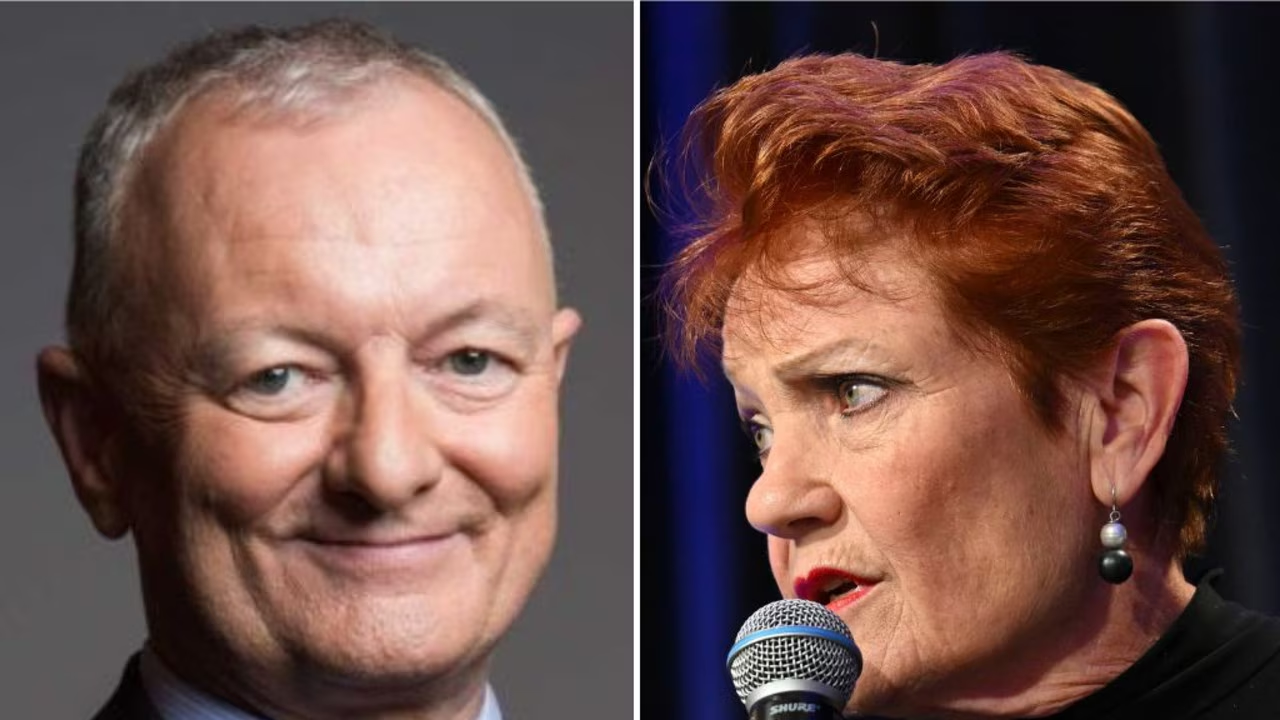
Veteran ABC election analyst Antony Green says the South Australian election may have delivered one of the most extraordinary results seen under the preferential voting system.
The surge of Pauline Hanson’s One Nation has played a pivotal role in the rare case of Finniss. In the coastal electorate, independent candidate Lou Nicholson appears to have achieved victory after starting in fourth place on primary votes.
“Amazing to go from fourth place to victory under preferential voting,” Green wrote on X.
“That looks like the feat achieved by Independent Lou Nicholson in the Victor Harbour-based seat of Finniss at the South Australian election.”
The result hinges not on first-preference votes, but on how preferences flowed between candidates, particularly from minor parties and independents.
In earlier analysis, as counting progressed, Green explained that Nicholson would first need to survive early eliminations and then overtake multiple rivals through preference distributions.
That scenario has now effectively played out, with Nicholson moving ahead of Labour and then passing the One Nation candidate to reach the final count.
Green says that the independent’s path to victory depended in part on how One Nation voters directed their preferences. That was a factor that was uncertain before election day.
“At this stage, based on the indicative count, Nicholson is favourite as she is attracting enough One Nation preferences to win,” he wrote on his famous election blog.
The outcome highlights a striking twist in the narrative surrounding One Nation’s performance at the election.
In the lead-up, the party had been widely tipped to challenge the Liberals for second place statewide and potentially convert its rising vote into seats.
Instead, in Finniss at least, One Nation has emerged as a decisive preference source, rather than an actual winning contender.
The result has served as another reminder of the volatility of the current political landscape as One Nation continues to surge.
While Labor secured a commanding statewide victory, the fragmentation of the non-Labor vote, which is now split between Liberals, One Nation and independents, has opened the door to wildly unexpected outcomes.
On a federal level, the Albanese government has plummeted to its lowest level of support since its thumping win at last year’s election.
The polls, released on Monday, also show the Coalition’s support is still in the doldrums, despite the change of leadership for both the Liberals and Nationals.
The polls were taken during a week in which the affordability crisis, exacerbated by the uncertainty of the Iran war, surging inflation, and skyrocketing fuel prices, dominated the national conversation.
All in all, Pauline Hanson’s One Nation won six seats in the 2026 South Australian election—three in the House of Assembly and three in the Legislative Council—marking the party’s first lower house seats outside Queensland and achieving 22.8 per cent of the primary vote.
The ABC gave One Nation the seat of MacKillop – formerly one of the Liberal Party’s safest seats- one Monday afternoon.
The Australian’s Newspoll surveyed 1232 voters from Monday to Thursday last week and found Labor’s primary vote dropping to 31 per cent, down from 36 per cent in November last year and 34.6 per cent in May, at the time of the federal election.
One Nation’s primary vote also dropped (26 per cent), while both the Coalition and the Greens lifted to 21 per cent and 12 per cent respectively.
The latest Redbridge poll in the Financial Review surveyed 1003 voters from Monday to Friday last week.
It found One Nation’s primary vote creep forward to 29 per cent, placing it behind Labor whose support remained unchanged at 32 per cent.
The Coalition’s primary vote dropped a further two points since the last poll in February to a record low of 17 per cent.
On a two-party preferred basis, the Redbridge poll found Labor led One Nation by 53 per cent to 47 per cent. Under preferences allocated by how they fell at the May election, Labor led the Coalition by 55 per cent to 45 per cent.
A total of 61 per cent of voters also solely blamed US President Donald Trump for the petrol price crisis – triggered by global energy shocks brought on by the Iran war – while 14 per cent blamed the government.
The poll also found Anthony Albanese’s net approval rating also take a hit. The Prime Minister’s net favourability was minus 17, a drop of 18 percentage points since December last year.
Read related topics:Adelaide