
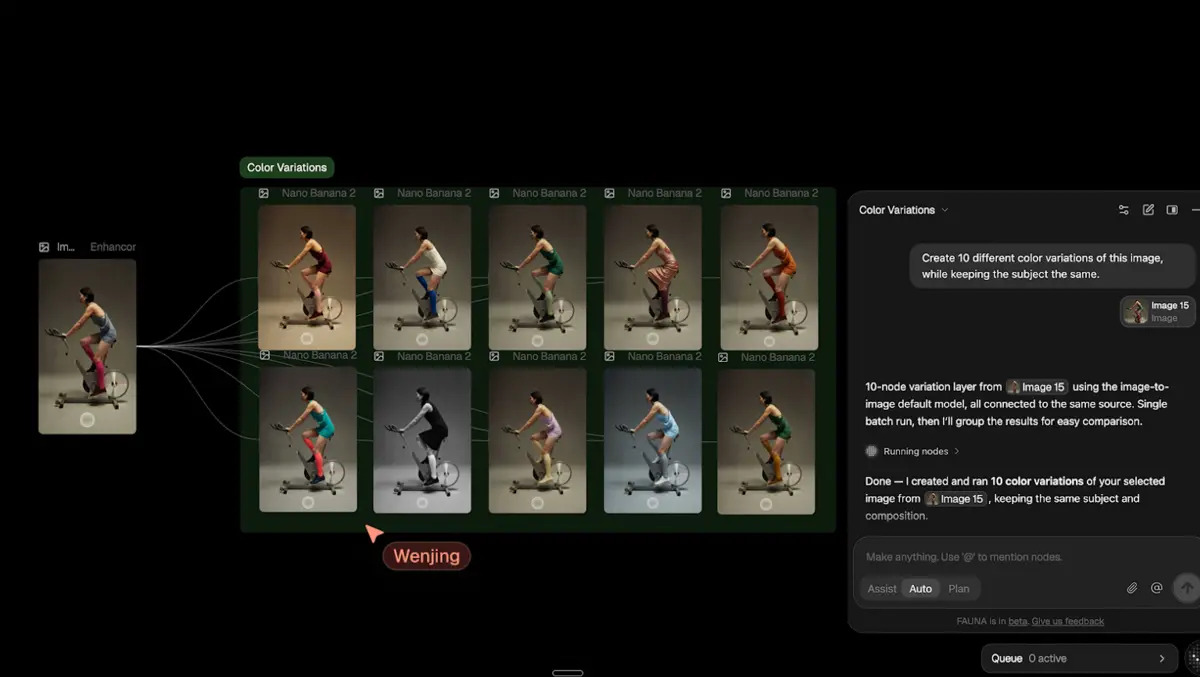
FLORA has launched FAUNA, an AI creative partner for professional teams designed to support creative work beyond simple prompting.
The launch comes as FLORA says it has raised USD $52 million to date from investors including Redpoint Ventures, a16z Games Speedrun, Menlo Ventures, Factorial Capital and Long Journey Ventures, alongside operators from the technology and design sectors.
FAUNA is aimed at creative professionals who want to build and edit work inside a visual canvas rather than rely on one-step image and design generators. The system builds workflows in real time by adding nodes, connecting models and executing generations while users watch and adjust the process.
The product begins by learning how a user works, including their creative history and instincts, then builds toward that user’s direction. FAUNA is also intended to turn creative briefs into live exchanges in which users describe ideas, review variations and refine the result.
Alongside FAUNA, FLORA has introduced Techniques and Image Editor. Techniques consists of reusable workflows developed by professionals at brands and agencies including Netflix, Base Design and Wonder Studios, while Image Editor adds editing tools directly into FLORA’s canvas.
One example is access to Pentagram’s brand system workflow, which designers can adapt for their own projects. FLORA says the approach is meant to make established working methods reusable across teams and assignments.
The platform gives users access to more than 50 AI models through a single canvas. FLORA has taken a model-agnostic approach so teams can use different models without being tied to a single provider.
That model-agnostic structure sits within a node-based visual canvas designed to make creative processes visible and reusable. It is intended to let teams keep technical steps in one environment rather than move between separate tools.
Weber Wong, Founder and Chief Executive Officer of FLORA, outlined how the company sees the market for AI in creative work.
“Creative work is splitting into three groups,” Wong said. “There are professionals refusing AI entirely, convinced they’re protecting their craft – but that stance won’t hold. There are people using AI as a generator – fast outputs, no control, generic work. They’re producing more of less. Then there’s a third group who see AI as a multiplier of their taste and judgment. FAUNA is built for that third group, but eventually everyone will need tools that prioritize craft over speed. This isn’t about helping people who can’t design. It’s about making people who already know what good looks like unstoppable.”
FLORA is based in Brooklyn, New York, and describes itself as a creative environment for generative workflows used by professional teams. Its backers include Hanabi and individual investors such as Guillermo Rauch of Vercel, Emery Wells of Frame.io, Justin Kan of Twitch and Gabe Whaley of MSCHF.
FLORA positions FAUNA as a response to a market increasingly crowded with tools that emphasise quick output. The company argues that professional creative teams are less concerned with generating the highest volume of work than with preserving a distinct style and making processes repeatable across campaigns and formats.
That view also shapes the launch of Techniques, which packages workflows from established creative organisations into systems other teams can use and modify. In practice, this could appeal to agencies and in-house brand teams seeking more consistency in how they build visual assets.
The broader pitch is that AI tools for creatives should expose, rather than hide, the decisions made during production. By showing workflows on a shared canvas and allowing users to change each step, FLORA is seeking to appeal to teams that want more control over how AI-generated outputs are developed.
FLORA says the platform is already being used in production by organisations including Netflix, Pentagram, Base Design and Wonder Studios.