
 Market_Recon_TSP1_KL
“A true leader always keeps an element of surprise up his sleeve, which others cannot grasp, but which keeps his public excited and breathless.”
– President Charles de Gaulle of France
Double Take
Your favorite trader, investor, economist, infantry NCO, hockey player, and financial writer enjoyed a meal with someone special on Monday evening. He passed the Wawa between his home and hers last night. His eyes quickly noticed the price lit up on the store’s sign. The cheap stuff, 87-octane gasoline, was going for $4.29 a gallon.
It was Sunday afternoon that I felt like a dope filling my tank for $3.99 a gallon at that same station. I glanced at the Mobil station across the street: $4.29 per gallon for cash purchases. Credit would cost you a dime more. Yikes.
Inflation scares become growth scares. A perception that inflation has escaped “Pandora’s Box” will slow economic activity all by itself as the populace prepares for more difficult times. That said, current Fed Chair Jerome Powell, who only has about six weeks left in his term at the helm of the world’s most powerful central bank, spoke at Harvard University on Monday. Known for his consistent disagreement with Pres. Trump concerning the trajectory of monetary policy, Powell’s words wandered down an unexpected path.
“Inflation expectations do appear to be well anchored beyond the short term, but nonetheless, it’s something we will eventually maybe face the question of what to do here. We’re not really facing it yet, because we don’t know what the economic effects will be, but we’ll certainly be mindful of that broader context when we make that decision.”
Powell said that he thinks the present target range for the Fed Funds Rate, which spans from 3.5% to 3.75% is in a “good place.” He has said that before. He did not take advantage of elevated consumer prices for fuel to press for higher short-term interest rates. In fact, he went the other way on that topic. He said that raising rates now would likely have a negative impact on the U.S. economy down the road. He understood that this is likely to be a temporary (I dare not say “transitory”) price spike due to a temporary supply shock. Powell added, “By the time the effects of a tightening in monetary policy take effect, the oil price shock is probably long gone, and you’re weighing on the economy at a time when it’s not appropriate.”
Run, Forrest, Run…
As I work my way through the zero-dark hours on Tuesday morning, I see front-month WTI Crude futures trading with a $102 (per barrel) handle. These futures traded with a $106 handle overnight before some relief finally set in. It’s nice to see oil prices off of their highs. It seems unreal that “the sweet stuff” went for about $88 per barrel just a week ago and $65 per barrel little more than a month ago.
Treasury debt securities finally found a bid on Monday after having run the wrong way for about a month as well. The U.S. Ten-Year Note paid 4.34% late Monday, down 8 basis points for the regular session. The U.S. Two-Year Note paid 3.83%, also down 8 basis points. I see those two yields at 4.32% and 3.82% with a couple of hours still to go until the glowing orange orb makes an appearance to my east.
The Real Surprise
Readers have very likely noticed by now that U.S. equity index futures have moved sharply higher overnight despite what are very bearish looking charts for the S&P 500 and Nasdaq Composite. Despite the fact that Asian equities were mostly lower on Tuesday and European stocks are opening just slightly to the upside. Month and quarter-end window dressing. That could be a factor this afternoon, though with bonds taking a beating this month, there will be less mandated pension fund asset allocation rebalancing than there might have been otherwise.
No. What is moving U.S. stocks very early on Tuesday morning is a piece that ran at the Wall Street Journal on Monday night. The Journal is, and now other outlets as well, are reporting that Pres. Trump has told those around him that he is willing to end the war in Iran even if the Strait of Hormuz remains mostly closed to maritime shippers supporting global commerce. The president’s inner circle has apparently, if this piece is true, decided that air / naval / ground operations aimed at forcing the Strait’s reopening would push the war out beyond the president’s original “six-week” window for completing all objectives.
Is the president pulling a “de Gaulle” here? That’s difficult to say. Algorithms are pushing asset prices around at the moment. Human traders would better understand that the situation remains fluid, that the Strait would remain closed and that thousands of Marines and Airborne troops stand at the ready with now an additional 10,000 infantry type troops on the way. Is the president softening in his resolve? Or is this disinformation ahead of an increase in the tempo of military operations? Both of those outcomes are believable.
It was just Monday (yesterday) that U.S. equities sold off yet again in response to the president posting to social media that Iran was now being led by a “more reasonable” regime, but still threatened that nation’s oil and electric infrastructure facilities should the Strait not be reopened immediately. That was probably about the same time that Secretary of State Marco Rubio spoke to Al Jazeera and said that the U.S. would be wrapping up military operations within weeks.
Related: Market Bottoms Require Several Steps. We’re Still Waiting for the First One.
Regardless…
The regime in Iran appears to have been emboldened by these reports. Overnight, the UAE’s military is reporting ongoing missile and drone attacks “across the country.” A Kuwaiti tanker ship carrying two million barrels of crude, was also struck off the coast of Dubai. That attack created on fire onboard that has since been put out. Perhaps most disturbing are reports that the Iranian government has started executing its own people again, targeting opposition groups.
Hold Back The Rain
Hold back the rain
Yes, we’re miles away from nowhere
And the wind doesn’t have a name
So call it what you want to call it
Still blows down the lane
People tell me that I haven’t changed at all
But I don’t feel the same
And I bet you’ve had that feeling too
You can’t laugh all the time
– J. Taylor, Le Bon, Rhodes, A. Taylor, R. Taylor (Duran Duran), 1982
Blue Monday
It really wasn’t all that bad. Not as bad as it felt, anyway. I think some traders were just worn out after the S&P 500 sold off for a seventh day in nine and for an 11th day in 15.
Some traders are worn out after what had started out as a potential sixth consecutive down week for the U.S. stock market. Some traders are worn out with one session to go in a month that now has the Nasdaq Composite down 8.3% and the S&P 500 down 7.8%. Those two indexes closed on Monday down 13.4% and down 9.4% from their respective highs. This has had some traders less worried about a “mere” correction and more worried about something more severe, like an actual bear market.
On Monday, the S&P 500 gave up just 0.39% as the Nasdaq Composite surrendered 0.73%. The Dow Transports were knocked 0.8% back, while the small caps were hit harder. The Russell 2000 lost 1.46%. What was beaten most severely though on Monday, were the semiconductors. The Philadelphia Semiconductor Index was roasted for a loss of 4.23% as the Dow Jones U.S. Semiconductor Index was hit in the teeth for 2.66%. The losers in that space were Micron Technology (MU) and Marvell Technology (MRVL) . Those two names were drubbed for losses of 9.9% and 7.5% respectively.
Breadth
Ugly? Not good, but not truly ugly. No panic. I’d like to say that traders kept their cool, but algorithms never panic. They are cold and merciless. That said, they were not quite so ruthless on Monday. Seven of the 11 S&P sector SPDR ETFs actually closed out the day in the green, led by the financials (XLF) and communication services (XLC) . Technology (XLK) and the Industrials (XLI) led the losers.
Losers beat winners by just a smidgen at the NYSE and by a rough seven-to-five margin at the Nasdaq. Advancing volume took a 46.1% share of composite NYSE-listed trade and a 43.9% share of composite Nasdaq-listed activity.
Trading volumes were elevated on the penultimate day of the month / quarter, but dramatically so. On a day-over-day basis, aggregate trade was up 6% across Nasdaq-listings and up 2.9% across NYSE-listed securities. Volume also expanded across the membership of the S&P 500.
Chart
Readers will now see that the S&P 500 has repeatedly put together confirmation and re-confirmations of the bearish trend in place since Feb. 26. Due for a relief rally? Yes.
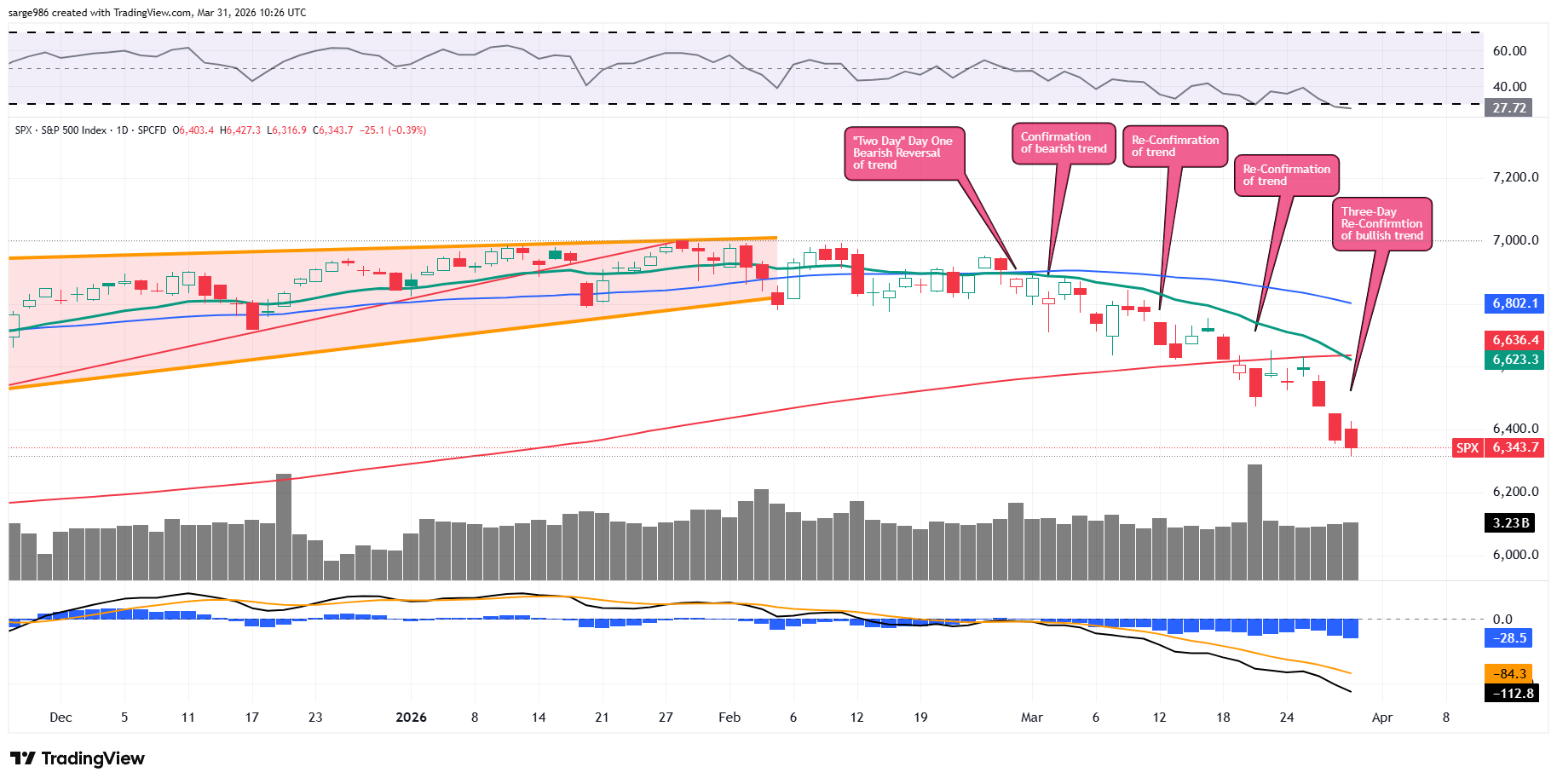
Do these presidential rumors fill that bill? Yes. We’ll see if it’s a ruse and what comes next. I trust nothing right now. As for the indicators, there is nothing close to bullish about either Relative Strength or the daily moving average convergence divergence. Both look like the plastic model of the city of Tokyo after the guys in the King Kong and Godzilla suits had their rumble (which was probably great fun) on that movie set.
You’ll Never Walk Alone
When you walk through a storm
Hold your head up high
And don’t be afraid of the dark
At the end of a storm
There’s a golden sky
And the sweet silver song of a lark
Walk on through the wind
Walk on through the rain
Walk on, walk on
With hope in your heart
And you’ll never walk alone
– Hammerstein, Rodgers (Gerry and the Pacemakers), 1963
Economics
(All Times Eastern)
08:55 – Redbook (Weekly): Last 6.7% y/y.
09:00 – Case-Shiller HPI (Jan): Expecting 1.5% y/y, Last 1.4% y/y.
09:00 – FHFA HPI (Jan): Expecting 0.1% m/m, Last 0.1% m/m.
09:45 – Chicago PMI (Mar): Expecting 55.2, Last 57.7.
10:00 – JOLTs Job Openings (Feb): Last 6.946M.
10:00 – JOLTs Job Quits (Feb): Last 3.1M.
10:00 – CB Consumer Confidence (Mar): Expecting 88, Last 91.2.
4:30 p.m. – API Oil Inventories (Weekly): Last +2.3M.
The Fed
(All Times Eastern)
12:00 p.m. – Speaker: Chicago Fed Pres. Austan Goolsbee.
3:00 – Speaker: Reserve Board Gov. Michael Barr.
Today’s Earnings Highlights
(Consensus EPS Expectations)
Before the Open: (FDS) (4.38), (MKC) (.59), (SNX) (3.31)
After the Close: (NKE) (.28), (PVH) (3.30), (RH) (2.20)
At the time of publication, Guilfoyle had no position in any security mentioned.