
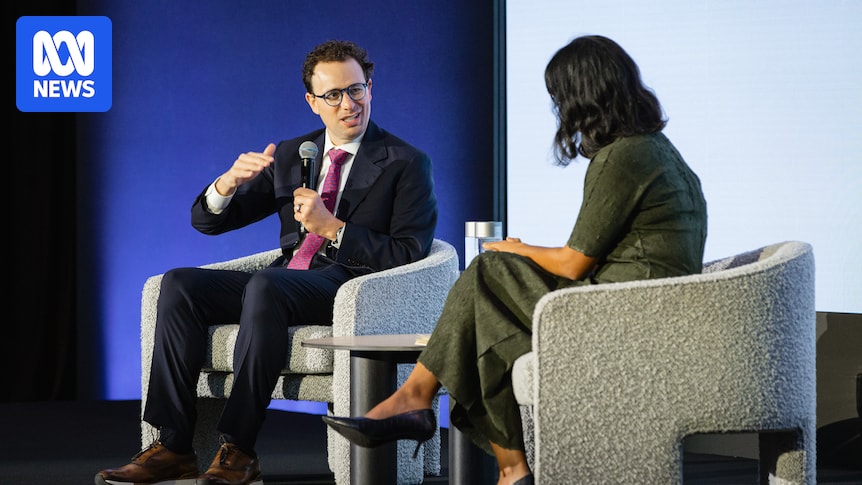
The billionaire boss of artificial intelligence behemoth Anthropic says he is not trying to convince Australia to change its mind on protecting the copyright of musicians, writers and other artists.
Anthropic chief executive Dario Amodei has also declared a “sophisticated” tax to ensure the profits generated by AI that would once have gone to a human workforce are still shared fairly in society is inevitable.
Mr Amodei took part in a wide-ranging conversation on stage at the Anthropic Futures Forum held at Parliament House today as part of a broader charm offensive by the company, which is now turning its attention to Australia.
Is Labor trusting big tech too much?
He revealed his concerns for parts of the workforce that were going to find it challenging to adapt to the new economy, and warned of the need for democracies to retain the “upper hand” militarily as AI expanded.
Earlier this morning, Mr Amodei met with Prime Minister Anthony Albanese and signed a memorandum of understanding with the federal government aimed at boosting local research, skills and investment.
Anthropic, which is responsible for the popular AI program Claude, is due to open a Sydney office later this year.
The $555 billion company has committed to the government’s AI plan and promised to invest in renewable energy to power data centres.
Copyright holders have ‘legitimate claims’
Mr Amodei acknowledged there had been “robust debate” in Australia about copyright, and insisted his company was not in the country to “try and convince you to change your mind on this”.
“We’re kind of more here to talk about how can we arrive at an arrangement that works for everyone? And leaves everyone better off?” he said.
Mr Amodei said rights holders had “legitimate claims” when it came to the use of their work by AI, but he did not think copyright was the “be-all and end-all for addressing the economic concerns with this technology”.
“I would generalise it to the point of, if we’re able to generate vast economic growth with AI, it’s a standard economic growth thing of making the pie bigger, and then there’s more that we can give to everyone,” he said.
“I think that frame is really important.”
Music boss doubtful of Anthropic’s copyright stance
But ARIA chief executive Annabelle Herd said she was sceptical of Mr Amodei’s insistence he was not looking to change Australia’s mind on copyright.
“Anthropic says it will comply with Australian law and is apparently willing to pay for the content it is copying,” she said.
“At the same time, it is pushing for a government sweetheart deal that cuts out rights holders and overrides copyright.
“That’s not how the free market works.”
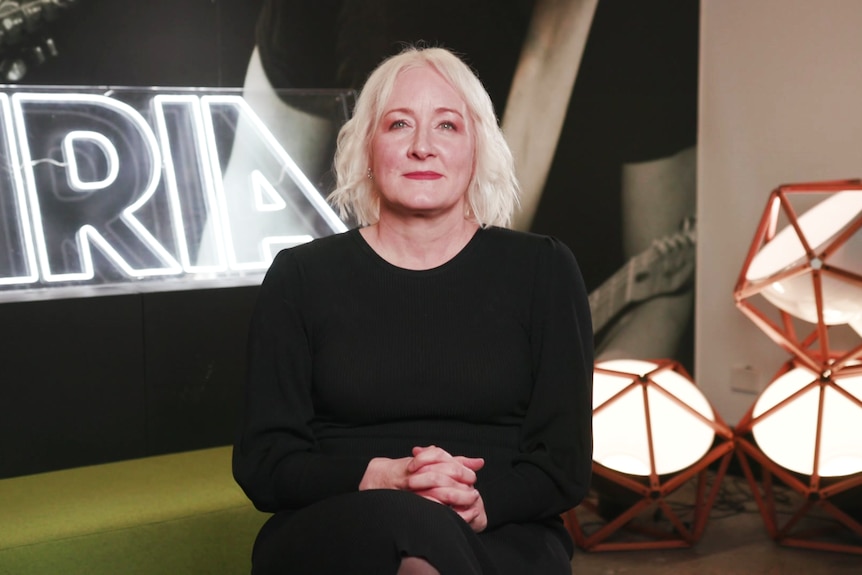
Annabelle Herd is sceptical of Dario Amodei’s intentions. (ABC News: Geoff Kemp)
Ms Herd said AI companies were already doing licensing deals at scale across music and other sectors, which proved they “know what they need to do”.
“If Anthropic really wants to build something that leaves everyone better off, the first step is simple: sit down with rights holders and negotiate licences,” she said.
University of NSW scientia professor of artificial intelligence Toby Walsh said companies had licensed content before.
“They’re [the companies] worth hundreds of billions of dollars,” he said.
“They could easily pay Australian copyright holders for their content. Why are they being such cheapskates?”Tax on AI inevitable as profits shift away from workers
Mr Amodei said he expected governments to develop “sophisticated” taxes to ensure the benefits of AI were shared by more people in society.
AI means machines and software owned by firms can do work previously done by people, so a larger share of the profit goes to those who own the technology rather than individual workers who supply the labour.
Mr Amodei said the right tax settings would ensure that at the end of this transition “everyone has much more than they would have”.
“I think it’s going to be the work of years to figure out what the structure of that tax should be and getting everyone behind [it], but … I don’t see any way to escape that basic conclusion,” he said.
Job losses a reality as AI spreads through economy
Mr Amodei said there was nothing “unprecedented” or “fundamentally different” about how AI would reshape the economy compared to past technological changes.
But he said the speed at which AI was developing was the “big problem” for societies trying to adjust.
“I worry about our ability to adapt fast enough,” he said.
“Governments, companies [and] civil society need to act faster.
“Not because this is a different thing … it’s just happening faster and so we need to react faster.”
Mr Amodei said there would be some people in the workforce who would “happily adapt” to the new job environment, but his concern was for the group who were “going to be unwilling or will have a hard time adapting”.
“That’s the group … public policy needs to be directed at,” he said.
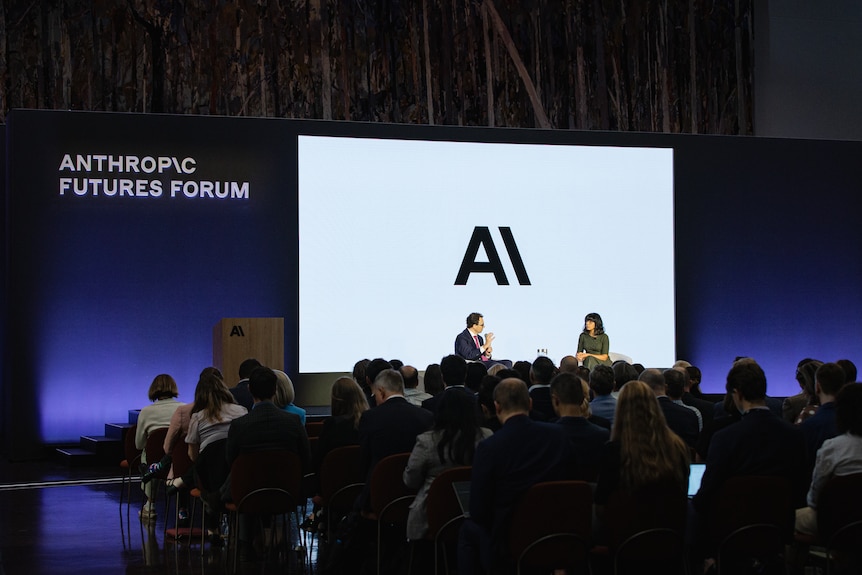
Dario Amodei says he wants a copyright arrangement that “works for everyone”. (Supplied: Futures Forum)
Cancer could be a thing of the past
Mr Amodei said he spent a lot of time talking about the “risks” posed by AI, but it was also important to explain why the technology was being built.
“I have a few answers, but I think the most powerful one is the medical benefits,” he said.
“I am really serious about the magnitude of benefits here.”
He said slow progress on treating diseases like cancer could be rapidly accelerated in the next five to 10 years.
“Ten years from now … cancer could look like the bubonic plague; something that we studied more in the history books,” Mr Amodei said.China going down ‘wrong path’
Mr Amodei said he believed China was an example of a country going down the “wrong path” on AI.
“They’re running a … highly sophisticated, impressive in a way … high-tech surveillance state, where they can watch every aspect of someone’s life,” he said.
Mr Amodei said augmenting that approach with AI would effectively lead to a “panopticon” situation, with discipline enforced through extreme monitoring of citizens.
A panopticon is an 18th-century-style circular prison, featuring a central observation tower, where inmates are constantly monitored but cannot see the guards.
AI powered ‘renaissance’ for democracies
Mr Amodei said the flip side of the sinister potential uses of AI was the possibility the technology could enhance democracies and their institutions.
Using the rule of law as an example, he said AI could be combined with the human elements of justice — such as a judge — to bring a machine-level of “consistency” that better protected and enforced people’s rights.
“We could really have a renaissance of our democratic institutions,” he said.
Mr Amodei said on the international stage, he was concerned about the use of AI in military competition.
“AI is a powerful technology,” he said.
“I don’t want autocracies to be militarily more powerful than democracies.
“I want to make sure democracies continue to have the upper hand.”