
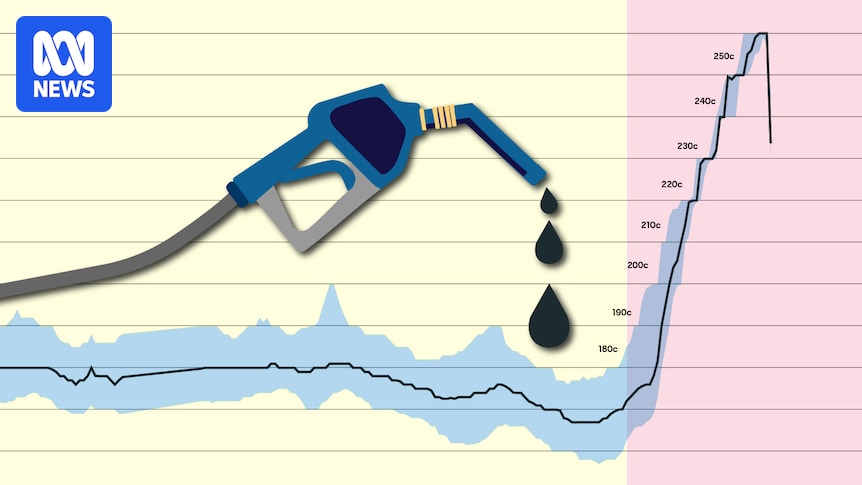
Petrol prices have climbed steeply since the start of the war in Iran, before dipping back slightly after the federal government’s cut to fuel excise.
The ABC is tracking fuel price data nationwide, and the prices in this article will update regularly; check back for the latest.
The average price of unleaded petrol across the country dropped by more than 20 cents per litre on Wednesday, as retailers immediately passed on savings from the temporary halving of Australia’s fuel excise.
The excise cut means a 65-litre tank will be $19 cheaper than it otherwise would have been, so long as the full savings have been passed on.
Data shows most stations around the country passed the savings on – almost in full – on the first day.
We’re using official government data across most Australian states and territories to track the latest prices at the pump – for both unleaded 91 and diesel.
The story for diesel is much the same as for unleaded petrol.
Even though most personal vehicles don’t run on diesel, it plays a crucial role in the economy. Australia’s transport, agriculture and mining industries are heavily reliant on it.
It does not appear that petrol stations immediately passed on as much of the excise cut for diesel prices.
What’s the fuel price in my area?
The usual price variations across cities and regional areas have fallen away in recent weeks, with prices converging at similar levels everywhere.
Here’s a breakdown of the latest prices in most major cities, states and territories.
Victorian and WA data is not currently available due to the way those states release price information. However, the trend is very similar nationwide.
Prices are updated in near ‘real-time’, with most stations reporting data at least once a day.How much supply does Australia have?
The federal government is reporting on fuel stocks held under the Minimum Stockholding Obligation each week during the Middle East war.
A spokeswoman for Energy Minister Chris Bowen says the minimum stockholding is essentially an emergency reserve, held over and above normal supplies flowing through the Australian economy.
Some of the stockpile has been released to relieve shortages in recent weeks, the spokeswoman said, but the number of days held in reserve has increased because supplies are still arriving in Australia and the stocks are being replenished.
This data lags significantly behind any kind of live supply-level reading.
The regulated entities that hold the fuel stocks have to report their levels as of each Tuesday, and the government then releases those figures in aggregate on Saturdays.
About the dataThe fuel price data contains a regular download of fuel price reports from the real-time fuel monitoring schemes in NSW, ACT, SA, QLD, Tas.WA and Victorian data is available but in a different format and not as real-time as other states. The ABC will investigate adding WA and Vic to this tracker over time.For each service station, we geolocate it to its greater capital city statistical area, and then calculate the mean and interquartile range for the prices nationally and in each sub-region.From April 1, 2026, we will download the fuel price reports multiple times a day, updating that day’s data point with the most recent observation.We remove missing observations, and exclude any station that has not updated its price in more than 48 hours (for the states that provide a last updated timestamp).All data is sourced from the following official state government services:The Victorian government’s Servo Saver was launched in late 2025, publishing data on a 24-hour delay, and so long-term comparisons are not available in Victoria.The Western Australian government publishes fuel price data through its FuelWatch program with a delay.