

When news that Anthony Albanese was planning an address to the nation spread around Canberra on Wednesday morning, memories of those deep, dark days during the worst of the pandemic came rushing back.
Amid fuel shortages and growing nervousness, a prime-time television address from the country’s leader was bound to remind anxious households of Covid-19 lockdowns and the chaos of the global financial crisis.
But once images of Albanese speaking from Parliament House were beamed into television sets shortly after 7pm, the message seemed to be: keep calm and go about your business.
Sign up for the Breaking News Australia email
Speaking in front of an Australian flag, the prime minister appeared upbeat, urging viewers to enjoy the Easter long weekend and live their lives as normal.
But sceptical viewers trying to wrangle family dinnertime or get children ready for bed may have found Albanese’s three-minute address wanting and his message quite mixed.
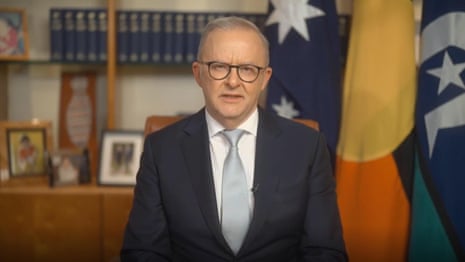 Australian PM says ‘next few months may not be easy’ in rare address to the nation – video
The decision to speak to the country – the first national address from a prime minister in six years – could actually serve to undermine the message he was trying to convey, that everything is in hand and there is no need to panic.
Acknowledging Donald Trump’s haphazard war in the Middle East had created the worst global energy shock on record, Albanese conceded tough times and soaring petrol and diesel prices would test Australia’s optimistic spirit in the weeks to come.
Talking up national cabinet’s new four-stage fuel security plan, announced on Monday, he stressed contingencies to keep the country moving were in place. Even if fuel supplies were seriously interrupted in the coming weeks, Albanese said the federal government and the states were ready to coordinate an effective response.
He pointed to the three-month cut in the fuel excise and moves to reduce the heavy vehicle road user charge for the transport industry to zero.
“The months ahead may not be easy,” Albanese said, promising to be upfront in the face of serious national uncertainty.
“No government can promise to eliminate the pressures that this war is causing.
“I can promise we will do everything we can to protect Australia from the worst of it.”
Despite speculation he was preparing to announce fuel rationing, travel bans or new work-from-home orders, Albanese said instead the government was working to shore up international fuel supplies and build refining capacity at home.
But it wasn’t all “nothing to see here”. He suggested workers might consider catching the train or tram to work if they could, to help “build our reserves” and save fuel for the farmers, tradies, shift workers and nurses who have no choice but to get behind the wheel.
All through the month-long crisis, Labor has stressed it wanted to avoid the mistakes of the pandemic, when mixed messages and inconsistent advice from political leaders badly undermined community confidence.
To this end, the government has held daily press conferences and tried to clearly explain fuel shortages being experienced at service stations across the country.
Like the briefings John Curtin gave the Canberra press gallery at the height of the second world war, Albanese briefed newspaper editors in a phone hook-up on Wednesday afternoon. Labor ministers are now fanning out across local media and the prime minister will answer questions at the National Press Club in Canberra on Thursday.
Albanese’s promise of calm and methodical government will be tested the longer the crisis goes on.
Suggesting the country work together and look after one another, Albanese’s address could be looked back on differently. As in previous crises, it could be seen as a marker of when things got really serious for Australia.
Tom McIlroy is Guardian Australia’s political editor