
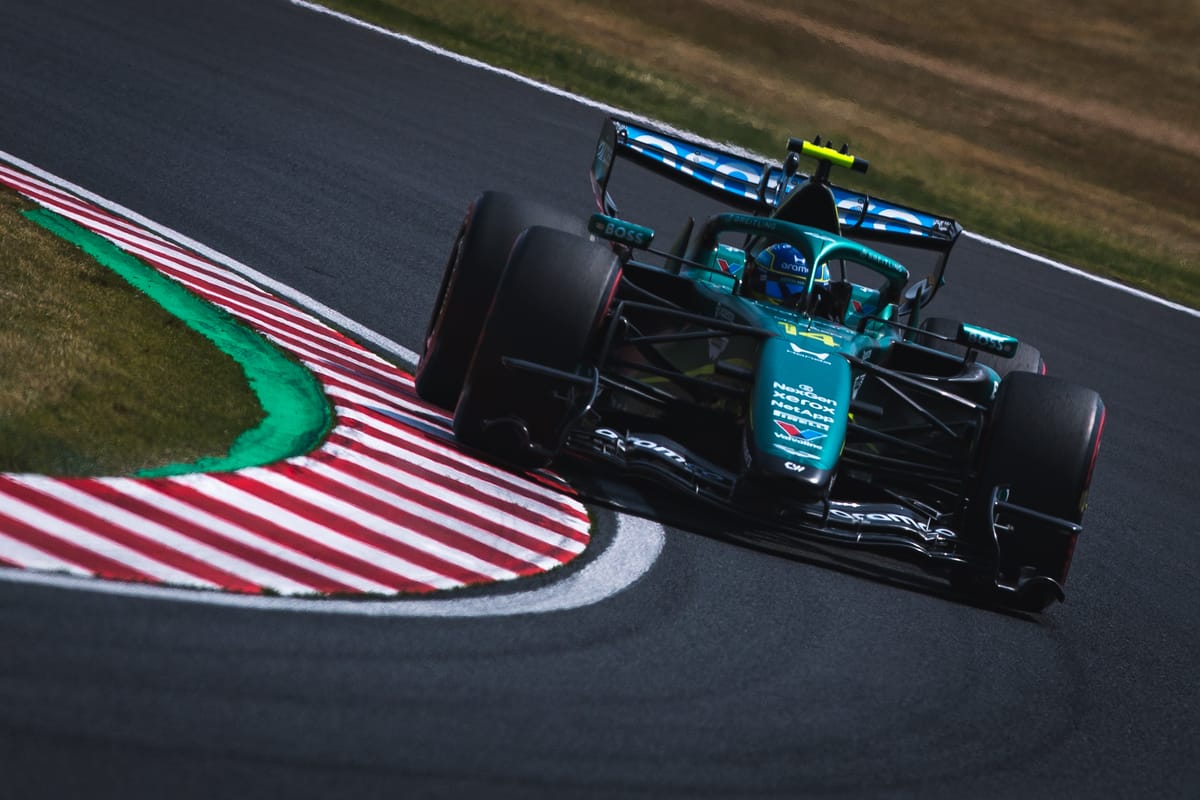
Aston Martin removed an experimental component that cured most of the vibration discomfort its Formula 1 drivers have suffered at the start of the season and did not race it at the Japanese Grand Prix.
A high-frequency sensation through the steering wheel has been uncomfortable for Fernando Alonso and Lance Stroll to deal with since the start of pre-season testing, as part of the problems Aston Martin and new engine partner Honda have suffered.
At the opening round Aston Martin’s F1 boss Adrian Newey said the issue left the drivers fearing permanent nerve damage if they were overexposed to it, and discomfort prompted Alonso to retire from the Chinese GP shortly after mid-distance – although he said he could have persevered if he was not running a futile race a lap down in last position.
Last week at Suzuka, Alonso said that in Friday practice “the car felt completely normal, nearly no vibrations”, so he was confused he then had “the same vibrations as ever” in qualifying.
The two-time world champion said “we didn’t change anything” and “that was a little bit difficult to understand”.
However, Aston Martin had in fact trialled something new on Friday aimed at mitigating the problem.
Given its description of the issue and how it manifests for the driver, this was probably a change around the steering column; something to dampen whatever vibrations are in the chassis rather than transmit them so easily.
Chief trackside officer Mike Krack confirmed post-race that “we had some countermeasures here” and “we tested something in the sessions that was a small improvement, but we could not race it”.
“Bringing new parts always brings a risk, so you need to consider that when you make reliability decisions,” Krack said.
“They were new parts, so we decided not to go into the race with them, but I think it shows some promise.”
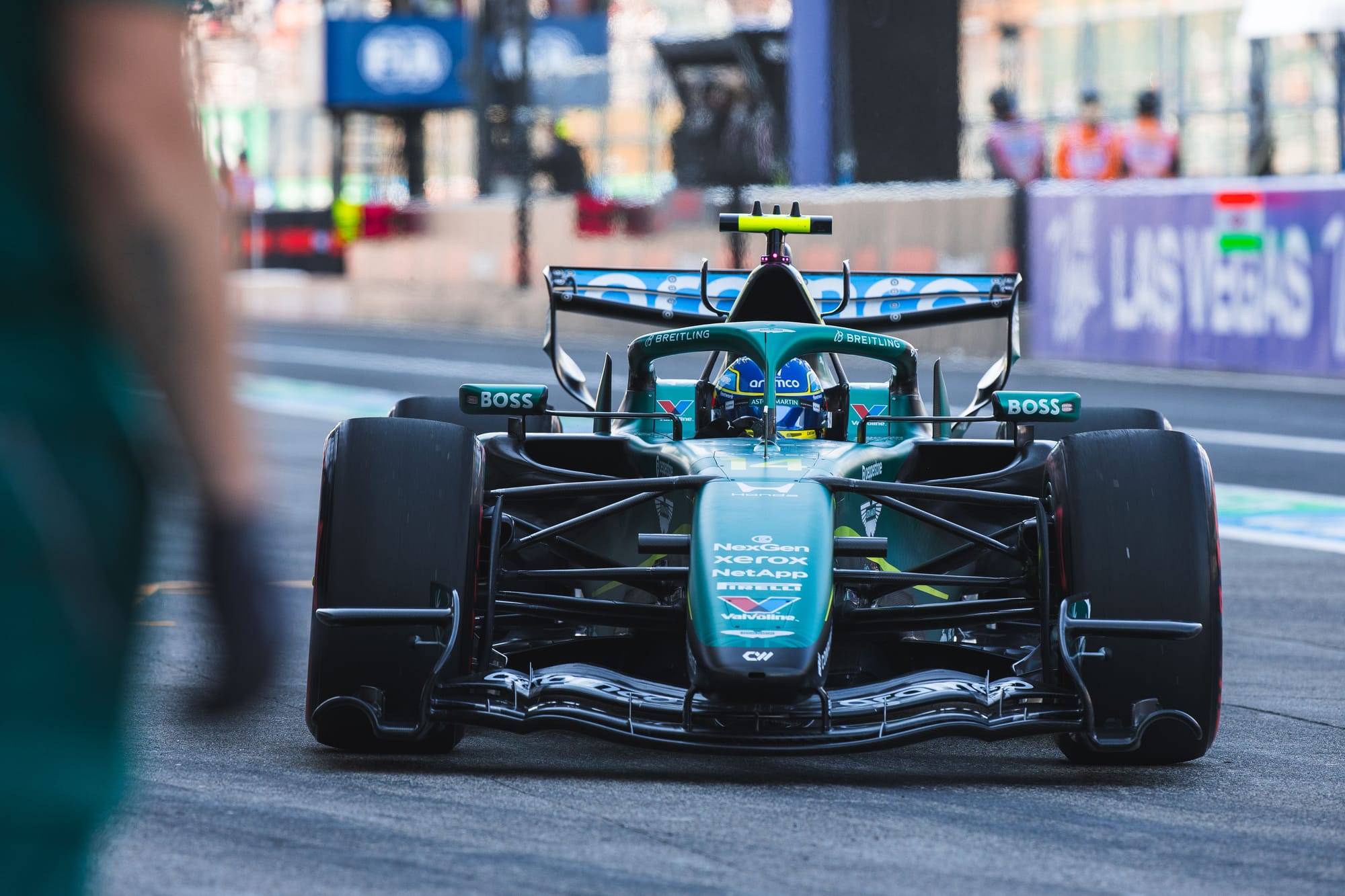
Despite that explanation, there still seemed to be uncertainty over how much Alonso was aware of even after the race.
Alonso arrived to Suzuka late, having missed Thursday following the birth of his first child, so may have not had a normal, full briefing of everything that would be tried during the weekend.
But why he would not then know after practice and qualifying that parts had been run and then removed is not clear. Even after the race Alonso reported the vibrations were “better” than on Saturday, despite nothing changing on the car, and said he still did “not really” understand why the vibrations were not present on Friday.
Regardless of any uncertainty the drivers had, Alonso describing the vibrations in Friday practice as “80% better” is a good sign for Aston Martin as it tries to clear its many early-season hurdles.
The plan is to introduce this fix properly at the next race in Miami in over a month’s time, after the unplanned April gap F1 now has following the cancellation of the Bahrain and Saudi Arabian GPs.
Krack said: “I am quite confident that for Miami we can do a step that [means] we are not speaking about it anymore.”
Removing whatever experimental parts were on the car meant the vibrations were a known issue going into the Japan race.
And while Stroll retired with a water leak, Alonso made it to the chequered flag for the first time in a grand prix this season, giving Aston Martin and Honda their first classified finish.
It still came with Alonso a lap down and almost half a minute behind the Cadillac of Sergio Perez on a weekend that the performance of Aston Martin’s car and engine was badly exposed.
But it meant a major embarrassment at Honda’s home race was avoided and there was at least validation that progress had been made regardless of the modesty of the achievement.
“We have many boxes to tick and this was one of them: finishing a race distance,” said Alonso.
“We didn’t manage it in Australia, China or at the tests. So it’s the very first time and hopefully the team has enough data now to understand the car a little bit more and get in a better place for the next one.”
Krack said even though finishing races in F1 “should be the norm, it should not be something that you have to celebrate”, Aston Martin had to “take the positives” given where it has come from so far this year.
“When you look back, in Melbourne we discussed doing six laps, in Shanghai we managed to do the sessions, but we had in between a lot of work to be able to do all the sessions,” Krack said.
“This was not the case here, so the cars could be prepared normally between the sessions, and our modest objective was to finish the race with both cars.
“We managed with one, so it’s one small step on the list with many, many, many small steps to be done.
“The mood in the camp, nobody is celebrating, but I think for the modest target that we have set ourselves, we have achieved a part of it.”