
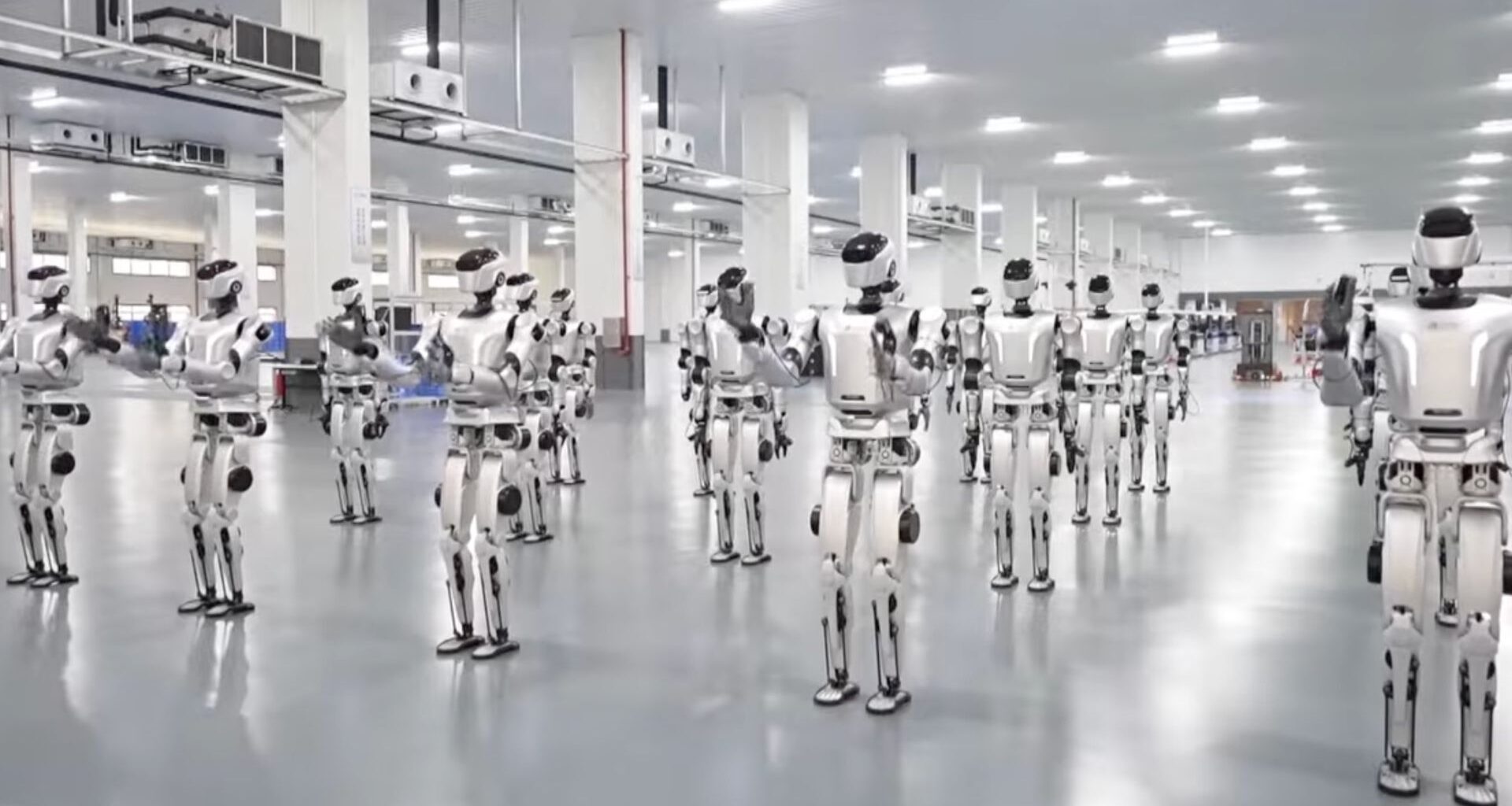
China’s humanoid robotics race entered a new phase on March 29, 2026, as a high-capacity production line in Guangdong officially began operations.
The factory is reported to be the country’s first capable of producing up to 10,000 humanoid robots annually, signaling a shift from small-scale experimentation to industrial-level manufacturing.
The development comes amid an intensifying global race to scale humanoid robot production, where output numbers are increasingly seen as a key benchmark of progress and investor confidence.
High-speed production line comes online
The newly launched facility is a joint effort between Leju Robotics and Dongfang Precision Science and Technology. The latter, once known mainly for corrugated packaging equipment, has rapidly expanded into robotic contract manufacturing.
According to technical details shared during the launch, the production line integrates 24 precision assembly stages and 77 inspection checkpoints. Each completed humanoid robot rolls off the line roughly every 30 minutes, delivering about a 50 percent improvement in efficiency compared to traditional assembly methods.
The system also uses a flexible manufacturing design. With automated guided vehicles and digital control systems in place, the factory can switch between different robot models without requiring a full production overhaul. This allows the facility to meet varying demands from industries such as automotive and home appliances.
A new contract manufacturing approach
The partnership highlights a growing shift in the robotics industry toward specialized contract manufacturing. In this model, Leju Robotics focuses on design and software, while Dongfang Precision handles large-scale production, system integration, and after-sales support.
This division of roles reflects a broader trend in the emerging Physical AI ecosystem. Companies are increasingly separating innovation from manufacturing execution to accelerate deployment.
Dongfang Precision’s involvement is further backed by its 2.8% equity stake in Leju Robotics, aligning incentives between design and production. The approach aims to address a long-standing challenge in robotics, where advanced prototypes often struggle to transition into reliable, mass-produced machines.
Scaling up in a competitive global race
With an annual capacity of 10,000 units, the Guangdong facility places Leju among the leading players in the humanoid robotics sector.
Several competitors are also rapidly expanding. Agibot recently announced the rollout of its 10,000th humanoid robot, while Unitree Robotics is pursuing a $580 million funding push to support a facility targeting 75,000 units per year.
Meanwhile, UBTECH Robotics is working toward producing 5,000 units annually, with a goal of bringing costs below $20,000 per robot.
For Leju, reaching the 10,000-unit mark is not just a milestone but a necessity. In the current market, production volume is becoming a critical factor in attracting investment and proving commercial viability.
Before leaving the production line, each robot undergoes 41 simulated work-condition tests. These checks are designed to ensure reliability as humanoid robots move beyond demonstrations and into continuous industrial operations.
Software remains the key challenge
Despite the rapid progress in hardware manufacturing, the industry still faces a major hurdle. The software needed to make humanoid robots effective in real-world, unpredictable environments is still developing.
While factories can now produce thousands of units, deploying them in meaningful roles remains a challenge.
With Guangdong’s supply chain now capable of large-scale output, the focus is shifting. The pressure is increasingly on AI developers to create systems that can turn these machines into productive workers rather than technological showcases.