
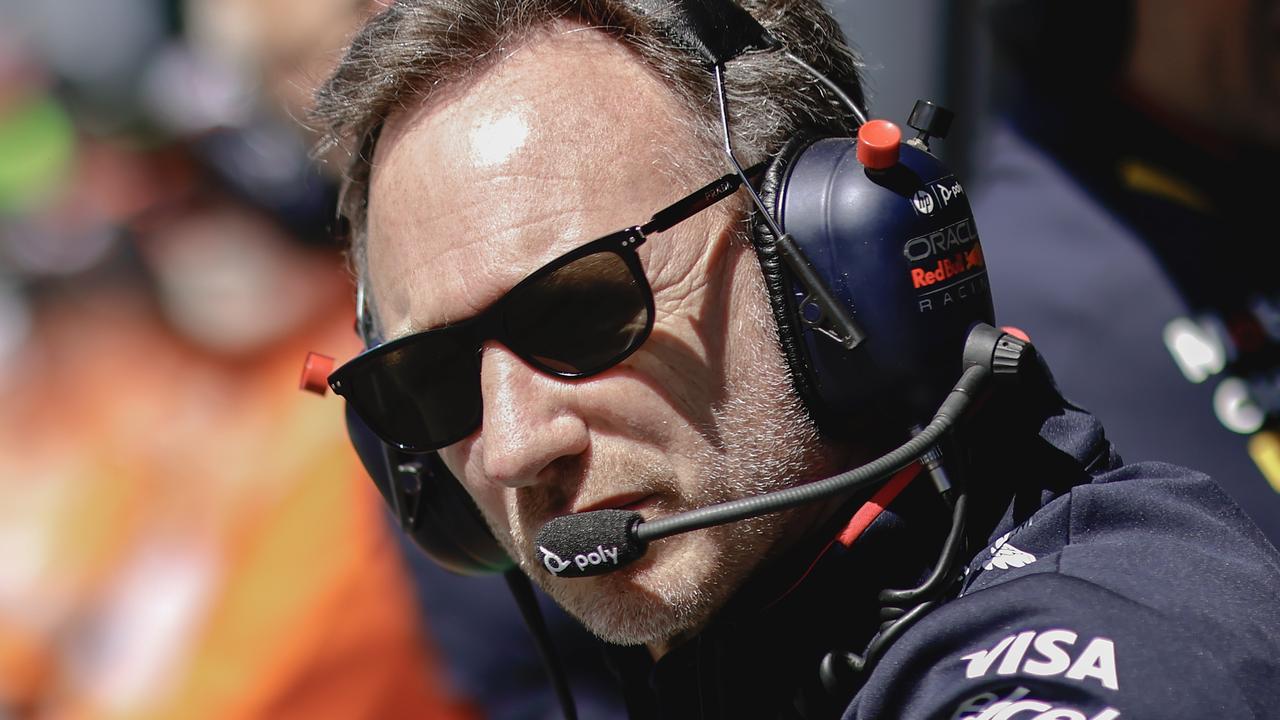
While the Formula 1 on-track action is on a month-long break, off track the wheels are turning faster than ever.
It’s not just the critical development race that will be continuing flat-out. The business of F1 never stops.
We’re at a potentially critical juncture for Christian Horner’s Formula 1 comeback.

Fox Sports, available on Kayo Sports, is the only place to watch every practice, qualifying session and race in the 2026 FIA Formula One World Championship™ LIVE in 4K. New to Kayo? Join now and get your first month for just $1.
Horner is in negotiations to buy a stake in the Alpine team that will get the title-winning former Red Bull Racing boss a foot back in the door.
But after reports in January suggested a deal was close to being closed, momentum behind the ousted Englishman’s return appears to have stalled.
He’s now in competition with arch rival Toto Wolff for a share in the team — a prospect that could ignite a political war over political power in Formula 1.
WHAT’S THE STATE OF PLAY?
The Alpine automotive brand, established in the 1950s, is wholly owned by Renault. The marque was phased out in the 1990s, but in 2017 it was relaunched as a boutique part of Renault Sport, and in 2021 the Renault Formula 1 team was rebranded as Alpine.
Alpine’s early days were successful. Esteban Ocon sensationally won the 2021 Hungarian Grand Prix, and the team improved from fifth to fourth in the 2022 constructors championship to give the impression its time-limited road map to the title was on track.
By 2023, Renault was keen to capitalise, and in June that year it announced it had sold a 24 per cent stake in the race team to a group of investors led by Otro Capital — including the investment vehicle of actors Ryan Reynolds, Rob McElhenney and Michael B Jordan — for €200 million. At the time it valued the team at around $1.4 billion.
It turned out to be the peak of the team’s competitiveness. Its form began declining in the second half of that season on the way to a disappointing sixth in the standings. By last year it had dropped to 10th in the standings as the most distant last-placed team by points in the championship’s history.
Renault has spent the intervening years batting away speculation that it was considering exiting the sport, even as a revolving door of executives instigating various management axing made Alpine the least stable team in Formula 1.
But why would it pull the plug when, despite the team’s sliding form, its valuation continued to grow?
Formula 1 valuations have risen considerably since 2023.
As just one example, the sale of a 15 per cent share of the Mercedes team had it valued at $7.1 billion in November.
Perhaps a more comparable example is Aston Martin, a team that has been similarly mired in the midfield in recent history, notwithstanding its big-spending owner and the considerable hype built ahead of the 2026 season. Last year it sold a minority stake in the team that had it valued at $4.62 billion.
While a team can be accurately valued only when sold — value is only the price someone is willing to pay — Forbes estimated Alpine to be worth $3.54 billion at the end of last year.
That’s an increase of around 252 per cent — nothing to sneeze at.
It means Otro’s stake is likely worth more than €500 million, or around $840 million. That’s quite the return in less than three years.
Now Otro, per months-long rumours, is ready to cash in — and given F1’s still-growing commercial appeal, it has no shortage of suitors.
PIT TALK PODCAST: Andrea Kimi Antonelli beats Oscar Piastri to victory at the Japanese Grand Prix on a big day for the Italian and a steadying one for the Australian and his McLaren team, while Max Verstappen says he’s weighing up his future in Formula 1 over the sport’s controversial 2026 regulations.
HORNER POSITIONS HIMSELF AS TOP BIDDER
The timing was perfect for Horner, who considers Formula 1 unfinished business after his sacking from Red Bull Racing.
But while he’s eager to return, he’s also in rush. He doesn’t want to comeback for the sake of it; he wants certain guarantees that he won’t find himself in the same vulnerable position again.
“I am not going to come back for just anything,” he told Press Association. “I am only going to come back for something that can win. I don’t want to go back in the paddock unless I have something to do.
“I would want to be a partner rather than just a hired hand, but we will see how it plays out. I am not in a rush. I don’t need to do anything.”
Though he has been linked, along with a consortium of financial backers, to several teams — both Haas and Aston Martin revealed late last year that they’d been sounded out by the ex-boss — Alpine was always his most likely destination given it presented as the most likely squad to be open to a sale.
Alpine boss Flavio Briatore confirmed at the launch of this year’s car that Horner was “negotiating” to buy in.
“Otro wants to sell their participation in Alpine,” he said, per Autosport. “It’s a few groups interested to buy 24 per cent.
“But it has no link with me, because he [Horner] is negotiating with Otro, not negotiating with us [Renault].”
The team formally confirmed Horner’s interest via a media statement.
Reports from a variety of European publications suggested a deal was imminent in January. Horner, as part of his eye-watering settlement reportedly as high as US$100 million (A$145 million), is believed to be free to work for another team as soon as this month.
But momentum behind the deal appears to have stalled.
In part it was thought to be related to a clause subsequently revealed in Otro’s purchase agreement that required Renault to consent to any sale before September this year.
But it has since become clear another bidder is complicating matters.
Supercars exploring wildcard for F1 star | 02:49
MERCEDES COMPLICATES THE SALE
During the Australian Grand Prix weekend the UK’s Telegraph reported that Mercedes was also making a bid to buy Otro’s 24 per cent share in the team.
The Mercedes Formula 1 team is owned in three equal parts by the Mercedes-Benz Group, British chemical company Ineos and Toto Wolff’s Motorsport Investment. Wolff sold a 15 per cent stake in his holding company to CrowdStrike CEO George Kurtz last year.
Wolff remains CEO by agreement. While it’s not accurate to say Wolff is bidding to buy Alpine, he would clearly be integral to the Mercedes team’s attempt to purchase the stake.
Briatore subsequently confirmed that Mercedes was is discussion to buy Otro’s share in the team.
It sets up an almighty power play between arch rivals Wolff and Horner that, at a minimum, will force whoever wins the bid to pay more than they otherwise would have, pushing up Alpine’s valuation.
It’s perhaps why Wolff’s position on Horner’s F1 comeback has hardened in recent months.
“He’s been a wonderful, great enemy over the years,” Wolff said last August. “Am I missing him? It’s quite strange to come here and Christian’s not going to be around. I mean, what are you doing with him not around? That’s a bit weird.
“We’re just totally different people, but even your biggest enemy is your best friend.”
This year, though, he saw difficulties in a return to the sport given the burning bridges he left behind.
“He [Horner] has broken quite a lot of glass, and these things have repercussions in our microcosm,” Wolff told Press Association. “When you say things … but that is what he has done all his life, and that is what he knows best.”
He denied, though, that their rivalry was playing any role in Mercedes’s decision to bid for the team.
“Us looking at that stake is in no connection with Christian,” he said. “The idea that there is a rivalry between Christian and me around who buys an Alpine stake is made up.
“It would be quite sad if that was a consideration of doing such an investment or not.
“We are looking at it from different angles, and we haven’t come to any conclusions. We want to know whether it makes sense.”
That’s certainly true. Whereas Horner wants to return to a position of power in Formula 1, Mercedes sees the Alpine stake in economic terms.
With valuations still rising, there’s a clear financial logic to buying in.
It would also give the team a stake in one of its customers, with Alpine having abandoned its in-house engine program this year to take a Mercedes supply. With Mercedes weighing up reducing its pool of engine customers in the coming years, having one effectively guaranteed through common ownership would be an attractive proposition.
Further, though The Race has reported Mercedes does not intend to turn Alpine into some sort of satellite operation — after all, Renault would still be the majority owner — having a friendly team somewhere behind you on the grid is never a bad thing to have in the event of a political brawl.
‘F*** our luck!’ – Russell CRACKS it | 00:30
F1 TEAM OWNERSHIP UNDER THE SPOTLIGHT
But the idea that two teams could share ownership is controversial.
As if two modern F1 titans being involved wasn’t enough, the prospect of Mercedes buying into Alpine could bring a third big dog into the fight.
Zak Brown, the McLaren CEO, has long been loudly against common ownership in the sport, seeing it as fundamentally anti-competitive.
The only sustained example of that happening in modern Formula 1 is Red Bull owning both Red Bull Racing and Racing Bulls.
“No other sport to my knowledge allows co-ownership of two teams that compete against each other,” Brown said in 2024.
“I think the sport, as we’re now in the budget cap era, has moved on to where we’re trying to have 10 independent teams from a sporting, from a political, from a technical point of view.
“I think they are very much playing by the rules. I have an issue with the rules, and believe the FIA needs to address this.”
Brown’s longstanding position would somewhat awkwardly put him on the opposing side of his engine supplier. McLaren and Mercedes have a long, deep and title-winning history, so how a potentially successful Wolff-led bid plays out could be politically fascinating — and fraught.
The alternative, however, must be barely more appealing to Brown, who has made no secret of his “genuine” rivalry and dislike for Horner.
“There’s no love lost there,” he told the UK Telegraph last year. “I don’t like how he rolls and no doubt he feels the same about me.”
Brown’s dislike for common ownership — that is, of Red Bull’s ownership of two teams — played a role in that.
There is a genuine philosophical debate to be had about common team ownership.
As Red Bull says in its defence, it was encouraged to buy the collapsing Minardi squad in the mid-2000s. It was a very different era, in which many Formula 1 teams existed perpetually on the brink of financial ruin, and having the might economic might of the energy drinks company underwriting two teams made sense for the sport.
Today, however, F1 team ownership is a profitable endeavour, as the clamour for the stake in Alpine demonstrates. The benefits of having shared ownership seem to be outweighed by the cons.
It’s unclear which way the Alpine sale will go, but the political and philosophical implications will be significant either way.
For Horner, though, the outcome is personal. If he’s blocked from buying Alpine, his comeback could be thwarted for the foreseeable future.