
CSIRO Senior Principal Research Scientist Dr Melita Keywood said Kennaook / Cape Grim delivers vital data for Australia’s climate research and internationally.
“The long-term data we collect from Kennaook / Cape Grim is critical for understanding changes in the atmosphere over time and how to manage them in the future.
“For example, we have seen an ongoing increase in CO₂ over the last 50 years from human–induced activities.
“However, we have also seen a decrease in the pollutant black carbon and ozone-depleting substances like CFC-11, showing us that international efforts to reduce pollution, like the Montreal Protocol, can be effective.”
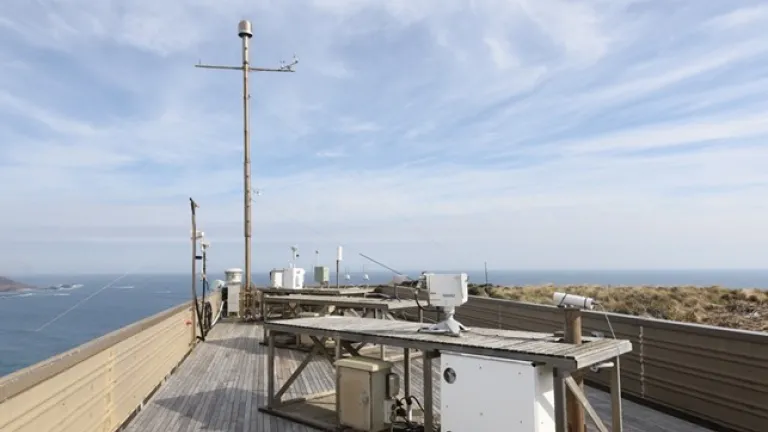
For 24 hours a day, air is drawn through several inlets – one located 80 metres up a tower – and analysed in real time to measure atmospheric compounds to track the drivers of climate change and ozone depletion.
Each season, scientists collect air samples into air tanks that are then sent to and stored at a CSIRO lab in Melbourne, Victoria, which has housed these important archived air samples since 1978.
Bureau of Meteorology Station Manager Sarah Prior said the station faced challenging beginnings at the remote site, with the first measurements made in a caravan that was donated by NASA after the Apollo missions.
“So much has changed over the past 50 years, from the way we capture our air samples to the types of pollutants that are now present in the atmosphere and the enormous technological advancements to measure them at trace levels.”
“This station is at the forefront of understanding changes to our Earth’s atmosphere. Data from this site underpins international agreements such as the Paris Agreement and enables scientists and policy makers to gauge the impact of emission reduction efforts.”