
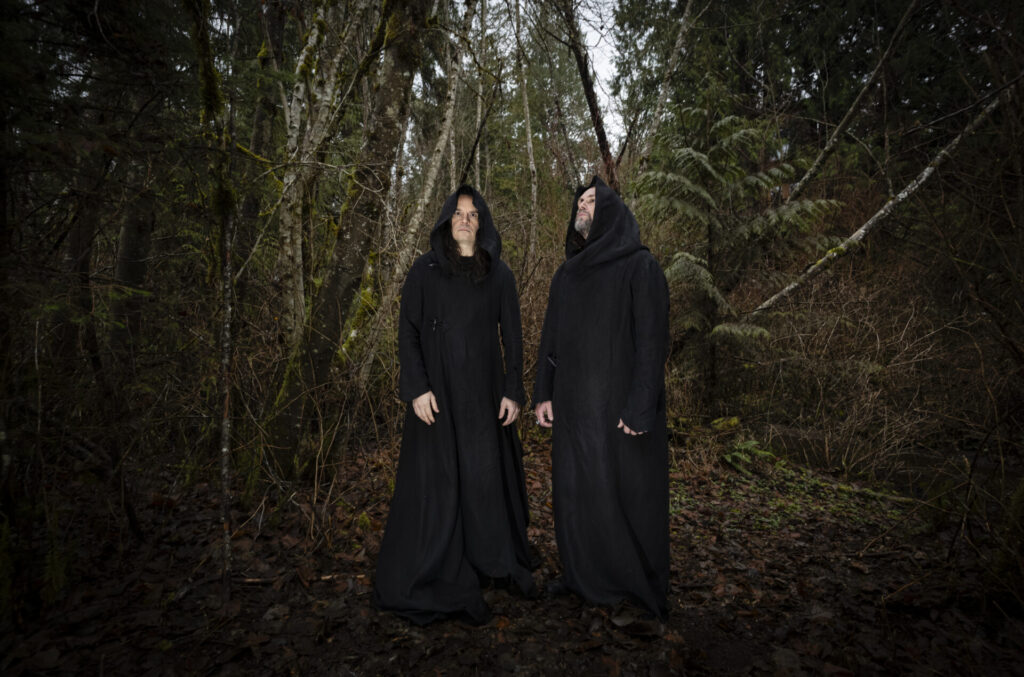
Stripped back to a two-piece, the latest from the Seattle-born drone monsters returns the group to their thrillingly arboreal roots
“He painted trees as by some special divining instinct of their essential qualities. He understood them.”
So begins Algernon Blackwood’s 1912 novella, ‘The Man Whom the Trees Loved’, a rich and unsettling tale that follows a man who, influenced by a painter specialising in portraits of trees, develops a strange obsession with the woodland surrounding his home. Whilst the painter’s arboreal depictions are said to be “wildly inaccurate” and at times approaching the ludicrous, his skill lies in capturing the “personality” of a particular tree: “friendly or hostile, good or evil. It emerged.”
Anyone who has spent time in deep woodland will most likely have experienced a range of emotional responses to their surroundings. Trees can inspire awe, fear, a sense of tranquility or even mystical states similar to those of Blackwood’s protagonist. Now that industrialisation, urban development and technological progress have thoroughly separated most of us from the natural world, entering a forest can feel both alien and familiar. A journey through woodland can be disorientating to the modern mind. Yet, the hardware of our brains evolved to process such stimuli, and the forest experience can bring great comfort to the hunter-gatherer within us all.
I find walks in the ancient woodlands surrounding my Wiltshire home to be an essential daily undertaking. They function as both a restorative antidote to the head-wrecking impact of ubiquitous tech, and a space for deep insight and creative inspiration. That’s not to say the experience is always entirely ‘pleasant’, in the traditional sense. Walking without a phone or map as I often do, once-familiar forests seem to shape-shift, causing temporary confusion and low-level panic. Whilst the scale of my local woods pales in comparison to the vast, scenic forests of the Pacific Northwest, the multitude of powerful psychic states they can induce is universal.
When drone doom deities SUNN O))) entered Bear Creek Studio in Washington state to record their latest full-length, spending time amidst the area’s breathtaking woodland quickly became a “crucial part of the process”. Tracking their absurdly detuned guitars in a room overlooking said trees, and taking time out from the sessions to hike amongst them, the enrobed duo of Stephen O’Malley and Greg Anderson have produced a beguiling work that distils the overwhelming impact of nature on the human psyche into 80 minutes of utterly transcendent avant metal.
Opener ‘XXANN’ begins with squalling layers of feedback, a sometimes-overlooked weapon in the SUNN O))) arsenal. Dissonance builds uncomfortably until their signature bowel-loosening sludge oozes forth from the speakers. There’s an almost woody quality to the guitar tone: the satisfying break-up of high-gain distortion mimicking the eerie creak of tall, swaying pines. The mix is spacious, with a soft, barely perceptible hiss adding to the sense of place. You can feel the wall of amps pushing air around the live room, the wind blowing gently through the trees.
‘Does Anyone Hear like Venom?’ again treats us to sinister whines of numbing feedback. Such attention to the upper end of the frequency spectrum conjures an icy ambience, reminding us that, unlike many guitar bands operating in the dronosphere, SUNN O))) are at heart frostbitten black metallers. It’s total sonic immersion, yes, but perhaps more akin to one of Wim Hof’s cornea-freezing feats of endurance than floating in warm amniotic fluid. The conditions invoked on this record are often far from comforting.
Having stripped back to a duo again after years of high-profile collaborations, the clarity of vision present on early SUNN O))) releases shines through here once more. Whilst vocal contributions from Attila Csihar, Julian Cope and Scott Walker have produced some of the most exciting moments of the band’s career, there’s much gained here by narrowing the parameters. This equation of addition by subtraction pulls our focus deeper into the details of the album’s meticulously woven sonic tapestry, with its extreme length and roomy production granting time and space to lose ourselves in its enchanting world.
If we haven’t yet submitted to the drone, mid-album behemoths ‘Butch’s Guns’ and ‘Mindrolling’ put forward a good case for doing so. The stop-start intro of the former will have even the most jaded metallers screwing up their faces in appreciation of its lurching heft, the false starts rendering its 14-minute hum all the more hypnotic. No less weighty, the latter piece includes one of a few field recordings of rain featured across the album: a reminder of the setting in which it was recorded and the subjective nature of experiencing this environment.
Rain is often interpreted as comforting when heard from indoors, yet heavy rain experienced outside, particularly in a non-urban environment, can be highly distressing. Traversing the windswept plains of Wiltshire in a heavy downpour is no joke, I can assure you. So, to me, the sonic fusion of thunderous power chords and precipitation brings no comfort. It acts instead as a reminder of our ultimate vulnerability in the face of the natural world, with SUNN O)))’s earth-shaking rumble mirroring the untameable forces of extreme weather.
‘Everett Moses’ introduces scratchy pick scrapes reminiscent of 90s-era grunge, fitting for the band’s first full-length release on Sub Pop. This pairing neatly closes the circle, with SUNN O))) returning to the label that put drone metal on the map with Earth’s seminal Earth 2: Special Low Frequency Version back in 1993. As the title suggests, album closer ‘Glory Black’ blazes with a surging, triumphant progression, breaking midway with a plaintive piano section. This reprieve is short-lived, and we’re quickly plunged back into the song’s ego-dissolving uber-riff, now seemingly doubled in velocity and power.
Blackwood’s novella ends with our man mysteriously absorbed into his beloved forest. Whether this process is beautiful or horrifying is largely a matter of perspective. As a reader, it might play on your fears of unknown entities lurking within dark woods, or perhaps appeal to a latent desire to escape the confines of modernity. Likewise, our absorption into SUNN O))’s dense riffscape can be joyous, soothing or completely untethering. In giving oneself over to the power of the ultra-low and the hyper-slow, we are temporarily unfixed from the everyday, allowing the subconscious to rise to the surface. Into their sonic void we pour ourselves, and much like a reflective journey through remote woodland, what we find there depends on us. Friendly or hostile. Good or evil. It emerges.