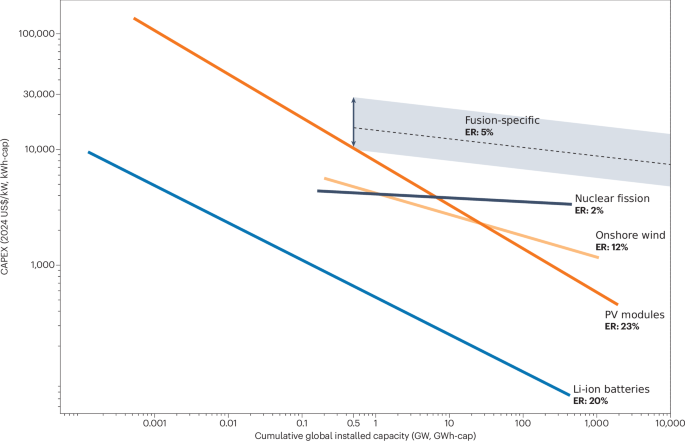
Governments are committing substantial public funding to nuclear fusion power as a potential source of safe, dispatchable low-carbon electricity to support power-sector decarbonization. These investments should be based on the certainty that fusion power plants (FPPs) may affordably serve an important role in future power systems. However, due to the technology’s nascency and lack of empirical cost data, current assumptions about future cost reductions are weakly substantiated. With inaccurate cost projections overestimating FPPs’ role in future power systems, this distorts investment priorities and funding allocations. Providing empirically grounded cost trajectories for fusion power is therefore key to ensuring that scarce public resources are directed towards technologies most likely to deliver affordable, reliable, timely, and clean electricity.