
AUCKLAND – After more than a century of global supremacy, the future of the All Blacks – New Zealand’s most recognisable brand – hangs in the balance. For a rugby-mad country, the decay of its national team is almost too awful to contemplate.
Former All Blacks captain David Kirk took over in 2025 as chairman of New Zealand Rugby (NZR), which runs the sport nationwide, to helm its turnaround. Rugby’s central place in the nation’s psyche means Kirk is not just administrating a sport, but stewarding part of the country’s identity.
“The game is so woven into our DNA,” Kirk, 65, said in an interview. “Failure is not acceptable.”
NZR has been in tumult for years. A scathing governance review in 2023 forced a board clean-out. Its financial losses have widened and there is still no permanent chief executive officer. Investments totaling NZ$262.5 million (S$193.1 million) by private equity firm Silver Lake since 2022 to turbocharge rugby’s commercial future have yet to borne fruit.
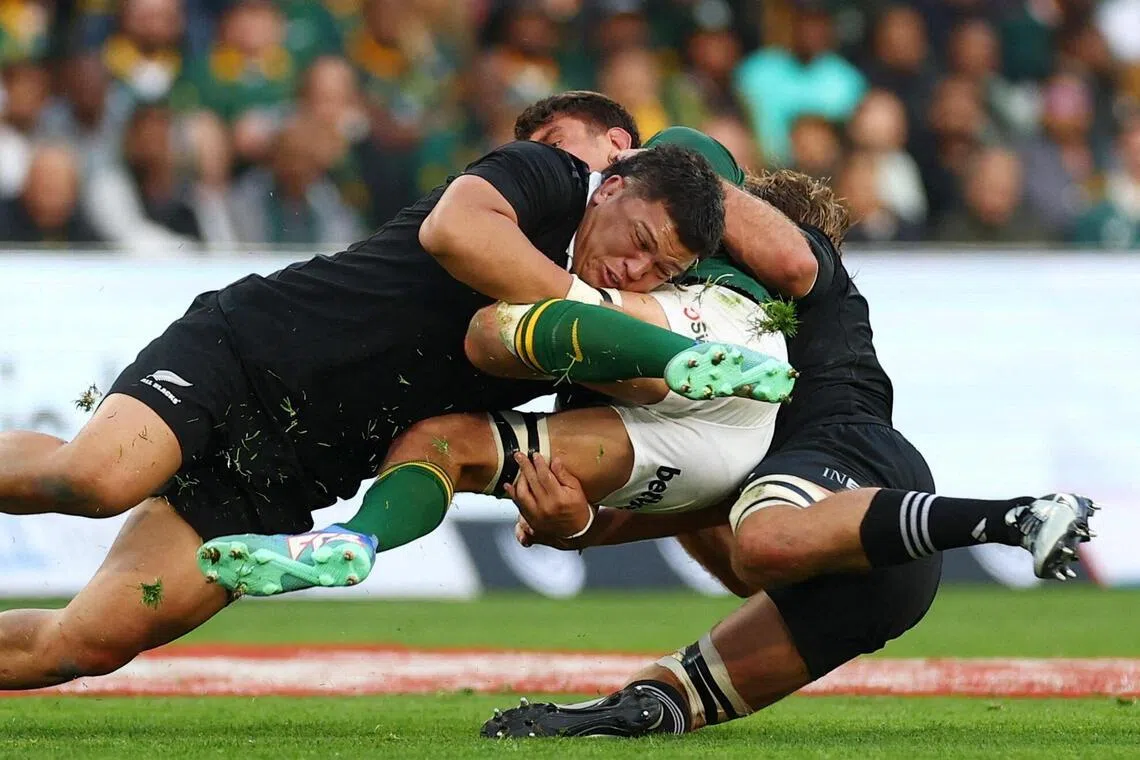
Perhaps most chastening of all, the All Blacks have suffered some recent humiliating losses – including a record 43-10 defeat in September in Wellington by current world No. 1 South Africa.
Kirk says his plan to boost the All Blacks brand worldwide depends on the team winning almost 80 per cent of their games. This is a rare feat in any sport, but a benchmark that reflects the All Blacks’ match-day track record.
“Winning drives the commercial outcomes,” said Kirk, who is based in Sydney as the managing partner and co-founder of technology investment firm Bailador, but travels between Australia and New Zealand regularly.
The All Blacks’ most recent results undermine its winning legacy, however, and the Silver Lake transaction risks becoming a cautionary tale of the vagaries of sports investments.
NZR’s NZ$3.5 billion valuation, the financial basis of Silver Lake’s investment, has not changed in four years, according to a person familiar with the company. That is scant progress for the private equity industry, which often flips assets after three to five years. The firm underestimated the challenges of dealing with an organisation that struggled to adapt to the modern professional game, added the person, who asked not to be identified as such details have not been made public.
With Kirk and a new board in place, Silver Lake is finally in a position to leverage the brand as originally planned, the person said, six years after negotiations with NZR began.
A spokesperson for Silver Lake declined to comment on the firm’s investment in NZR.
Kirk knows better than most what is required, having captained the team that won rugby’s first-ever World Cup in 1987. He played in 34 matches for the national team and lost only three. But Kirk says while the brand power of teams such as the Dallas Cowboys can often stretch far beyond their actual win rate, the All Blacks have no such luxury.
“We shouldn’t expect to be considered a great brand, and be successful monetising that brand, if we don’t back it up by winning,” said Kirk, who is also the chairman of New Zealand-based investment firm Forsyth Barr and KMD Brands, owner of outdoor gear brands Rip Curl and Kathmandu. On March 31, Kirk said he would step down from his KMD role in the coming months.
The All Blacks, who played for the first time in 1884, are often considered to be among the greatest-ever sports teams. According to NZR, the team has an all-time win rate against other national sides of 77 per cent. That is far better than the New York Yankees, and streets ahead of the Los Angeles Lakers, who win about 60 per cent of the time. None of the National Football League teams comes even close. The All Blacks are currently ranked second in the world.
The previous coach Scott Robertson quit in January after falling short of the mark – he had won only 74 per cent of the time. His fate was sealed after losses against England and Argentina, on top of the one against South Africa.
Whether the All Blacks do well is a matter of national importance that is unparalleled in any other country. When they win, a feel-good factor intoxicates the nation of over 5 million, said former Prime Minister John Key. He served three terms, including during New Zealand’s 2011 World Cup win as host and when they defended the title four years later.
Key remembers chatting to former US President Barack Obama about the All Blacks, and giving Chinese President Xi Jinping a team jersey with his name on the back. “It’s one of the very few things that internationally most people link to New Zealand,” he said.
Silver Lake’s bet, however, came after the All Blacks’ peak. The team has not won the World Cup since 2015. In 2022 – the year of the deal – they fell to fifth in the world rankings, their worst-ever position. NZR has lost money every year since. It is yet to release its 2025 annual report.
The team’s recent decline can be traced back to 1995, when rugby became a professional sport worldwide. Players and coaches with specialist skills and knowledge began to seep out of New Zealand, tempted by higher pay elsewhere. Training methods and game strategies that were once unique to the country became homogeneous. In particular, England, France and South Africa were able to close the performance gap.
“The competitive advantage we’ve had for a very long time has come to an end,” said Kirk. “We’ve got to innovate.”
After decades in the corporate world, Kirk must now prove his credentials as a sports administrator and turn NZR into a profitable business. He is looking beyond the small domestic market for new fans in the US, Europe and Asia, and for larger sponsorship deals. In 2024, sponsorship and licensing was by far NZR’s biggest source of income.
According to the person familiar with Silver Lake, the firm believes financial losses in recent years have little significance compared to the revenue growth opportunities at NZR. Silver Lake thinks it is now far more engaged with the investment after years of contributing very little, the person said.
It is hard for a national team to win new followers elsewhere though, according to Mark Crowe, Australia managing director for brand valuation consultancy Brand Finance, as fans tend to support local teams. Compounding the challenge, the All Blacks usually play no more than 15 matches a year, which limits the amount of game-day footage that can be recycled online to attract new fans, Crowe added.
“It’s extremely challenging to go into new markets where you’re not playing or don’t have a strong presence,” Crowe said. Success, he said, will require “deep pockets and a very long-term horizon.”
Kirk said late last year that NZR+, a digital platform for New Zealand rugby content that launched in 2023, has proven to be too expensive and underperformed.
NZR said in an e-mail that its content is on several platforms including YouTube, and NZR+ has more than 435,000 registered users. The organisation has reduced content-production costs and is aiming for more than 1.5 billion non-live video views in 2026, up 30 per cent from 2025.
World Cup performances can be critical because sponsorship deals tend to follow the tournament’s four-year cycle. In 2031, the men’s tournament takes place for the first time in the US – World Rugby, the sport’s global governing body, is leaning on the All Blacks to raise rugby’s profile. The team played the US national side in Washington, DC in 2021 and Ireland in Chicago in 2025. They are due to take on South Africa in Baltimore in September.
Kirk is also still hunting for a permanent CEO for NZR, months after the position became vacant. But Silver Lake has funded structural changes to help revitalise the sport in the longer term – about NZ$60 million has been ring-fenced to create a fund to develop rugby in the community.
Participation is falling, especially at school and club level, due to concerns over head injuries and changing demographics. In 2000, there were 30,500 players in the age group, falling 23 per cent to about 23,500 by 2020. Numbers have since rebounded to 26,000, largely driven by growth in the women’s game, according to New Zealand sociologist and demographer Paul Spoonley.
That comes amid the increasing popularity of women’s rugby worldwide, especially following the success of the 2025 World Cup in England. Farah Palmer, a former captain of the New Zealand women’s team, the Black Ferns, and one of NZR’s representatives on World Rugby’s council, says the women’s game is critical to rugby’s future at home.
“Now the players are household names,” said Palmer, who is also an academic at New Zealand’s Massey University. “But I don’t want people to take the foot off the throttle. It can easily go backwards if we say ‘everything’s fine now, let’s just leave it alone.’”
As next year’s men’s World Cup in Australia looms, Kirk says the prospect of a fading All Blacks team is unpalatable.
“People would feel like we had something really special, and it hasn’t been looked after,” said Kirk. “I’m not going to let that happen.” BLOOMBERG