
In 2013, National Geographic photographer Steve Winter used a remote wildlife camera to snap a seemingly impossible photo: a collared mountain lion on the prowl in one of LA’s most popular parks, right in the middle of the city. The Hollywood sign, one of California’s most famous attractions, loomed in the background.

The photo of mountain lion P-22 quickly catapulted the young male cat into his own stardom. For those outside Los Angeles, the photo showed a truth about the city that can be hard to understand from afar: that the nation’s second-largest city includes rugged wild spaces with bears and mountain lions. Angelenos projected their own experiences of the city, from traffic to dating woes, onto the young male cat, who crossed two freeways to reach Griffith Park, where he spent his days as the only mountain lion on an island of parkland. The perennial bachelor, surrounded by freeways and development, never found a mate.
For Adam Matano, a sculpture artist tasked with creating a permanent memorial to the mountain lion, the iconic photos of P-22 came a few years after moving to Los Angeles from Rhode Island. The images reminded him of the steady loss of green space back home and of his broader interest in how humans are impacting wildlife and biodiversity.
Article continues below this ad
Artist Adam Matano poses for a portrait in his studio space in Los Angeles on March 13, 2026.
Jessie Alcheh/SFGATE
Sculpting tools in artist Adam Matano’s studio space in Los Angeles on March 13, 2026.
Jessie Alcheh/SFGATE
Sculptures in Artist Adam Matano’s studio space in Los Angeles on March 13, 2026.
Jessie Alcheh/SFGATE
Article continues below this ad
“I was already super interested in animals living with humans, and he was like the perfect example with that photo with the Hollywood sign in the background. So I was just hooked from then on,” Matano said.
That’s the challenge with trying to memorialize an iconic figure like P-22; in Southern California, everyone has their own specific association with the cat and what he represents. And no one knows what P-22 would make of his fame, or whose interpretation of Los Angeles he’d agree with. P-22 became the mascot for conservation efforts in Los Angeles and beyond, and he has inspired museum exhibits, the world’s largest wildlife crossing and an annual festival in his honor, now in its 11th year.
People arrive for a memorial for the famed mountain lion P-22 at the Greek Theatre in Los Angeles on Feb. 4, 2023.
ROBYN BECK/Robyn Beck/AFP/Getty Images
People pose with a photo of P-22 during a public memorial for the celebrated mountain lion on Feb. 4, 2023, in Los Angles.
David McNew/Getty Images
P-22 was euthanized in December 2022, after sustaining severe injuries from being hit by a car. That was in addition to serious ongoing health issues, including kidney failure, heart disease and a parasitic skin infection. He’d lived in Griffith Park for 10 years. He was buried during a private, “historically significant” ceremony in the Santa Monica Mountains, according to the Natural History Museum of Los Angeles County. A later public memorial received human celebrity treatment: Thousands of people attended, the event’s dozens of speakers and performers ranged from Diplo to Rainn Wilson, and countless more mourners watched a livestream.
Article continues below this ad
“I don’t know of any individual cat anywhere in the world that has made such a great impact on people like P-22,” Winter, the National Geographic photographer, told the magazine in 2022.
So how do you build a monument to one of LA’s biggest, but unknowable, icons? For Matano, the answer is close attention to detail, from the landscape P-22 inhabited to the cat’s varying facial expressions.
“He doesn’t know he’s an icon, he’s just living his life,” Matano said of the famous photos of P-22. “I wanted to show the power and presence of him but also relate it to all of wildlife. He’s kind of the poster child for wildlife in general.”
Article continues below this ad
A P-22 image in artist Adam Matano’s studio space in Los Angeles on March 13, 2026.
Jessie Alcheh/SFGATE
Artist Adam Matano’s studio space is seen in Los Angeles on March 13, 2026.
Jessie Alcheh/SFGATE
Back in October, Matano was selected as the artist tasked with creating a sculpture of P-22, which will be installed in Griffith Park near the visitor center. Matano’s proposal “provided a moving representation of the famous mountain lion that will invite people to both celebrate and contemplate their relationship with the cat,” according to Friends of Griffith Park, one of the organizations that commissioned the piece.
The new P-22 statue will join a small group of memorial statues for specific and beloved local animals, many of which became a symbol in their communities. P-22 is one of the most famous creatures Matano has sculpted, up there with Andy N. Condor, a beloved condor and “celebirdy” who lived at Salt Lake City’s Tracy Aviary for over 60 years. Other similar examples include a statue of Samson the Hot Tub Bear in the foothill community of Monrovia, which permanently memorialized a 500-pound male black bear that regularly appeared in the suburb in the 1990s (with a particular affinity for hot tubs).
Article continues below this ad
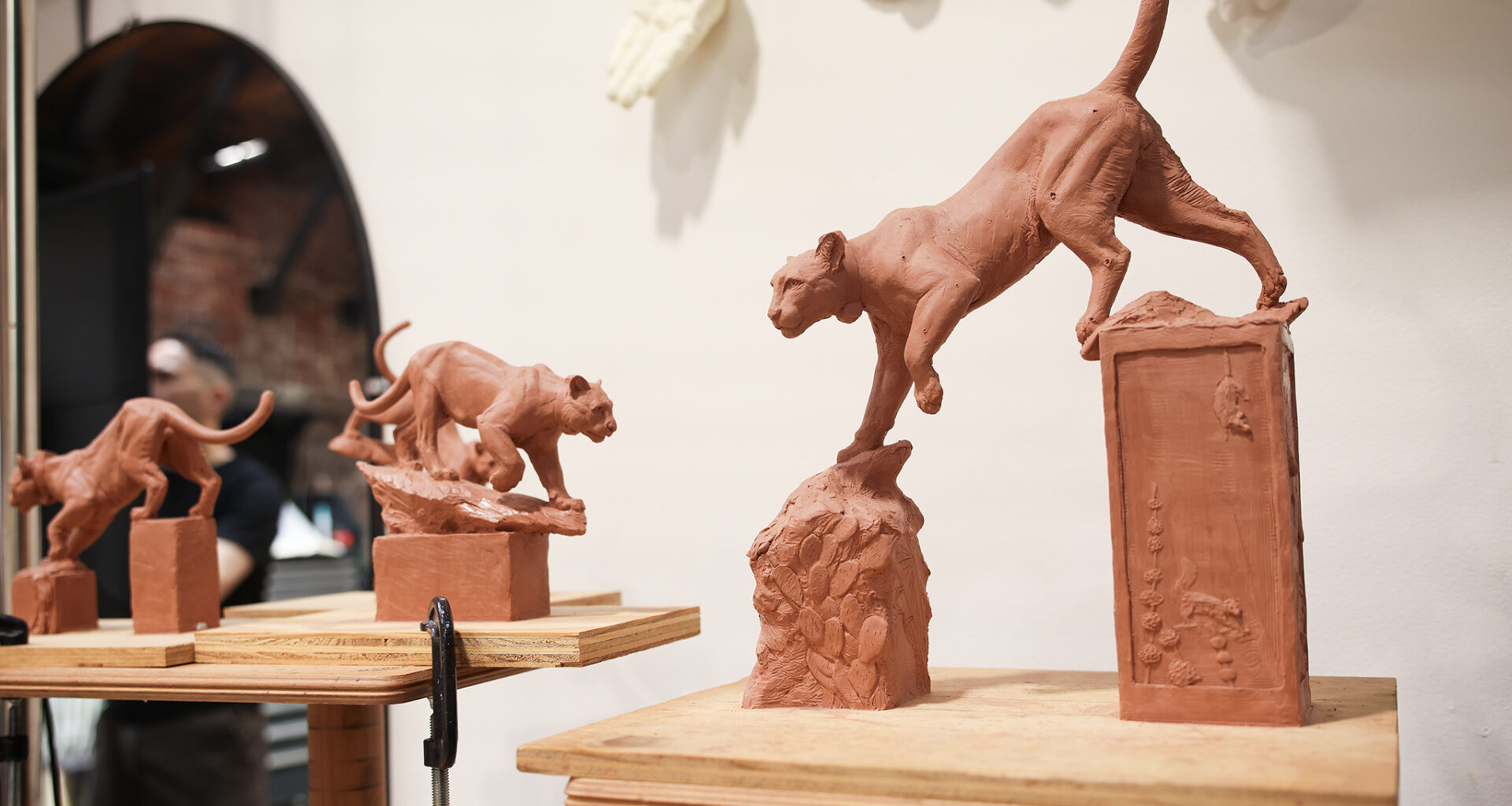
When finished, the bronze sculpture will weigh 2,000 pounds, and P-22’s face will be about eye level, allowing visitors to come face to face with a roughly life-sized version of the cat they’d only seen in photographs. P-22 will be stepping forward on the sculpture, off a human-made-looking pillar and onto a more natural scrap of land — bridging human-made and wild space. The sculpture’s estimated cost is upward of $250,000, with the bill handled by nonprofit groups and donations.
A sculpture in artist Adam Matano’s studio space in Los Angeles on March 13, 2026.
Jessie Alcheh/SFGATE
Texture work on a sculpture in artist Adam Matano’s studio space in Los Angeles on March 13, 2026.
Jessie Alcheh/SFGATE
“Showcasing P-22 bridging both the natural and man-made world, and navigating the space and dangers in between – Matano’s design is a beautiful ode to the improbable life led by our beloved mountain lion,” said City Council member Nithya Raman in an October news release, also calling P-22 “our dearly departed King.”
Article continues below this ad
The pillar at the base of the statue will be carved with other reminders of the intersections of urban and wild space in Los Angeles: possums and the Griffith Observatory, coyotes and highways, the Los Angeles River and the downtown skyline.
Matano has scoured every possible source, both digital and physical, in his quest to portray P-22 as realistically as possible. He’s hiked through trails in the park P-22 called home, visited mountain lions at the Orange County Zoo and held P-22’s actual tracking collar in his hands. His desktop is filled with photos and videos of the cat, from wildlife camera footage of P-22 in remote park locations to later news clips and social media videos of P-22 trapped in a basement and in residential areas, as the cat became sicker and more disoriented. Matano has studied anatomical charts of mountain lions and consulted with Miguel Ordeñana, a wildlife biologist who first discovered P-22’s existence in Griffith Park, on the cat’s actual measurements.
Artist Adam Matano poses for a portrait in his studio space in Los Angeles on March 13, 2026.
Jessie Alcheh/SFGATE
Sculls in artist Adam Matano’s studio space in Los Angeles on March 13, 2026.
Jessie Alcheh/SFGATE
Artist Adam Matano’s cat, Finneas, sleeps in his studio space in Los Angeles on March 13, 2026.
Jessie Alcheh/SFGATE
The result is a striking rendition of P-22 (collar and all) that currently looms large under a skylight in Matano’s Lincoln Heights studio. Matano’s 17-pound cat, whose movements and mannerisms have also served as occasional inspiration for the sculpture, usually lounges nearby. The sculpture is in clay form and later will be cast in bronze before its installation in Griffith Park by the end of the year.
Article continues below this ad
Matano tries not to think too much about the pressure of trying to coalesce everything that P-22 means to everyone into one art piece. Instead, the hope is that, like with the real-life mountain lion, the sculpture will invite Angelenos to form their own understanding of the piece and what it says about the intersection of urban development and wildlife in the city.
“The viewer has to look inside themselves. So, some people might say, ‘Oh, he’s hardly got anything he’s standing on, almost like [the natural space] is being diminished.’ But it could be that he’s just about to jump off to something bigger, leaving the containment and going to more,” Matano said.