
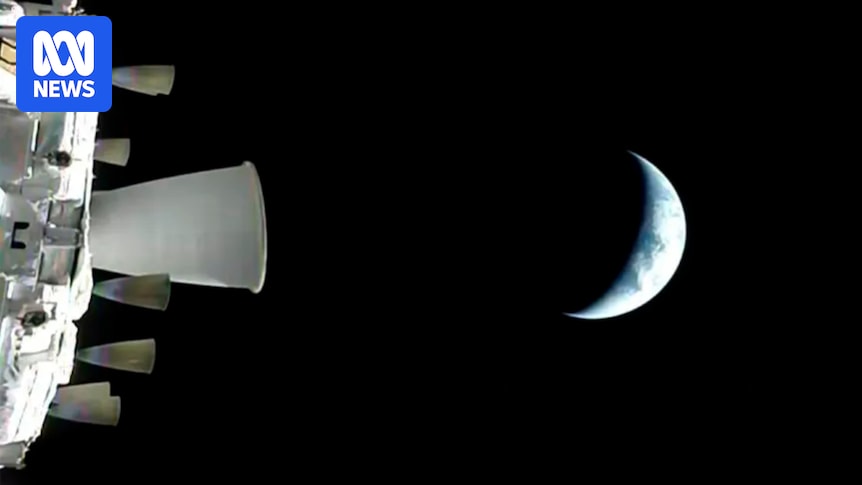
The Orion capsule carrying four astronauts on NASA’s Artemis II mission successfully fired its engines this morning, kicking the crew out of Earth’s orbit and setting them on a path towards the moon.
The so-called trans-lunar ignition commits them to reaching the farthest distance humans have ever travelled in space.
The burn lasted less than six minutes.
Loading…
The crew members are now on a path to enter the moon’s sphere of gravitational influence early next week as they prepare to beat the distance record set by Apollo 13 in 1970.
Canadian astronaut Jeremy Hansen told mission control some 10 minutes after the thruster firing:
“We are getting just a beautiful view of the dark side of the Earth lit by the moon right now. Phenomenal.”
Since launching 26 hours earlier from Florida, the astronauts spent their first day in space testing cameras, steering their Orion spacecraft and dealing with small toilet and email issues that were later fixed.
Commander Reid Wiseman saw Earth as a shrinking sunlit globe, and said taking photos from that distance made it difficult to adjust exposure settings.
As he snapped photos of his home planet with an iPhone, he told the Mission Control Center in Houston:
“It’s like walking out back at your house, trying to take a picture of the moon. That’s what it feels like right now trying to take a picture of Earth.”
To set the mood for the day’s main event, mission control woke up the crew with John Legend’s Green Light featuring Andre 3000 and a medley of NASA teams cheering them.
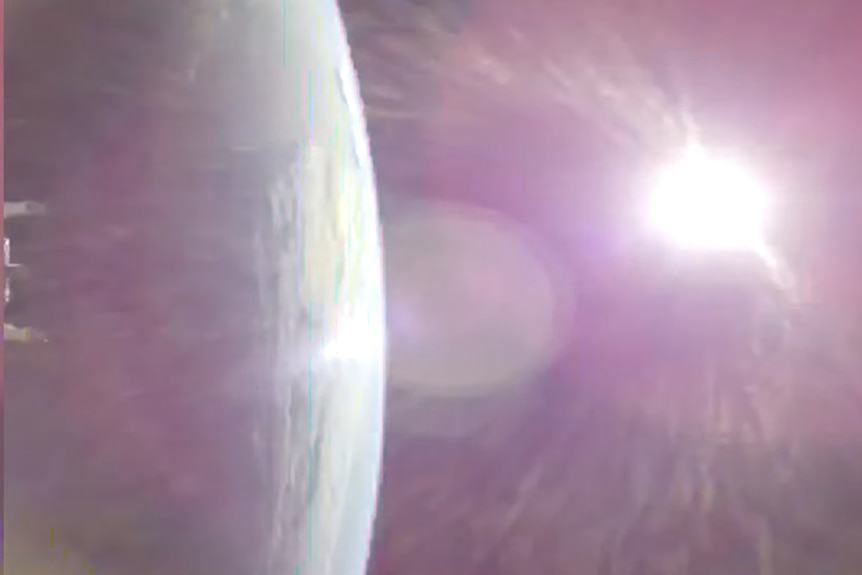
The Earth (left), as seen from NASA’s Orion spacecraft as it fired its engines heading towards the moon. (AP: NASA)
Astronauts use phones to document trip
The four astronauts of NASA’s Artemis II mission, which launched from Florida on Wednesday local time, have a few different devices on board to take photos of space from inside their Orion capsule throughout the flight.
They include a small GoPro action camera and iPhones, as well as professional Nikon cameras that have been used by NASA astronauts on the International Space Station for years.
The decision to equip the crew with iPhones was made under NASA administrator Jared Isaacman, a billionaire astronaut who flew on two private SpaceX Dragon missions and used the devices during his own flights, NASA officials have said.
On day six, the astronauts are expected to reach roughly 252,000 miles (406,000 kilometres) from Earth, the most distant point ever flown by humans, when the planet will appear no larger than a basketball beyond the moon’s shadowed far side.
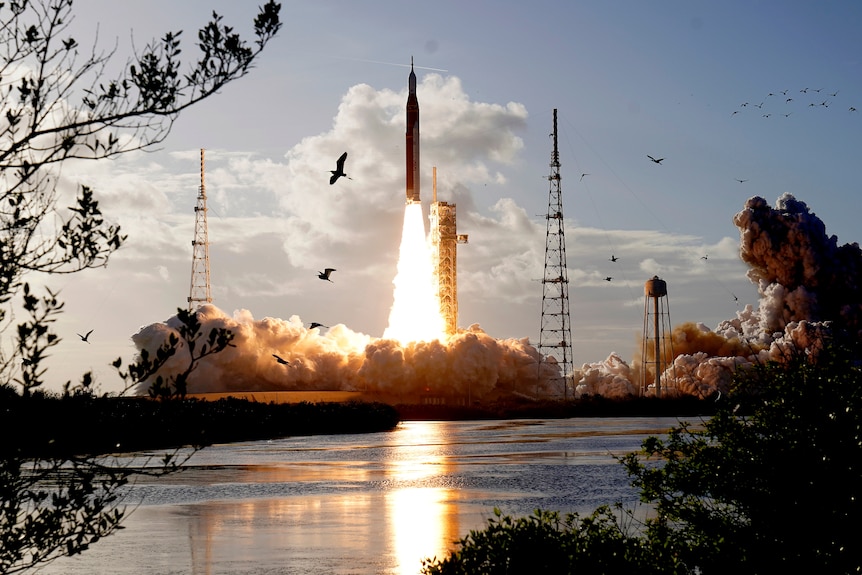
NASA’s Artemis II moon rocket lifts off from the Kennedy Space Center. (AP: Chris O’Meara)
Commander Wiseman faced a minor tech issue when his initial attempts to use Microsoft Outlook to check emails failed.
“I also see that I have two Microsoft Outlooks and neither one of those are working,” he could be heard saying in the spacecraft.
“If you want to remote in and check the Optimus and those two Outlooks that would be awesome.”
Mission control said the issue would be fixed quickly, and patched the problem shortly after it was reported.
Relief for astronauts as toilet fixed
Not long after the successful launch, astronaut Christina Koch alerted mission control in Houston to a red blinking light signalling a problem with Orion’s toilet, housed in a small compartment within the crew cabin, itself only slightly larger than a mini-van’s interior.
Mission engineers implemented a fix after a proximity operations test, NASA said.
Mission control guided the astronauts through some plumbing tricks and they finally got it going, but not before having to resort to using contingency urine storage bags.
Controllers also managed to bump up the cabin temperature.
It was so cold earlier in the flight that the astronauts had to dig into their suitcases for long-sleeved clothes.
Wires