
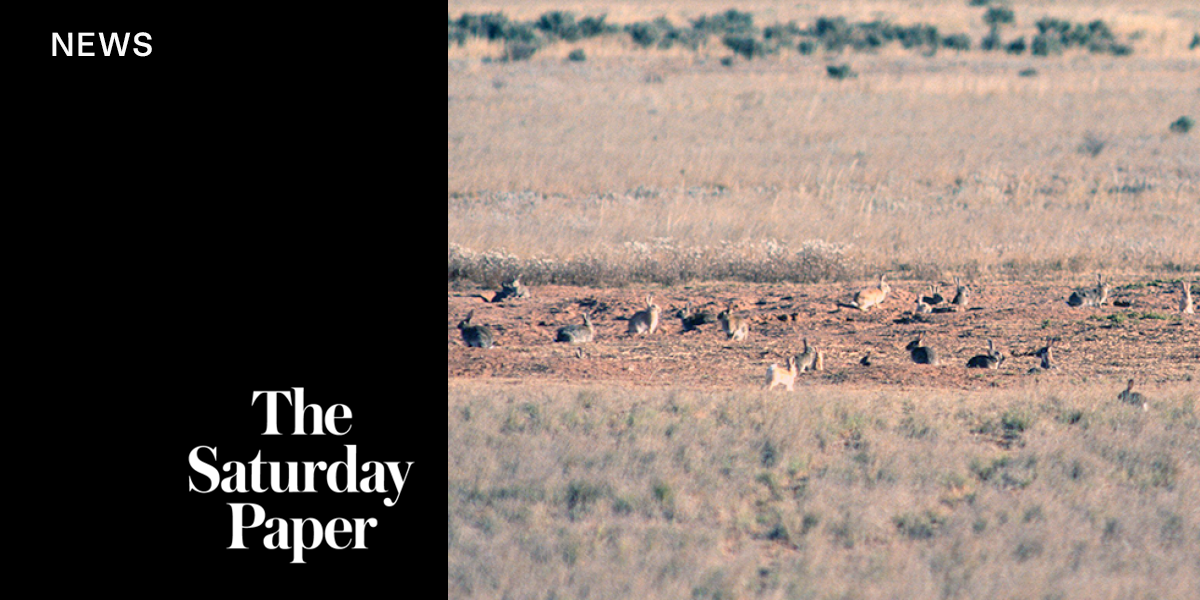
Vinny O’Loughlin goes out rabbit shooting at night, but he could just as easily do it during the day from his front door in the small South Australian town of Willalooka. “We’ve got half-a-dozen rabbits in our front yard in the morning when we get out of bed,” he says.
At night “you can come up over a rise and it is nothing to see 100 rabbits within the next 50 metres”.
In Melbourne’s outer municipality of Casey, a local school had to relocate their athletics carnival because the oval was riddled with rabbit warrens, and the market gardeners of Cranbourne are in despair seeing crop after crop of seedlings obliterated. “I was elected in November 2024 and [the rabbit problem] was the No. 1 issue that people spoke to me about before the election,” says Casey councillor and deputy mayor Michelle Crowther.
In Junee, southern New South Wales, not even the dead can rest in peace, as rabbits tunnel around and under graves, forcing the local council to close the cemetery to deal with the problem.
From the Western Australian wheatbelt to southern Queensland, rabbits are causing headaches for local councils and havoc for landowners and farmers. The arsenal of biological control weapons that for decades has kept rabbit numbers in check is dangerously depleted, as a lack of funding slows the research and development needed to keep pace with rabbit reproduction.
“It’s not possible to eat our way or shoot our way … or bait our way out of this problem, and that’s because rabbits breed like rabbits,” says Jack Gough, chief executive of the Invasive Species Council, a national non-government organisation campaigning for action on invasive species. “You need to be getting well over 80 per cent of the rabbits in an area every year … and that’s very difficult to achieve with conventional methods of control.”
Older Australians might recall the worst days of rabbit plagues, when billions swarmed the landscape, gnawing any plant life – native or introduced – into the dirt.
The release of the South American myxoma virus in the 1950s reduced rabbit numbers by more than 90 per cent. Then in 1996, a new virus – rabbit haemorrhagic disease virus, or calicivirus – was released, and killed as many as 98 per cent of wild rabbits in some parts of Australia. In both cases, however, rabbits gradually developed resistance. Those original viruses, and the engineered or imported variants developed and released since then, are still out there in the wild, but their mortality rates are now as low as 50 per cent.
“We have previously observed that the effectiveness of rabbit biocontrols start to wane after approximately 10 to 15 years,” says Dr Tanja Strive, lead rabbit biocontrol research scientist at CSIRO.
“Given the exotic RHDV2 [an exotic variant of calicivirus] arrived in Australia around 2014, we are entering the point in the cycle where we may see increases in rabbit numbers again,” she says.
After the initial dramatic success of myxomatosis, it soon became clear the war against rabbits would be a long one, needing sustained and secure investment in research to maintain a pipeline of new strains and varieties of biological control.
That research effort began in earnest through the Invasive Animals Cooperative Research Centre in 2007 and continued through the Centre for Invasive Species Solutions – a collaboration of state, territory and federal governments, CSIRO and Meat and Livestock Australia.
Then in 2022, federal funding for the national Rabbit Biocontrol Pipeline Strategy that began in 2007 came to an end, and the Albanese government has yet to recommit funds to the initiative.
“Mother Nature is very good at exponential growth. It can feel like there’s almost none there and then, overnight, suddenly you’re like, why are there rabbits everywhere?”
Craig Magnussen, chair of Rabbit-Free Australia – a non-profit working towards the eradication of wild rabbits – says efforts in the past have been so successful that rabbits have become an “out of sight, out of mind” problem. “They’ve fallen down a priority list. We’ve found ourselves in a situation where we don’t have assured program funding for research into new biocontrols,” he says.
Developing, testing, getting approval for and deploying a new biological control agent is a long-term effort. Tanja Strive says while CSIRO is at the stage of identifying and selecting new virus variants, it can take eight to 10 years for those variants to go through the extensive testing and regulatory processes required to release them safely and effectively.
Her own research on genetic biocontrols, or gene drives, could also take decades to deliver field-ready solutions, “which means there is a need for further virus releases until this technology is possibly ready for deployment in rabbits in the longer term”, she says.
A spokesperson for the federal Department of Agriculture, Fisheries and Forestry says the department currently spends $1.2 million on wild rabbit control, which includes just over $1 million in funding for CSIRO research into rabbit biocontrol and to monitor existing biocontrol agents.
Jack Gough argues that’s not nearly enough. The first five years of the multi-pronged, long-term strategy for rabbit biocontrol that was endorsed by the federal government’s own Environment and Invasives Committee in 2024 would cost about $15 million.
The $1 million the federal government currently spends on rabbit biocontrol is also due to lapse in June, and the Invasive Species Council is concerned the federal government has not given guarantees that even that funding will be renewed.
“There is a proposal on the table that needs funding,” says Gough. “Someone needs to fund this as a national priority, because every day we wait is a day rabbits are breeding up, and is a day we’re delaying when we’ve got that next tool in the toolbox.”
There’s also a lack of spending on national surveys that would give a clearer picture of rabbit numbers. “Other than citizen science and people using RabbitScan – which is a free desktop tool or app on your smartphone to map rabbits – we have no national data,” says Heidi Kleinert, the national feral rabbit management coordinator at the Centre for Invasive Species Solutions, whose position is also federally funded.
“That’s really concerning, because if you don’t know how big the problem is, if you don’t measure it, you can’t tackle it.”
The lack of highly effective biocontrol measures also puts the pressure on local government, landowners, farmers and even households to deal with the rabbit problem at their own expense.
For farmers, that means large-scale measures such as baiting, trapping and manually ripping up rabbit warrens. “Warren-ripping is great, and it’s worked terrifically well out here,” says David Lord, a wool producer in Broken Hill. He adds, however, that “the cost of ripping a hectare of land for rabbits was about the same price as purchasing new land”.
Vinny O’Loughlin does warren-ripping in South Australia as a contractor. He says farmers are doing the hard work to eradicate rabbits from their own land, only to have them repopulate from nearby council land. “We’ve got dirt roads down here – council roads – where the rabbits have undermined the roads, so that the roads have collapsed in along the hole,” he says.
Rabbits are also invading urban and peri-urban areas. “We don’t have a great handle on the science behind that increase in their presence as a peri-urban pest,” says Rabbit-Free Australia’s Magnussen, adding that “it’s a really challenging environment to try and undertake best practice control”. Baits can’t be used because there’s a risk pets will eat them; ripping isn’t practical for a sports field or backyard; and shooting is out of the question.
Not only are biological controls the best option for urban areas, they can also eradicate rabbits from sensitive environmental areas where conventional control methods aren’t practical or ideal.
Michelle Crowther’s municipality of Casey includes the Royal Botanic Gardens Cranbourne and the Dandenong Ranges. “We have the southern brown bandicoot here, and rabbits are competing for habitat and food,” she says. “It impacts so many things that you don’t think of.”
The latest estimates from 2025 put the national rabbit population near 200 million, but a lot can happen in a year. “In perfect breeding conditions, they can breed every 28 days,” Heidi Kleinert says. “That means that if you had two rabbits, you’d have 184 rabbits in 18 months’ time.”
The problem with invasive species, Jack Gough says, is that no one cares until it’s too late. “Mother Nature is very good at exponential growth,” he says. “It can feel like there’s almost none there and then, overnight, suddenly you’re like, why are there rabbits everywhere? That’s the nature of them.”
This article was first published in the print edition of The Saturday Paper on
April 4, 2026 as “Rabbit redux”.
For almost a decade, The Saturday Paper has published Australia’s leading writers and thinkers.
We have pursued stories that are ignored elsewhere, covering them with sensitivity and depth.
We have done this on refugee policy, on government integrity, on robo-debt, on aged care,
on climate change, on the pandemic.
All our journalism is fiercely independent. It relies on the support of readers.
By subscribing to The Saturday Paper, you are ensuring that we can continue to produce essential,
issue-defining coverage, to dig out stories that take time, to doggedly hold to account
politicians and the political class.
There are very few titles that have the freedom and the space to produce journalism like this.
In a country with a concentration of media ownership unlike anything else in the world,
it is vitally important. Your subscription helps make it possible.
Send this article to a friend for free.
Share this subscriber exclusive article with a friend or family member using share credits.

Used 1 of … credits
use share credits to share this article with friend or family.
You’ve shared all of your credits for this month. They will refresh on May 1. If you would like to share more, you can buy a gift subscription for a friend.
SHARE WITH A FRIEND
? CREDITS REMAIN
SHARE WITH A SUBSCRIBER
UNLIMITED
Loading…