
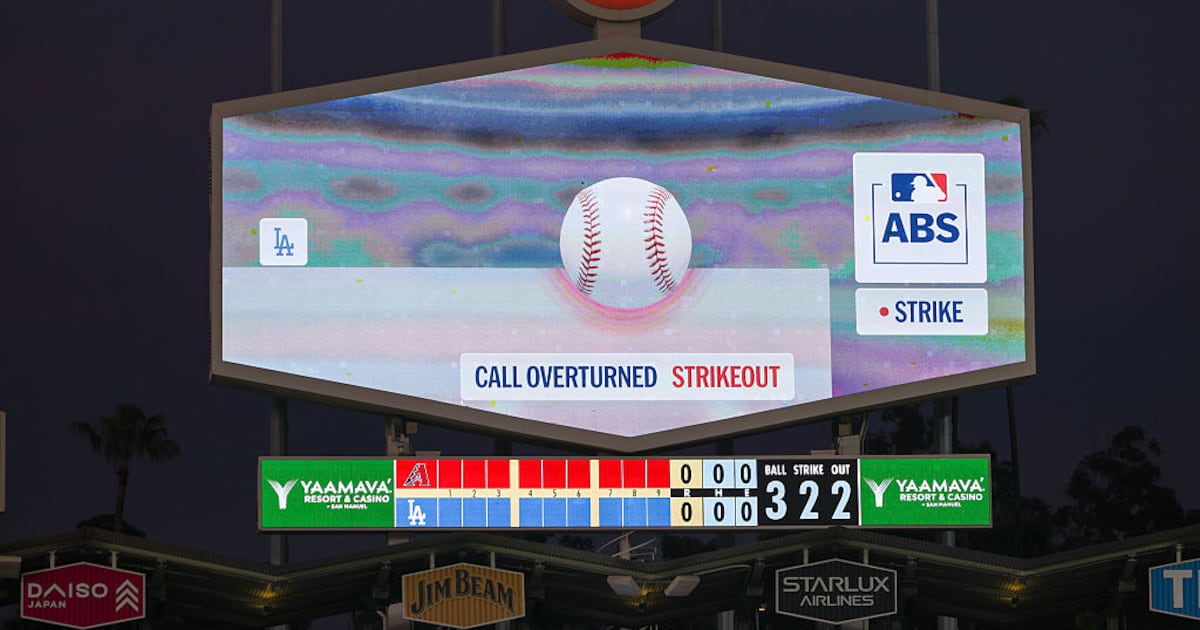
MLB’s first week with the ABS challenge system has been a “learning process that’s felt almost experimental,” according to Chad Jennings of THE ATHLETIC. The D-backs challenged only seven pitches in the first week while the Twins challenged 26. The Guardians were 2-for-12 in their challenges, while the Orioles were 12-for-14. Although every team spent time in spring training discussing ABS strategy, it is “still a work in progress in most dugouts.” Some teams are “being aggressive” while others “are holding back.” The Padres keep a challenge play sheet in the dugout “similar to a play sheet an NFL coach might use when deciding whether to go for 2 — that outlines situations in which to be most or least aggressive in challenging borderline pitches.” The challenge system has “done its job in its first week.” Calls have been corrected, games have been affected, and “new strategies have been put into play.” There is “more to do and more to come, but when all’s said and done, there’s less to complain about” (THE ATHLETIC, 4/3).
PLAYERS’ LOVE: In Toronto, Gregor Chisholm writes one week into the ABS system in place, it has “accomplished what it set out to do.” Obvious miscalls are being overturned and there has been “very little impact on the pace of play.” The vast majority of MLBers “appear to be in favour of the new rules, even while some believe a few minor tweaks would make it better.” The challenge system has also “injected additional excitement into the in-stadium experience.” No matter the score, fans “get into it whenever a call goes to ABS.” The only “real controversies have been about the time permitted to make each challenge.” Players are supposed to make their decision immediately after the pitch, which MLB has described as “roughly two seconds,” which is “a bit vague” (TORONTO STAR, 4/3).
NUMBERS TO IT: In D.C., Liam Griffin wrote the setup has “offered a learning curve for the players on the field.” According to MLB StatCast, players have succeeded on 55% of challenges through the first week of the season. Catchers have been “more successful than pitchers or batters,” converting 59% of their calls, compared to 52% for batters and 42% for pitchers. The strategic opportunities are a “gold mine for MLB fans and coaches who have embraced analytics over the past two decades.” When to use a challenge “is an evolving art for managers to teach their players” (WASHINGTON TIMES, 4/2).
UMPIRES PUT IN THE MIDDLE: TSN.ca’s Steve Phillips noted the only ones “who don’t love the new system are the umpires.” They are “getting exposed publicly when they make mistakes.” It is “embarrassing for the umps and leads to even more heckling.” The residual benefit of the ABS system is that it “will hold umpires accountable for the quality of their work.” The evaluations of the umpires have “never been made public, but now their work is front and centre.” There is “no spinning the number of calls that get overturned by each umpire” (TSN.ca, 4/1). THE VERGE’s Terrence O’Brien noted during Saturday’s game between the Red Sox and the Reds, 3B Eugenio Suarez challenged umpire C.B. Bucknor on back-to-back strike three calls and had each successfully overturned. It was a “bad night” for Bucknor overall. There were eight ABS challenges over the course of the game, and six were successful. Three pitches he called strikes missed by 2.4 inches or more – one was a full 2.7 inches out of the zone. There were several umpires whose first brushes with ABS “went worse.” Chad Whitson had all seven challenges in his game between the Yankees and the Giants on March 28 overturned (THE VERGE, 4/2).
NEGATIVE REACTIONS: In Cincinnati, Jason Williams wrote he does not like ABS as it “promotes showing up the umpire, even embarrassing him.” But embarrassing Bucknor and all of his colleagues via ABS “is setting a bad precedent.” The fallout for umpires from ABS “isn’t going to encourage people to sign up to be an ump” (CINCINNATI ENQUIRER, 4/2). In Massachusetts, Matt Vautour writes eventually they are “going to get to using ABS on every pitch.” So how about “skipping to the end right now.” This “can’t be the final product.” The concept that the “most accurate information is readily available, but is only used a limited number of times when asked for is illogical.” But if MLB wants to use the technology, then use it all the way “on every pitch” (MASSLIVE.com, 4/3).