
This week, Artemis II took off from the launch pad at the Kennedy Space Center in Florida, making its four astronauts the first people to have gone beyond low-Earth orbit in more than half a century.
The crew’s new home for the next 10 days — which is around the size of two large SUVs — has plenty of updated features from the Apollo missions of the 1960s and 70s.
Loading…
But there are some things in spaceflight that remain exactly the same, even 50 years later.
We unpack the similarities and differences between these two iconic generations of lunar exploration.
Rocket design: some things never change
While the designs of rockets have changed over the last half a century, according to Adam Gilmour, the CEO of Gilmour Space Technologies, the underlying technology has remained surprisingly similar.
“The core concepts of rockets haven’t really changed in the last 70 years,” he said.
“No-one’s come up with a warp-drive or an anti-gravity drive or anything like that.”
Saturn V is one of NASA’s most famous rockets. It was built and used for all of the Apollo missions and was a towering 111 metres tall.
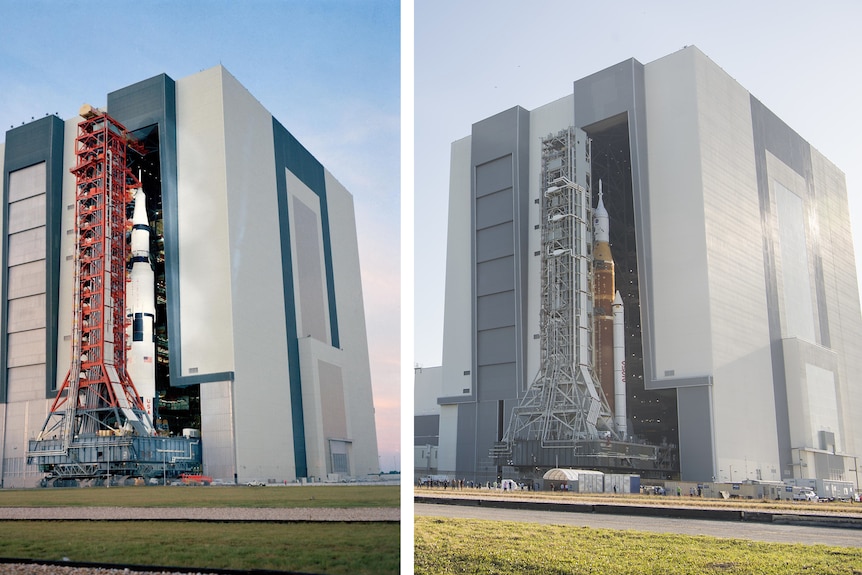
The Vehicle Assembly Building has barely changed since the Saturn V rocket for Apollo 14 (left) to Artemis I. (Supplied: NASA/Aubrey Gemignani)
The Saturn V rocket used just one large main engine to launch, but later during the Space Shuttle era NASA switched to using three rocket engines.
The Artemis missions are using a very similar design, with the Space Launch System (SLS) using one main rocket plus two booster rockets, one on each side of the stack.
In fact, Artemis II is using components that have already travelled to space on multiple space shuttle missions — including casings on the booster rockets and the four engines at the bottom of the main rocket, which are repurposed space shuttle engines.
The similarities also extend to the fuel.
“An extensive amount of R&D was done in the 50s, 60s, and 70s to look at any and every type of fuel you could possibly combine, to see which one worked the best,” Mr Gilmour said.
“The reality is the fuel that has the best performance is hydrogen and oxygen. They’re very simple products. You don’t get any better from having some whiz-bang chemical formula.”
Computing power
One of the most important parts of the original Apollo missions was the spacecraft’s digital computer and the meticulously hand-coded software that made the flights possible.
This machine, known as the Apollo Guidance Computer, was able to take on a surprising amount of the piloting of the spacecraft — including guidance, navigation and control.
“They went all the way to the Moon and back with a computer that had a hundredth or a thousandth of the capability of your phone,” Mr Gilmour said.
The computer had 74 kilobytes of memory and the equivalent of about 4Kb of RAM.
“They didn’t have the computing power that we have now, but they still had workarounds that did the job.”
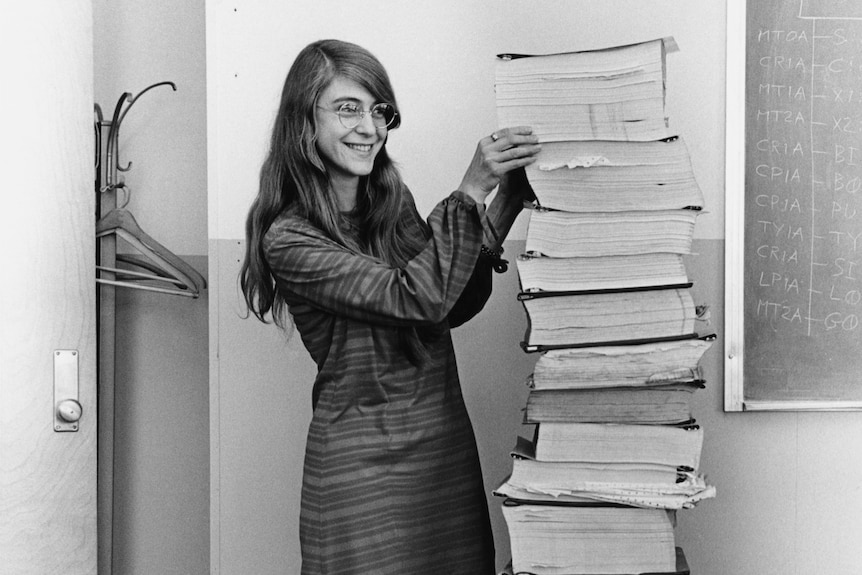
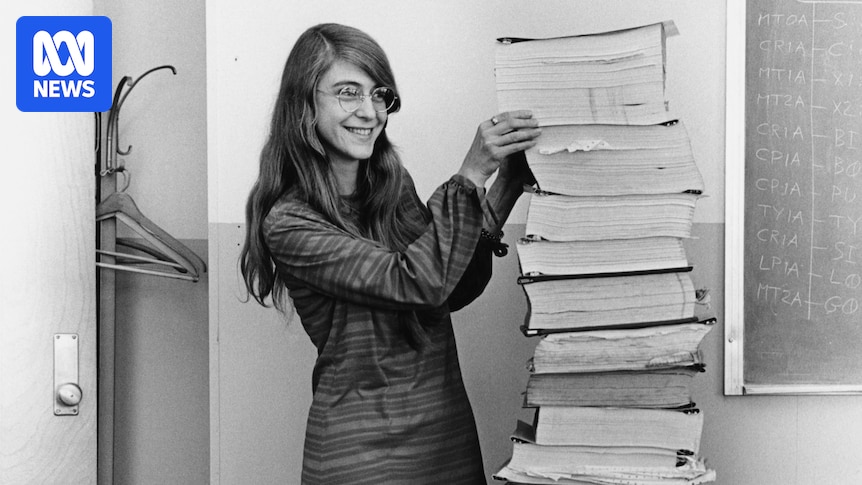
Margaret Hamilton stands next to a pile of flight software she led the development of as part of the Apollo Project. (Wikimedia Commons: Draper Laboratory, Margaret Hamilton, PDM)
While the computer was extremely important for the mission — it had the occasional problem.
During the Apollo 8 mission, astronaut Jim Lovell entered incorrect code into the guidance computer during the journey back to Earth. He had to use the onboard sextant to determine the spacecraft’s location and manually re-enter it into the system.
Although this shouldn’t be an issue today, the astronauts on board have still been suffering some technical issues with less essential digital technologies, like emails and cameras.
Interestingly, piloting on the Artemis I mission was done mostly autonomously, with some guidance from flight controllers on Earth; the only crew on that flight were mannequins.
Since the Apollo days, NASA has had plenty of experience with these types of uncrewed missions, with things like the Mars rovers and missions like Cassini and Juno, which have visited the Solar System’s outer planets.
Pilots, though, are vital on crewed missions in case something goes wrong.
For the Artemis mission, the “brain” of Orion is called the Command and Data Handling Console.
Its job is mostly to carry information between the computers on the ground and those on the spacecraft, as well as collecting measurements and data.
Artemis’s computer systems can process data 20,000 times faster than Apollo’s and pack 128,000 times more memory.
The real nerve centre of the whole operation, however, remains the same: the Christopher C Kraft Jr Mission Control Center — better known by its radio call sign, Houston — has been in the same building at the Johnson Space Center in Texas since 1965.
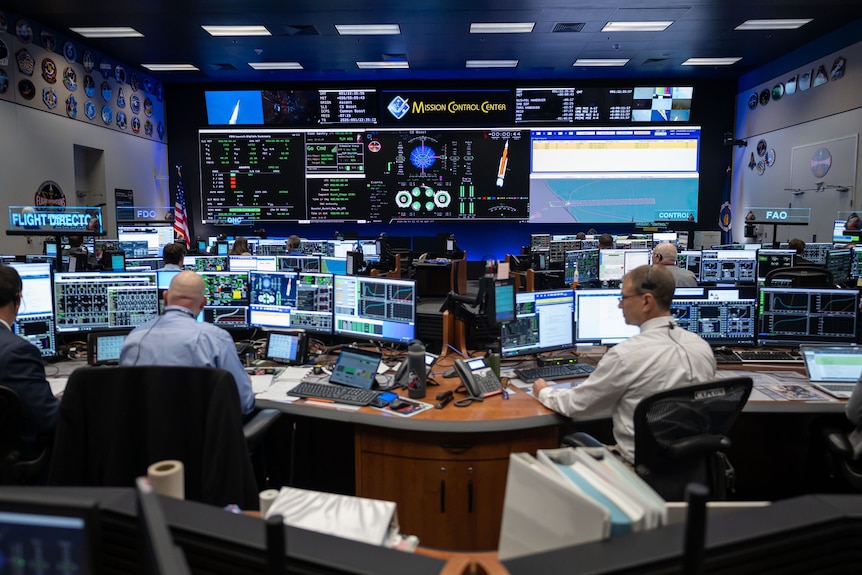
Mission control for NASA lunar spaceflight remains where it always was — at Johnson Space Center in Houston, Texas. (Supplied: NASA JSC)
A giant leap for toilets
The toilet situation during the Apollo era was so dire as to be non-existent.
Astronauts instead had to roll on a cuff and urinate into “urine collection bags”. Keep in mind that all of the Apollo astronauts were men, so they had the anatomical apparatus required for the cuff to work.
Faeces, on the other hand, went into plastic bags — usually. There was an infamous event on day six of the Apollo 10 mission, when mission commander Tom Stafford noticed something out of the ordinary.
“Give me a napkin quick,” he was recorded saying. “There’s a turd floating through the air.”
The first space toilet was located on Russia’s Soyuz spacecraft all the way back in 1967, but it was said to be extremely uncomfortable and rarely used on those early journeys.
Luckily, toilets have grown much more sophisticated since then, culminating in the “Universal Waste Management System” aboard the Orion spacecraft.
This is the same design as the toilet on the International Space Station and looks a lot like a high-tech camp toilet.
Without gravity, the toilet needs to suck away waste like urine, and the design has parts for both male and female anatomy.
However, even the most high-tech toilets can have issues — with the Artemis II crew experiencing a worrying toilet issue after launch, which thankfully has now been resolved.
If the toilet does stop working? They’ll be back to the Apollo way of doing things.
Getting back to Earth
Getting home has always been one of the most physically taxing parts of a space mission.
The Orion spacecraft has a large heat shield on the bottom to protect it from the heat and friction of the atmosphere as it plummets back towards Earth.
It is made from a material called Avcoat and is a re-engineered version of the shield that was used in the original Apollo missions.
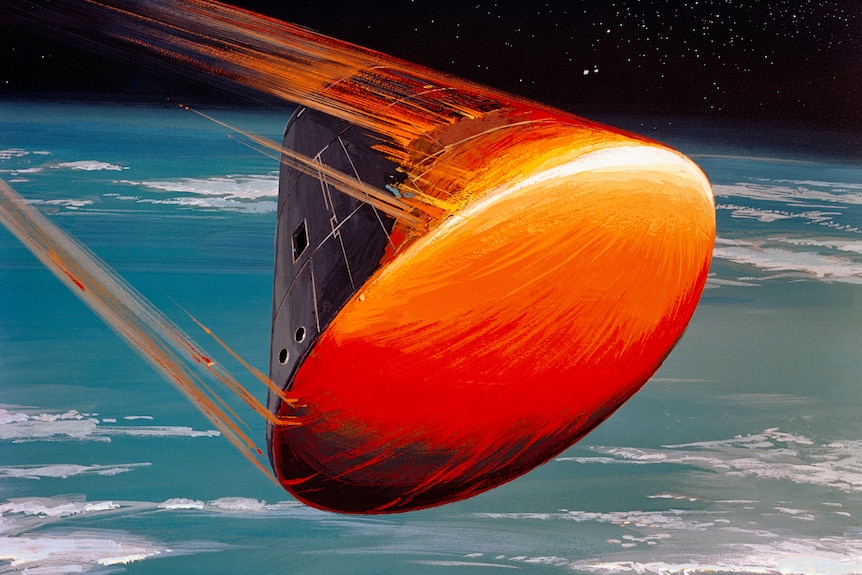
The Apollo Command Module used a similar material for the heat shield, but in one large block. (Supplied: NASA)
However, some experts have suggested that the slight changes in the new version, as well as the differences in the way the the coating has been applied, have the potential to cause serious issues on re-entry.
The Apollo spacecraft all re-entered Earth’s atmosphere at approximately 35,000 kilometres per hour: 10 times faster than a bullet.
At the end of the Artemis II mission, the Orion spacecraft will be returning to Earth at an even faster speed: approximately 40,000km/h.
This will be the fastest re-entry ever attempted for a craft with astronauts on board.
In an attempt to avoid any issues with the heat shield, the “skip-entry” manoeuvre used during Artemis I has been replaced with a more direct re-entry pathway, at a steeper angle.
At the very least, once the Artemis II astronauts are back on the ground, they won’t have to quarantine for 21 days due to the worry of Moon contagions.
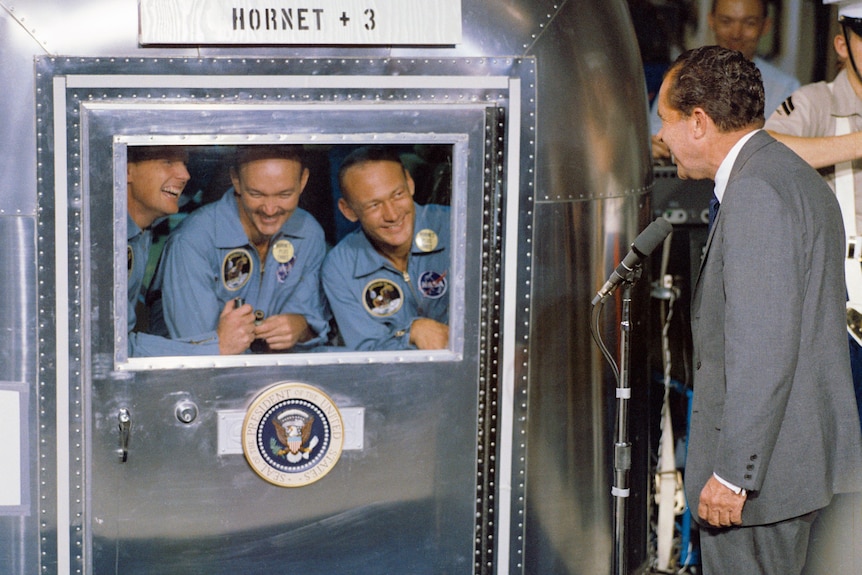
The Apollo 11 astronauts were welcomed back to Earth by President Nixon while still in quarantine, aboard the USS Hornet. (Supplied: NASA)
Back in 1969, the astronauts from the first lunar landing — Apollo 11 — had to spend a week crammed into a converted Airstream caravan, which was transported to NASA’s “Lunar Receiving Laboratory” where the crew spent the rest of their quarantine period in a specially-made quarantine complex.
All of the astronauts found the conditions oppressive. Michael Collins was recorded saying: “I want out.”
The reason for the extra security was the potential risk of lunar pathogens. During the weeks of quarantine, the scientists exposed plant and animal samples to the air the astronauts were breathing.
Better safe than sorry!
Stay up-to-date on the Artemis II mission with the podcast Science Friction: Artemis Explained from ABC Radio National.