
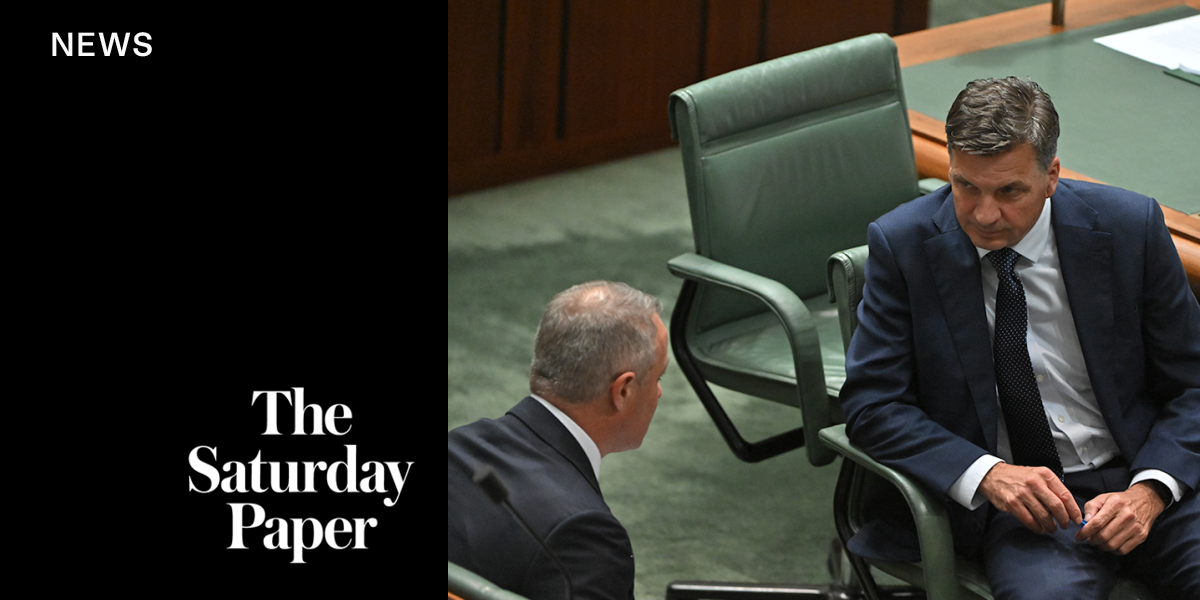
The first worry is the PowerPoint presentation. Angus Taylor has begun showing it to colleagues, using complex econometric modelling to explain how he intends to confront Labor. According to senior Liberals, the slideshow is proof Taylor is still more a management consultant than a politician.
The graphs are supposed to represent Taylor’s preparation for his first budget reply speech, although to colleagues they represent confusion and a man without a capacity to communicate a clear political narrative.
“Political acumen is not something Angus is overly endowed with,” one Liberal MP tells The Saturday Paper.
“What he’s very good at is pulling apart businesses and rebuilding them, and I worry that he’s leaning too hard into that and basically overcomplicating things … He has little instinct for what lights up voters and how to get their attention.”
With opinion polls showing support for the Liberals going further backwards, the pressure on Taylor to find a coherent political message is becoming more pressing. If the party is to have any hope, he needs to re-establish the economic credentials lost during the previous parliament.
The latest Australian Financial Review/RedBridge Group/Accent Research poll shows the Coalition’s primary vote has fallen to a record low of 17 per cent, down two percentage points since February, when Taylor toppled Sussan Ley to become Liberal leader. One Nation has climbed to 29 per cent, just three points behind Labor’s 32 per cent primary vote.
On Taylor’s left flank, Liberal moderates are grumbling that he is not making use of his shadow treasurer, Tim Wilson. The Victorian MP’s lack of presence in Question Time over the past four parliamentary sitting weeks has not gone unnoticed.
“We haven’t bothered to have a question from the shadow treasurer in the last Question Time before the budget,” Prime Minister Anthony Albanese told parliament on Wednesday. “It shows that their focus is not on talking Australia up, just talking things down.”
Wilson’s colleagues expressed concern this week that Taylor’s experience in economic portfolios – he was shadow treasurer for three years under Peter Dutton in the last term – has made him reluctant to let go.
“Tim knows how to talk to people,” one Liberal moderate tells The Saturday Paper.
“He gets retail politics in a way that few people on our side understand. The problem is he is being kept in the background when he should be out front.
“It’s not obvious that Tim has a big say in our Question Time tactics. Taylor doesn’t seem to consult him much either. And that’s not a good sign when [the government is] giving us so much to aim at,” the MP adds.
“The economic case against the government writes itself, but we’re not prosecuting it, not on inflation, not on interest rates, not on the flatlining economy, and whenever we do stray into those areas, they’re ready for us. Worse, they’re not just ready for us, they’re laughing at us.”
By way of contrast, Albanese and Treasurer Jim Chalmers appear to have a clearer sense of how dangerous Wilson can be. The government has methodically catalogued the policy positions Wilson has taken over the past decade – which may in part explain why Taylor is not keen to lean on him.
“Tim knows how to talk to people. He gets retail politics in a way that few people on our side understand. The problem is he is being kept in the background … Taylor doesn’t seem to consult him much either.”
Topping the list of things that Labor won’t let Wilson forget is a withering attack on the tax system he delivered to parliament in 2018, which the government is using to buttress its own arguments for tax reform policy proposals being floated ahead of the budget.
“Today it’s time to be honest: the tax system is screwing over young Australians. Instead, it favours well-off, established interests against those trying to get ahead,” Wilson told parliament at the time. “In short: if you work hard to get ahead, you get hit hard; if you live off assets, you don’t.”
With Albanese and Chalmers both flagging possible changes to the capital gains tax discount in the budget, a move aimed at giving younger Australians a better chance of getting into the housing market, Wilson’s 2018 words will make it harder for the new shadow treasurer to oppose a budget measure designed to address that same imbalance.
Chalmers has also made hay with Wilson’s record on other issues, such as superannuation.
In a 2019 appearance on The Bolt Report, Wilson suggested that compulsory superannuation may not be serving the interests of low- and middle-income earners, arguing some workers might be better off taking the money as income in order to make it easier to pay down debt such as a mortgage.
“We’re pouring more and more money into superannuation each year. Analysis by the Grattan Institute, of all people, has highlighted that most of the benefit is going to the rich,” Wilson told Andrew Bolt. “Some of us are saying for low-income earners or even for medium-income earners in particular it might make more sense that they have at least the choice to be able to take that money instead of taking it as more super – putting it towards their wages just to be able to do things like pay down debt, particularly on a house.”
Whether or not Wilson’s argument has merit, it blunts his ability to argue against Labor’s recent changes to the way superannuation is taxed, which introduced a higher concessional rate of tax for about 90,000 people with the biggest superannuation balances.
Then there is Medicare, Labor’s policy talisman, which has been a central pillar of its election strategy for decades.
In 2011, five years before he entered parliament, Wilson wrote a piece for online news and opinion website The Punch, arguing that instead of continuing to provide universal health financing the government should “restructure our health system toward a bottom-up individual health account system”.
“Put simply every Australian would have an individual health account that they contribute to on a periodic basis from their income, like superannuation. That savings account would then be used to pay for healthcare services as required throughout their lifetime.”
Despite the fact Wilson has never repeated the proposal, it hasn’t stopped Chalmers and other Labor ministers from arguing that Wilson’s real agenda is to privatise Medicare.
Wilson’s supporters reject the suggestion he is being sidelined. Those close to him argue that the fuel crisis has simply consumed the political oxygen and asking questions in parliament about the budget or the government’s handling of the economy would have been a waste of good ammunition.
Wilson’s view, which he has shared with those close to him, is that the intensity of Labor’s focus on him is a confirmation of his effectiveness.
One anecdote Wilson regards as a compliment, and which he has repeated to colleagues, is of a recent conversation with a Labor MP who told him: “We’ll do Taylor slowly – you have to be stopped early or you’ll be unstoppable.”
Those who know Wilson argue that his critics have tended to underestimate his style.
In 2018, in the lead-up to the 2019 election, Wilson identified Labor’s plan to tax franking credits – tax credits attached to share dividends that allow shareholders to avoid being taxed twice – as a key issue. Labor initially dismissed and mocked it but ultimately lost the 2019 election, in part because of an equity measure he had reframed as a “retirement tax”.
Wilson also takes credit for identifying housing affordability as the defining issue of the coming decade in his 2020 book, The New Social Contract: Renewing the liberal vision for Australia, helping to frame the policy response of both his Liberal colleagues and Labor.
Wilson is untroubled by Labor’s current cataloguing of his past positions. His response to the government’s attack lines is not to retreat but to redirect.
On the topic of the budget and the issue of whether he is getting enough time at the dispatch box during Question Time, Wilson’s view is that he needs to be less focused on the current news cycle than on where things will land when voters go to the polls.
“In ice hockey, if you run for the puck, by the time you get there it’s already moved,” he has told colleagues. “You have to race to where the puck will be. I’m focused on where the puck will be in two years’ time, not today.”
If there are Liberal MPs on Angus Taylor’s left worried about his perceived treatment of Wilson, there are problems on his right flank, too, largely in the form of Andrew Hastie. The former SASR officer used an appearance on the ABC’s Insiders last Sunday to deliver what amounted to a public challenge to the policy direction of the party under Taylor’s leadership.
Arguing that the Coalition’s policy approach was not working, and its primary vote was being cannibalised from both the left and the right, Hastie urged the party to adopt a posture of humility and open-mindedness.
He backed that up by expressing an openness to policy changes strongly opposed by the Liberal leadership, such as a windfall profits tax on gas exports. He refused to rule out changes to negative gearing and the capital gains tax discount and declared that in a “new era”, where the world order had collapsed, nothing should be off the table.
“No one’s going to reward us for a final last stand for neoliberal politics,” Hastie said. “I actually want to win and deliver a centre-right government for this country. And the best way to beat Labor is to start listening to people and meeting their concerns head-on rather than reactively slapping them down.”
Among Hastie’s coterie of rusted-on supporters, the response to his Insiders interview was barely concealed delight, deepening their conviction that he is better placed than Taylor to lead the party to the next election.
Inside the broader party room, however, the reaction was less enthusiastic. Many colleagues privately questioned what Hastie was trying to achieve. The appearance reinforced the perception that Hastie is not a team player, with one MP telling The Australian nobody else in the party agreed with him.
“The left want higher taxes,” they said. “That’s not our position.”
Taylor himself moved quickly to shut down the speculation. “If you whack a tax on something, you get less of it,” he said on Monday. “Right now, I want to see more crude oil … more gas … more houses. And that has to be an imperative for this budget.”
The Australian subsequently reported that Hastie was set to receive a “gentle reminder” of shadow cabinet processes after freelancing on policy. When contacted, Hastie said he had not heard from the opposition leader’s office.
Albanese needed no invitation to exploit the division.
In a sharp exchange across the table during Question Time on Tuesday, after Taylor demanded Albanese rule out a proposal to enlarge the size of parliament, Albanese turned the attack to his benefit.
“I don’t take orders from you, mate,” he said to Taylor, before pointing to Hastie and adding, “and he doesn’t take orders from you either.”
Emerging from the House of Representatives a few minutes later, Albanese encountered a group of journalists.
“I give him until Christmas,” he said of Taylor’s leadership.
This article was first published in the print edition of The Saturday Paper on
April 4, 2026 as “The Angus Taylor PowerPoint: ‘Political acumen is not his skill’”.
For almost a decade, The Saturday Paper has published Australia’s leading writers and thinkers.
We have pursued stories that are ignored elsewhere, covering them with sensitivity and depth.
We have done this on refugee policy, on government integrity, on robo-debt, on aged care,
on climate change, on the pandemic.
All our journalism is fiercely independent. It relies on the support of readers.
By subscribing to The Saturday Paper, you are ensuring that we can continue to produce essential,
issue-defining coverage, to dig out stories that take time, to doggedly hold to account
politicians and the political class.
There are very few titles that have the freedom and the space to produce journalism like this.
In a country with a concentration of media ownership unlike anything else in the world,
it is vitally important. Your subscription helps make it possible.
Send this article to a friend for free.
Share this subscriber exclusive article with a friend or family member using share credits.

Used 1 of … credits
use share credits to share this article with friend or family.
You’ve shared all of your credits for this month. They will refresh on May 1. If you would like to share more, you can buy a gift subscription for a friend.
SHARE WITH A FRIEND
? CREDITS REMAIN
SHARE WITH A SUBSCRIBER
UNLIMITED
Loading…