
Welcome to Scott Wheeler’s 2026 rankings of every NHL organization’s prospects. You can find the complete ranking and more information on the project and its criteria here, as we count down daily from No. 32 to No. 1. The series, which includes evaluations on nearly 500 prospects, runs from March 9 to April 8.
The Mammoth don’t have the quantity some of the league’s other top pools have, but they have the quality, with a top seven that stacks up with just about any pool. They have a top prospect at every position, too.
2025 prospect pool rank: No. 7 (change: +1)
Tier 1 1. Tij Iginla, C/LW/RW, 19, Kelowna (No. 6, 2024)
After playing his rookie season in a limited role with the WHL champion Seattle Thunderbirds — at times he was even scratched — Tij, the son of Jarome Iginla, was traded to Kelowna and took off with the Rockets in his draft year, regularly looking dangerous both off the rush and attacking inside the offensive zone. In his post-draft season last year, he got off to a strong start before undergoing hip surgery. This year, he returned to action and was one of the top forwards in the CHL with the Memorial Cup hosts. Since the trade to the Rockets, he has now combined for 102 goals and 206 points in 133 games across three seasons at age 17-19. In between, he had a point in every game at U18 worlds and finished the tournament with goals in the semifinal against Sweden and final against USA to end with 12 points in seven games (fifth in the tournament). He also registered eight points in seven games at the World Juniors, where he also hit a few posts, drew multiple power plays, and I thought he was the most consistent player on a line with star prospects Michael Misa and Porter Martone. He has also done it mostly as a center after many viewed him as a winger in his draft year.
He’s an excellent skater who can beat you in a straight-out race, cut past you laterally with quick weight shifts or build speed through tight crossover patterns around the offensive zone. On the puck, he’s a threatening individual creator who can create in knifing bursts and works quickly to put defenders on their heels, attacking on angles and jumps. Off it, he has great instincts for jumping into gaps in coverage to get open for his linemates. His snap shot, which has a traditional look to it and is more wrists and leverage than the curl-and-drag you commonly see now, consistently beats goalies cleanly with both its pop and how quickly it comes off. He has high-end handling with impressive hands in tight and always seems to handle his first touch at speed, even when pucks are put into his feet, and adjustability, which blends with real creativity to create an often-dynamic one-on-one player.
He’s an impressive athlete who performed well in the combine testing. He’s also a fan favorite type who gets after it on the forecheck and involves himself in the play often with some sneaky strength, though I think his defensive awareness and consistency still need to come, and his off-puck play might have been a little overrated in his draft year. Add in NHL puck skill and a dangerous and heavy wrister from mid-range, and you have a fun player and prospect. Add in the emergence of a power game that has seen him really begin to take pucks to the inside and drive the net, and suddenly you have a perimeter and interior offensive threat who has strength, speed, skill and scoring in his profile. He doesn’t always make the right play as a passer, but plays with speed and skill, can score and protects pucks well through open ice and into coverage, and has some star qualities.
He has a pretty clear top-six, scoring-skill-jump profile, with a ton of tools that have developed at an exciting rate when healthy. He’s going to score goals and make plays in the NHL.
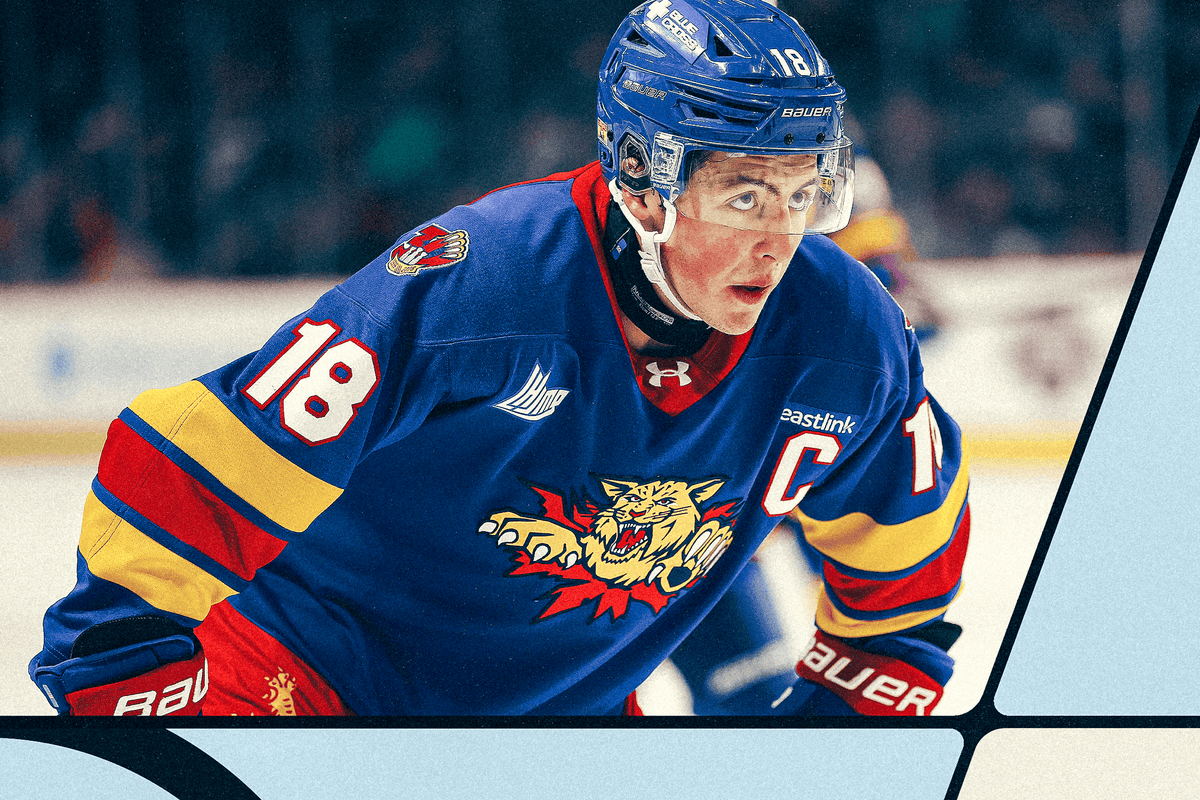
2. Caleb Desnoyers, C, 18, Moncton (No. 4, 2025)
Desnoyers was the No. 1 pick in the 2023 QMJHL Draft after a run to a silver medal at Canada’s under-18 championship and captaining Quebec at the Canada Winter Games. He was one of the top young players in the Q as a rookie two seasons ago, regularly playing 20 minutes per game as a forward for a good Wildcats team, and wore a letter for the gold medal-winning Canada White at under-17s as well as for Team Canada at the Hlinka. I thought he had a tough time as a center in a limited role at U18 worlds two springs ago despite registering five points in five games and his numbers didn’t pop out of the gate last season, but he was one of the best players in the QMJHL for six months and really elevated his game — and, importantly for scouts, his production — as the top forward on the top team in the QMJHL. That’s despite dealing with two injured wrists from November onward in his draft year. He stamped that by leading the Wildcats to a Q title as the league’s playoff MVP with 30 points in 19 playoff games as well. He wasn’t able to rise again in the Memorial Cup for them, but the wrists were really nagging him by then, and he still made two big plays in the semifinal.
This season, after a bit of a slower start again in his return from injury, Desnoyers took off with another top team in Moncton, finishing the year with 78 points in 45 games for a 1.73 points per game clip that was second-best in the league. He also registered six points in seven games at the World Juniors, where he started as the 13th forward but quickly rose to and stayed on the third line, playing well at five-on-five and making positive plays.
Desnoyers is a good-sized center with room to add muscle, and scouts love him as a projectable top-six pivot who plays a smart, detailed, well-rounded two-way game with good skill, smarts and poise. He’s competitive and has great habits. He’s committed to playing defense, supporting pucks, staying in good positions and not cheating for offense while excelling in the faceoff circle. He gets glowing reviews as a winner that people gravitate around. He’s opportunistic and gets open really well. He involves himself in play, he can carry and hold pucks or play off his linemates in give-and-gos, he has a real feel for the game offensively and he’s consistently impactful.
While he’s not a dynamic skater or individual creator, I see plenty of skill and have seen him make plenty of high-skill plays — including a Michigan goal and a ton of high-IQ, quick-hands plays in tight/in traffic — and he’s a better skater than his older brother Elliot was at the same age. If he can add a little more pace and muscle, he’s going to have a long career as an important center who contributes to winning on good teams. He has had a very comparable QMJHL career and impact to Nico Hischier and Pierre-Luc Dubois, who were both also top-five picks. He’s more Hischier than PLD, though.
Tier 23. Dmitri Simashev, LHD, 21, Tucson/Utah (No. 6, 2023)
Every team wants long defensemen who can really skate, and Simashev checks both of those boxes as a mobile 6-5 lefty. He’s a rangy, smooth-skating defenseman who played 18 KHL games in his draft year, was great in the MHL playoffs and played full-time in the KHL in 2023-24 and 2024-25 to good results for a defenseman his age. Though his numbers didn’t take a step last year, they have in his first year in North America, where he has played to a point per game in the AHL — an important step for a player who has always played to good defensive results and featured on the penalty kill. Though his results in the NHL have been just OK early on, he’s only 21 and has already defended at a strong level in two top pro leagues. He’s also comfortable playing both sides.
It’s hard not to like the way he can play in transition, whether defending the rush with his feet and reach, skating back to retrieve pucks or skating through neutral ice/out of the defensive zone in possession. He has shown improved comfort and smarts in control, even if his play with the puck and offensive game are never going to be his calling card at the NHL level. He gaps well and can take away a carrier’s space. He has a good stick and defends more with his length and feet than body. I’m still not as high on him as some others are and didn’t feel he was a No. 6 pick in 2023, but he has most of the more important makings of a potential top-four defenseman who can play minutes and drive results with his defensive play, length and skating.
4. Michael Hrabal, G, 21, UMass/Tucson (No. 38, 2023)
Early on three seasons ago, when Hrabal arrived from Czechia’s junior league and took the USHL by storm, putting up gaudy numbers through September and into early November, there was first-round buzz about him. Here was this massive 6-6/7 goalie with an impressive early track record. Then he hit a rut into the new year and lost his job for a spell, only to regain form in March and April, both down the stretch with the Lancers and then as one of the top three players on Czechia at U18 worlds, where I thought he was mostly excellent. Two seasons ago, as a freshman at UMass, he was mostly good as well and finished with a .912 save percentage, although his first World Juniors was more of a mixed bag: he was great in Czechia’s upset win over Canada but also had some really rough moments, giving up some bad goals. Last season, after a summer of good training, Hrabal began to realize all of his potential, playing to a .924 save percentage as a sophomore at UMass and leading the Czechs to another bronze medal at his second World Juniors with a better tournament that included a huge performance in the bronze medal game (and its IIHF record-long 14-round shootout). He built on that in his junior year this season, putting up a .937 save percentage as one of the best players in college hockey and turning pro.
The size jumps out at you right away, but there are layers, good and bad, to the rest of his game. Hrabal used to get down into his butterfly a little slowly, opening up his five-hole for shooters (a common problem for bigger goalies), but he has made progress on it over the last two years and really covers the bottom of the net well. Once he’s on his knees, he actually scrambles well for a goalie as tall as he is. His hands (both glove and blocker) need some work up high, and he has an odd tendency to try to catch low shots instead of making a pad save; I suspect it’s because he doesn’t trust his rebound control on quick shots. I’ve seen him look completely in command, fill the net and take everything away from shooters. I’ve also seen him get beaten cleanly and look like he’s not tracking pucks. I would like to see him work on playing the puck as well.
The upside is hard to ignore, though. He has some real natural ability and a game-stealing quality when he’s dialed in, which has happened more and more. When he’s sharp on his lines, square to shooters and on his toes, he’s tough to beat. Fewer shots are sneaking through his body, and his competitiveness and size are a good combination. He has also developed more and more power to his game, with more that will come as he continues to fill out his frame; though he’s now listed at around 216 pounds, he still looks a little wiry. He moves well for his size and can really take away a shooter’s options when his angles are on point.
He has the tools to become a starter in the NHL with a little refinement, and there aren’t many goalies I can say that about.
5. Daniil But, LW, 21, Tucson/Utah (No. 12, 2023)
After playing on Russia’s Hlinka Gretzky team four summers ago, But played to a point per game in the MHL as one of its top 2005s four seasons ago and then began his draft year three seasons ago on a tear in the MHL, scoring 11 goals in his first 15 games of the season before earning a mid-October promotion to the KHL. Two seasons ago, playing as a regular in the KHL with Lokomotiv, But broke 10 goals and 20 points despite playing under 10 minutes per game. Last season, those minutes rose to about 12 on average, and he won a KHL title playing a reduced role in the playoffs (6-7 minutes per game). Despite the limited usage, he registered a respectable 28 points in 54 games, which was seventh on Lokomotiv in scoring. This season has been a positive first one in North America, too, and has included point-per-game play in the AHL and his first few NHL goals. Though it feels like he has been around forever, he’s still only 21.
Scouts were drawn to But because of his size-skill combo as a 6-6 winger with natural skill/scoring touch and a committed 200-foot game. While he could look a little uncoordinated out there at times earlier in his career, those things have smoothed out, he skates well and his hands are nimble for his size. The draw is real, and there are some definite tools there. He’s excellent on the wall in puck protection and also has some outside-in skill so that he can attack off holds into the middle third. He has impressive shooting mechanics, given how long his stick is, and he regularly pulls pucks into his feet to change his angle face-up against goalies. I love the way he shields pucks and waits for his opportunities to attack. While he has some work to do to get a little quicker from the jump in the game’s 10-foot races for the NHL, he does have some power and balance through his stride to build upon and skates pretty well for his size and age.
It’s hard to be a true top-of-the-lineup forward at his size, though, and he’s not the most physical player, so he’ll have to rely on his reach-skill-shooting combo to be an impactful secondary producer in the NHL. I think he projects as a complementary scorer who gives a lineup a bit of a different look. There’s a lot to work with, and he’s a legitimate prospect. He’ll be a unique top-nine winger in the NHL and maybe even a second-liner if he hits.
Tier 36. Maveric Lamoureux, RHD, 22, Tucson/Utah (No. 29, 2022)
Scouts have long been fascinated by Lamoureux’s towering 6-7 frame and smooth skating. When you watch him in isolation in a practice setting, it’s easy to see why. He has a short, compact stride for how big he is, he moves really well, his shot explodes off his stick from the point, he’s naturally athletic and coordinated, and he has a good first touch. His processing, reads and decision-making have all come a long way to cut down on mistakes and penalties (though he still takes his fair share) and improve his game management with the puck as well as his choices on when to use his physicality, which has resulted in some discipline at times. His play with the puck has also developed more poise and assuredness. He has also added some muscle to his athletic frame to really impose himself defensively. And he plays at a quicker pace now, making his decisions quickly.
Last season was a promising one. He made an immediate two-way impact and looked like a stud in the AHL, and he got off to a strong start to his NHL career. I thought he showed he belonged, which is pretty rare for a D turning 21 midseason at his size — though he did hit a bit of a wall in the second half. This year, the arrival of Simashev has muddied his path a little, but he has still played 19-20 minutes per game to generally positive results and has held his own in his brief NHL time.
As he continues to tweak and figure things out, there’s real promise that he could become a pretty unique No. 5 defenseman. With Simashev, Utah’s blue line of the future should have a distinguished look with all of that length/mobility. He was an absolute force against his peers in the QMJHL, dominating play all over the ice — I thought he really rose to the challenge on a disappointing Team Canada when he was asked to play a first-pairing role in Tristan Luneau’s absence, too — before a shoulder injury ended his season two years ago. There are still areas where his game can continue to grow, and he has dealt with some injuries that have cost him valuable development time, so for him to already look as strong as he has as a pro and to have made the progress he has when healthy is quite impressive. I could see him wearing a letter for Utah someday, too.
7. Cole Beaudoin, C, 19, Barrie (No. 24, 2024)
The son of Eric Beaudoin, a former OHL captain and fourth-round NHL draft pick who played parts of three seasons in the NHL and had a successful career in Europe, Beaudoin plays a pro style and makes good reads and decisions around the ice. He’s a driven, hardworking, average-skilled player who carried over his standout play at the Hlinka Gretzky Cup into his second OHL season with an eight-points-in-four-games preseason. While his start to the regular season of his draft campaign was a little slower in production, he worked his way back to a point per game. Last season, though he played to just a point per game again in Barrie post-draft, he was their top all-situations forward. This season, he took an important step forward offensively and wore the “C” for the Colts, registering 88 points in 54 games for a 1.63 points per game clip that was second-highest in the OHL behind Seattle Kraken top prospect Jake O’Brien.
Over the years, he has played well in my viewings in Barrie, in Moncton for the CHL/NHL Top Prospects Game, in Finland for U18 worlds (where he again made himself an invaluable part of Team Canada as a go-to penalty killer and its most used center) and in Ottawa, Plymouth, Oakville and Minnesota as part of the World Juniors program. He struggled to produce offense in his first World Juniors but was one of Canada’s only tone-setters in terms of physicality and heaviness, and then registered seven points in seven games as a returnee.
An incredibly strong athlete in the gym, he already looks like a pro — and then some — physically. Though he’s definitely not quick (which showed up in the on-ice testing last year) and he needs to work on his skating and hands, he excels in off-ice testing and endurance. He’s a sturdy skater once he gets into his stride, which allows him to get after it on the forecheck and backcheck and drive play down ice. He also has a high-end motor that never stops, even late in games and late in shifts, constantly applying pressure and leaning on players to win pucks. Beaudoin is a very well-rounded player who supports pucks well on both sides, protects pucks well against defenders and can be relied upon. He also has a good shot and an excellent cycle game, will empty the tank on effort plays and can never be faulted for his work ethic. Plus, he has great habits and detail, and he’s jacked.
He should become an effective bottom-six player in the NHL someday. That’s not a type I typically rank in the first round (he slotted 37th on my board) but he has the respect of people in the OHL; there’s a reason he has showed up in multiple categories in the OHL’s coaches poll the last two years. Same with Hockey Canada and NHL clubs — other clubs were going to take him right after Utah if they passed. He has a high floor and will get the most out of his career because of his drive, heaviness on pucks, battle level, strength in the dot, willingness to lay the body or block a shot and his forechecking. If he can continue to refine his touch and work on his hands and his first couple of steps, he’ll have a long career.
8. Artem Duda, LHD, 21, Tucson (No. 36, 2022)
One of the top 2004-born Russian prospects, Duda was a dominant two-way defenseman against his peers at home and didn’t look out of place in spot use in the KHL. He made the decision to come to North America instead of climbing up the depth chart in the KHL, but couldn’t get NCAA approval due primarily to his pro experience. Instead, he took one of the most unusual paths for a top prospect in years by playing U Sports hockey in Canada two seasons ago before making the jump to the AHL last year. U Sports is a better level than people realize in that it’s filled with guys in their mid-20s who were top CHL players, including some who played a bit of pro in the AHL and ECHL briefly, some who were NHL draft picks and many who were rookie camp invites. He handled it well, too, playing an important role for Toronto Metropolitan University as their youngest player and living up to his pedigree. He has been excellent (or close) in the AHL for me the last two years when healthy, too, playing 22 minutes per game as an impactful two-way, top-four D in Tucson at 20 and 21.
Duda has a little bit of everything in his game. He has the frame (6-1, 200 pounds). He likes to carry and shoot the puck and does both well. He can activate off the line to create his own looks or get open into the high slot. He can comfortably lead rushes and can run a power play but also plays a big role on Tucson’s penalty kill. He creates exits and entries with his feet. He also has strong posture, core control and an impressive stick defensively. Though he can be a little passive defensively and doesn’t defend particularly hard man-to-man, we can confuse that as needing correcting when, at least in his case, it’s actually quite effective at keeping play to the outside and staying out of the box. I think he’s competitive enough, too, but he defends to be disruptive and smart rather than physical.
I’m a fan. He’s a very good young player who, to me, looks like he’s on a path to the NHL. The crowd in Utah could make it tricky, but he’s going to play games sooner rather than later.
Tier 49. Max Pšenicka, RHD, 19, Portland (No. 46, 2025)
Psenicka is a 6-5 right-shot defenseman with strong mobility/athleticism and more offensive talent than his statistical profile in the WHL last season indicated. He started his draft year splitting time between Plzen’s junior team and pro team in Czechia’s top flight before making the jump to North America with the Portland Winterhawks. And while he only registered 15 points in 42 combined regular-season and playoff games, he showed some really strong attributes and had some real fans pre-draft. This year, in his first full year in North America, he played 22-23 minutes per game (up from 20-21 last year) for the Winterhawks and was more productive, registering 30 points in 53 games. He was also a No. 5 D for Czechia at the World Juniors, where he was the best No. 5 D in the tournament on the deepest blue line in the tournament.
At five-on-five and on the penalty kill, his combination of length, skating and poise and comfort on the puck are all consistently evident. He has a good stick, reads and angles well, plays hard defensively and has a lot of pro attributes. He takes up so much space with his skating and length, plays to positive results and can contribute offensively. He has a real path to becoming a third-pairing, two-way transition D.
Tier 510. Tomas Lavoie, RHD, 20, Chicoutimi (No. 89, 2024)
The No. 1 pick in the 2022 QMJHL draft, Lavoie didn’t produce or show the offense pre-draft that you’d expect of a player of that notoriety coming out of minor hockey. But he played huge, tough minutes in the league two years ago, regularly logging 25-plus per game, and has now taken a step over the last two seasons to emerge as a point-per-game defenseman in the league and one of the most productive D in the QMJHL. At 6-4, 230 pounds, Lavoie can look heavy out there, which limited his ability to play in transition offensively with his feet and at times one-on-one defending faster players, but he has slowly come along and has made progress the last two summers.
He moves pucks efficiently, has a hard and accurate point shot, has a good head for the game, keeps his eyes up and plays an effective, trusted style. He’s also a physical, strong player who’s a competitor and plays hard. He has some calm to his game and moves pucks decisively and confidently. His game is effective offensively at getting pucks through. He processes the game well. He’s also, by all accounts, a good teammate. While he doesn’t look like a star prospect anymore, I do think that with continued development, he has the size, smarts and two-way maturity to become a third-pairing type in the NHL, and he should have a good pro career and be a worthy depth call-up option at minimum.
11. Gabe Smith, C, 19, Moncton (No. 103, 2024)
After a strong playoff run in which he registered 22 points in 19 playoff games, won a QMJHL title and registered another four points in four Memorial Cup games, the Mammoth signed Smith to an entry-level contract at the end of May. He then played well enough in Mammoth development camp and main camp to get two NHL preseason games as a 19-year-old this fall. He followed that up with a strong season on another top Moncton team, finishing 14th in the QMJHL in scoring with 77 points and 10th in goals with 34 in 60 games, while playing 22 minutes per game in all situations, including as a go-to PKer and late-in-game forward. At year’s end, he’d taken nearly 1,200 faceoffs and won an impressive 58.9 percent of them.
He’s a 6-4, 225-pound strong center who brings toughness, physicality, competitiveness and secondary offense. He knows who he is, plays a consistent game and has what you’re looking for in a potential fourth-line center. And while his skating isn’t an asset, it has come along enough that he has driven down ice and won his routes a lot this year, including on a couple of short-handed goals:
12. Yegor Borikov, LW/RW, 20, Minsk (No. 110, 2025)
Borikov, an August birthday, was drafted as an overager after registering 25 points in 67 games in the KHL as a 19-year-old (fifth among all U20 skaters) and tying Evgeny Kuznetsov’s KHL record for most goals in a playoff run by a U20 skater with seven goals and eight points in 11 games. He followed that up with 16 goals and 30 points in 59 games this year to finish fourth among all U21 skaters in KHL scoring, too.
He’s a 6-1, 187-pound left-shot winger whose contract with Minsk is set to expire at the end of May. He played on the second unit of both of their special teams this year and works well both in the bumper and off the flank because he has a quick release. He can also create in transition and does a good job finding ways into the offensive zone and either delaying to find the trailer or slithering into a shooting position. Off the puck, he plays on instinct more than physicality, but will put himself in good spots, both offensively and defensively.
13. Vadim Moroz, LW/RW, 22, Mińsk (No. 88, 2023)
Another Minsk winger whose KHL contract expires at the end of May, Moroz is the more veteran of the Mammoth pair and has already scored 56 KHL goals, including 40 in the last two seasons. He’s a 6-2, 183-pound right shot. He’s a little streakier and less reliable off the puck than Borikov, but his game also has a little more pop, and he was more of a focal point of their PP than Borikov. He can cut to the middle and make things happen for himself with the puck. He has a comfortable one-timer on his off-wing. He’s a little bigger and a little more physical when he’s playing his best. I have wondered if he lacks a clear NHL role and tops out as a top-six AHL scorer, but he’s a name worth knowing.
14. Melker Thelin, G, 20, Färjestad (No. 134, 2023)
Thelin was a positive story for the Coyotes the season before their move to Utah, performing well across levels (J20, Sweden’s third-tier HockeyEttan and HockeyAllsvenskan) and making his first World Juniors in Gothenburg. Last year he gave up some bad goals as the returnee starter at the World Juniors and I think he should have lost the net to Marcus Gidlöf before they made the switch for the bronze medal game. But he again played well in both J20 and HockeyAllsvenskan, with a sterling record with Björklöven, where he outplayed veteran tandem mate Joona Voutilainen. That earned him an opportunity with Färjestad in the SHL for this season, and with them, he and veteran tandem mate Emil Larmi both posted identical .899 save percentages.
Thelin is an average-sized goalie (6-2 and lean) with good feet and quickness, which he relies on to stick with shooters one-on-one, bounce in and out of recoveries and move to make difficult saves. He can be a little busy in the net at times, occasionally losing his net, but that’s not uncommon for a lighter, smaller(ish) goalie, and he plays with enough control that he can hold his outside edges firmly enough to avoid swimming. He gives up a lot of goals through his body/on sharp angles, though, and can struggle to seal posts, close his five-hole and hold the triangles between his arms and his pads. Those technical holes have prevented him from getting signed to this point, even if his play has put him in the conversation. With progress in some of his details and habits, I could see him becoming good organizational depth.
15. Will Skahan, LHD, 19, Boston College (No. 65, 2024)
Skahan is a 6-5, 223-pound defenseman with decent mobility for his size and age. He played to good defensive underlying numbers on an NTDP blue line that had a tough time, then had a fine season as a teenage freshman and depth defenseman on one of the top teams in college hockey last year with the Eagles. He didn’t take a step on a weaker BC team this year as a sophomore, though, averaging 13:18 and registering just a lone point — though, again, he played to decent defensive results in those minutes.
His offensive game has developed more slowly than many hoped and expected it would, but he outlets the puck well, he has a heavy shot, and with his frame and mobility, scouts were intrigued by his potential defensively. His father Sean is a strength and conditioning coach who has worked with the Minnesota Wild and Anaheim Ducks, so he comes by the power and strength in his game honestly. He’s stronger than his peers and can push players off pucks, though he also has a good stick.
His gap-ups still need some work, but he’s a good skater going forward and has some real power to his stride. He’s vulnerable to getting beat wide by quicker players and can misread plays to pull himself out of position, but when he’s dialed in, he can make life hard on opposing carriers. He’s also capable of joining the rush and finding the trailer and has shown at times that he can involve himself in transition (though not consistently enough). I’d expect him to be more involved down ice with his skating as he gets comfortable in the college game, but the clock is now ticking on him to take a step in his junior year there next year. He’s never going to be a points guy, but he can help out in transition and make himself available.
I was definitely expecting him to take a bigger step as a big-time two-way defenseman with the U18 team than he did, and that same story has kind of played out in college. There have been defensive defenders without a statistical track record who’ve made it up levels out of college (Alex Vlasic, Ty Emberson) but he needs to show that he can be a tough-minutes D in college first. He may just be a third-pairing AHL guy long-term, and I debated ranking the two honorable mentions over him here, but I’ve given him the benefit of the doubt for his age and athletic makeup.
Honorable mentionsNoel Nordh, LW, 21, Tucson (No. 72, 2023)
A top-nine player for Sweden throughout its international schedule at the U18 level, Nordh was a regular in the second-tier HockeyAllsvenskan two years ago before leaving for the OHL after Brynäs was promoted to the SHL. He was a solid player internationally for Sweden and was a late addition to last year’s World Junior team in Ottawa due to injury. After playing a couple of games in the AHL to start last year, he was a solid contributor for the Soo in the OHL, registering 52 points in 47 games. This year, in his first full season in the AHL, he has only played about 11 minutes per game but has been more productive than peers his age playing similar usage like Owen Allard (who was also his teammate in the Soo), Julian Lutz and Miko Matikka, who I decided not to list this year.
Nordh is a well-rounded winger with pro size (6-2, about 200 pounds), good dexterity and reflexes around the net, and a willingness to go to the dirty areas and use his size. His game can lack creativity, but he plays a direct style effectively. And while his first couple of strides can stomp a little, he’s a strong skater once he’s in flight, with a quick release and the average skill needed to contribute and make the odd play. He tops out as a future fourth-liner/call-up option and maybe just becomes an AHL middle-sixer, but I do think his game works better on the smaller ice in North America, and he knows what he is/his role.
Stepan Hoch, C, 19, České Budějovice (No. 78, 2025)
Hoch is a big, strong two-way forward who has played a lot of both center and wing, but was back at center in Czechia’s pro level this year and is actually strong in the faceoff circle. He doesn’t have a ton of natural offense in his game, especially for an October ’06 who I would’ve liked to see produce more in junior last year. He also struggled with the pace of play at the World Juniors, where I thought he was one of the only Czechs who underperformed.
But he can penalty kill, he has a legit shot (which I’ve seen him really lean into in my viewings and would like to see him use more) and he plays off his linemates well. I think he needs to develop more of an identity, because he’s not a power forward, a skill guy or a checker. He’s a solid all-around player, but he’s a high-floor, low-ceiling type who I’ve often felt looked like more of a future AHLer than NHLer when I’ve watched him.