

John KeimApr 3, 2026, 04:42 AM
CloseJohn Keim covers the Washington Commanders for ESPN. He joined ESPN in 2013 after a stint with the Washington Post. He started covering the team in 1994 for the Journal Newspapers and later for the Washington Examiner. He has authored/co-authored four books. You can also listen to him on ‘The John Keim Report’, which airs on ESPN Richmond radio.
Multiple Authors
PHOENIX — Washington Commanders general manager Adam Peters and his front office spent the early parts of free agency collecting players who could help a pass rush that struggled for most of last season.
Washington’s lack of depth in key spots along its front contributed to the disappointing year. So, Peters & Co.’s plan this offseason was to add pass-rushers both on the edge and inside.
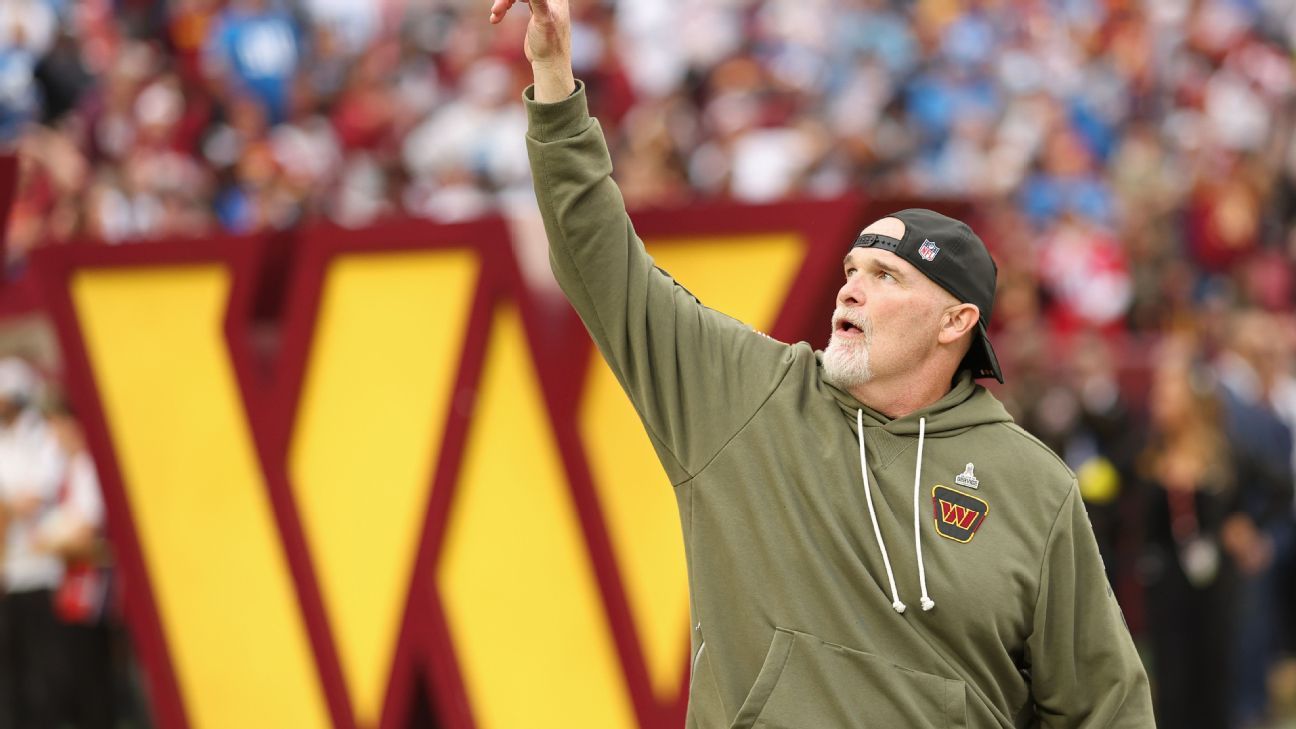
“Amen,” coach Dan Quinn said. “He delivered.”
Editor’s Picks
1 Related
In free agency, Washington acquired defensive ends Odafe Oweh and K’Lavon Chaisson as well as Charles Omenihu and tackle Tim Settle Jr. They also signed a speedy linebacker with blitzing ability in Leo Chenal.
Washington hopes the group provides a boost for returning players — most notably end Dorance Armstrong, tackle Daron Payne, and linebacker Frankie Luvu.
With the additions, the Commanders now have four former first-round picks along their front. They are hoping the new starting foursome — Payne, Oweh, Chaisson and Javon Kinlaw — will help produce the pressure on opposing quarterbacks Quinn covets.
“The best teams that I’ve been a part of had waves of players that could apply pressure,” Quinn said. “We’ll need to be able to do that and we will.”
Best case scenario, Washington will be able to create more pass rush packages for new coordinator Daronte Jones than it has in Quinn’s first two seasons. They can also use Luvu more effectively as a blitzer, moving him around more as they did 2024, when he recorded eight sacks compared to just three last season when he was forced to play more on the edge.
Dan Quinn is encouraged by the reinforcements along the line this offseason. Geoff Burke-Imagn Images
But this isn’t just about sacking the quarterback more, it’s about trying to create takeaways. The Commanders ranked 31st the past two seasons combined in turnovers forced. During that same period, Minnesota, where Jones was a key assistant to defensive coordinator Brian Flores, ranked fourth. And the Vikings led the NFL with 21 takeaways off blitzes compared to only four for Washington.
Some of that will fall on the secondary. But, the Commanders hope, they can cause hesitation in quarterbacks with disguises. Then the rush can be more versatile — with more effective stunts — and that, in turn, can help create takeaway opportunities.
“Whether you’re affecting a bad throw, or you’re hitting the quarterback to try to get the ball off them,” Quinn said, “if we can do that consistently, then we’ll have a chance to really play like we like.”
The versatility stems from having more options to create pass-rush packages. They can use Omenihu inside. They can use three defensive tackle packages. They can use three ends in rush situations — pairing Omenihu with Armstrong and Oweh or Chaisson outside. They can rush out of a 3-4 package with four rushers — using a combination of Payne, Settle and Jer’Zhan Newton inside. And they can rush over center — as can Omenihu.
“That versatility has been driving my thoughts,” Quinn said.
Then it’s about adding Chenal’s rush ability. The former third-round pick in 2022 recorded seven sacks in four seasons, but Andy Reid called him “one of my favorite guys.” He also served as a spy on quarterbacks — it helped that he was the fourth fastest linebacker at the 2022 combine, running the 40 in 4.53 seconds.
“He’s a good pass rusher; we’ve put him over the center, we’ve had him chase quarterbacks around,” Reid said at the NFL’s annual league meeting. “We had him in coverages. He can do about anything.”
But Quinn prizes that blitzing ability.
“How do we get him going forward and being aggressive in that way because he’s got size, he’s strong, he can blitz,” Quinn said. “He’s a secure tackler. I envisioned the blitzing of him first. That’s a big deal. And so it was like, how do we put people in the location to allow them to kick ass?”
The Commanders were cognizant of how much their pass rush struggled without Armstrong, who tore his ACL in Week 6, last season. With him, they ranked fourth in pass rush win rate. From Weeks 7-18, they ranked 24th.
The team hopes adding multiple young edge rushers — Oweh (27), Chaisson (26) and Chenal (25) in particular — provides a boost. Sources with knowledge of the negotiations said they tried to sign Trey Hendrickson after adding Oweh but lost him to Baltimore — then quickly pivoted to Chaisson for one year and $11 million. Peters said he thought Chaisson would cost more but they opted to wait and their patience was rewarded.
What to know for the NFL offseason
• Free agent class ranks | Signing grades
• Kiper’s new mock | Best draft prospects
• Coach hirings | Draft order | See more
“He’s going to be motivated because he’s still really young. He’s still ascending,” Peters said.
Peters called Oweh “ascending” as well. He recorded 10.5 sacks in 13 games with the Chargers, including three in a playoff loss to New England. But Oweh didn’t have a sack in five games with Baltimore before being traded. However, he had 10 in 2024 — and his pass rush win rate was higher last season with the Ravens than with the Chargers.
“He knew… the clock was ticking,” said new Baltimore head coach Jesse Minter, who was the Chargers’ defensive coordinator last season. “There was a little bit of a fresh start. We tried to breed confidence into him and his ability as a pass rusher… Washington got a good player.”
Quinn said he liked Oweh’s “initial quickness; I loved to see him chase and burst.” It’s no wonder: the 6-foot-5 Oweh was timed in the 40-yard dash a 4.36 seconds in 2021.
Chargers coach Jim Harbaugh called him “super disruptive… just athletic, long.”
All of it sounds good in the spring, but the Commanders need to make it work in the fall. They feel they’ve set the stage for success.
“That was something we needed to address,” Peters said, “and we did.”