
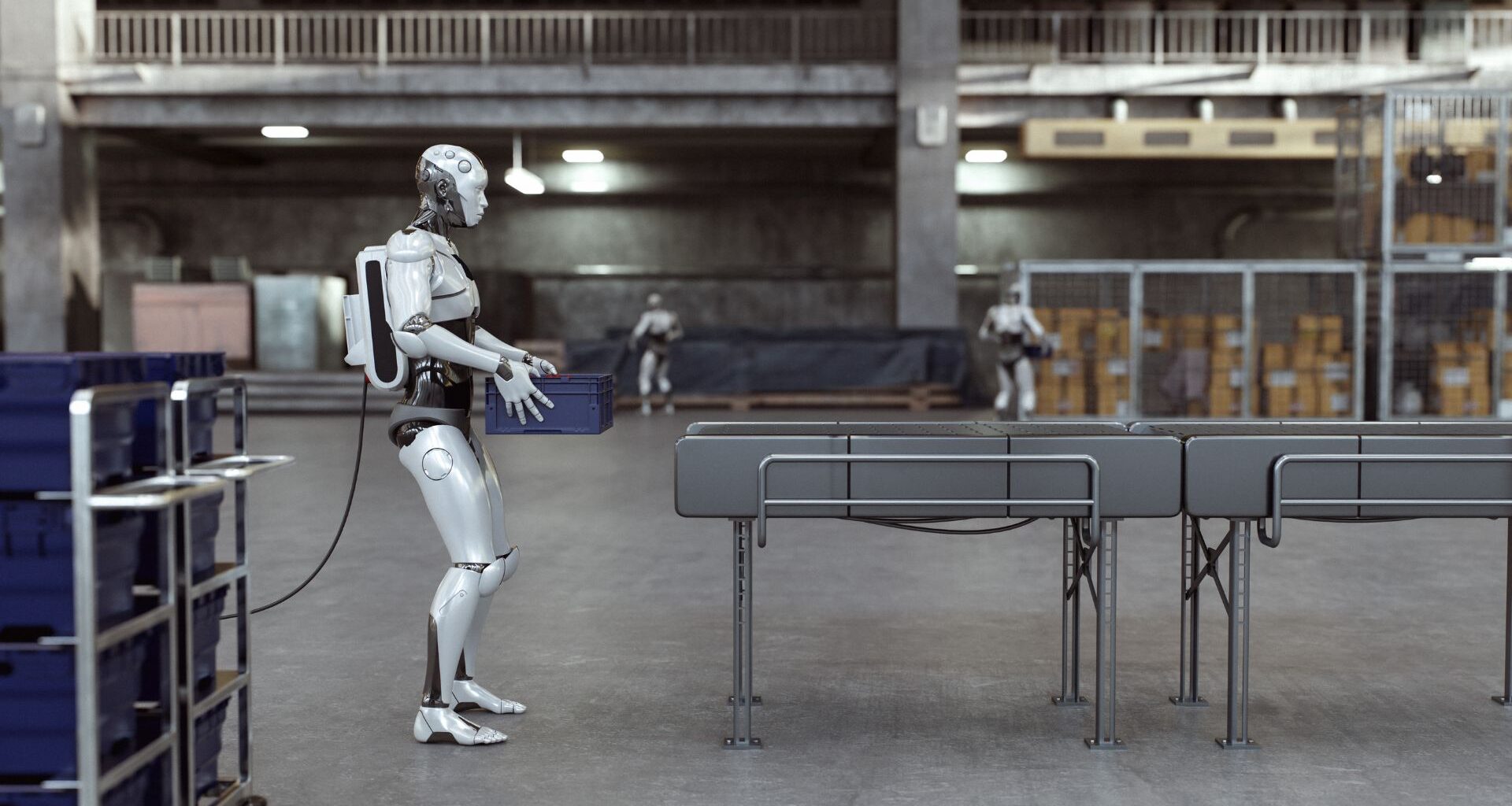
Industrial humanoid robots have begun working as “interns” at a factory in south China’s Guangxi region, marking a new step in smart manufacturing.
At Dongfeng Liuzhou Motor, 11 UBTech Walker S1 robots are being trained to handle real shop-floor tasks.
Guided by an instructor, the robots use visual navigation to move to assigned stations and perform materials handling duties, according to Chinese media reports.
Inside a dedicated 200-square-meter training zone, they practice sorting parts, moving bins, and collecting empty containers, offering a glimpse into the future of human-robot collaboration in industrial production.
In March, UBTech partnered with Siemens Digital Industries Software to scale humanoid robot manufacturing, targeting an annual production of 10,000 units by 2026.
AI factory training
Liuzhou, a major industrial hub in Guangxi, is emerging as a testing ground for artificial intelligence in manufacturing.
According to People’s Daily Online (PDO), its diverse industrial base provides realistic environments where humanoid robots can be trained to handle complex, real-world factory conditions before deployment on production lines. These systems rely heavily on visual recognition, making them sensitive to variables such as lighting, humidity, and changing layouts—factors that add significant challenges outside controlled settings.
In one workshop, a robot repeatedly practices a precise task—using two fingers to pick up a tiny screw no larger than a fingernail. The process highlights that such actions are not intuitive for machines and must be programmed step by step.
Unlike humans, who rely on experience and instinct, robots depend entirely on algorithms. Effective training requires understanding how their joints move and how their vision systems interpret surroundings, allowing trainers to refine control methods and improve task execution efficiency, reports PDO.
Currently still in early training stages, the robots are being prepared to enhance efficiency, reduce operational costs, and take over physically demanding or hazardous tasks. Their gradual integration is expected to transform traditional manufacturing by introducing adaptive, intelligent automation.
China robot scaling
To support this transition, the city has established an embodied AI data collection and testing center.
Designed as a large-scale training facility, it replicates production environments across key industries, including automotive manufacturing, construction equipment, pharmaceuticals, and the production of Luosifen, a well-known regional food specialty.
The center produces vast amounts of training data daily, enabling continuous learning and refinement, reports PDO. Within this facility, around 120 humanoid robots are undergoing hands-on training alongside human supervisors, steadily developing the skills needed for industrial operations.
Recently, China launched a high-capacity humanoid robot production line in Guangdong, marking a significant step toward large-scale industrial manufacturing. The facility is the country’s first with the capability to produce up to 10,000 humanoid robots annually, reflecting a shift from experimental development to mass production.
Developed through a collaboration between Leju Robotics and Dongfang Precision Science and Technology, the plant highlights China’s growing focus on scaling robotics output. The production system integrates 24 precision assembly stages and 77 inspection checkpoints, ensuring both efficiency and quality control. A new robot is completed every 30 minutes, representing a roughly 50 percent improvement over traditional assembly methods.
The factory also features a flexible manufacturing setup, supported by automated guided vehicles and digital control systems. This enables rapid switching between different robot models without major reconfiguration, allowing the facility to adapt to diverse industry demands, including automotive and home appliance manufacturing.
Jijo is an automotive and business journalist based in India. Armed with a BA in History (Honors) from St. Stephen’s College, Delhi University, and a PG diploma in Journalism from the Indian Institute of Mass Communication, Delhi, he has worked for news agencies, national newspapers, and automotive magazines. In his spare time, he likes to go off-roading, engage in political discourse, travel, and teach languages.