
Ask a recreational golfer how far they carry the driver and you’re bound to get the best drive they hit last Tuesday. What they won’t tell you—because most don’t know—is what the club does on an off-center strike. Depending on where the ball makes contact, it can be a dramatically different number.
But that’s quietly changing as equipment manufacturers continue to improve performance across the entire face. That 2,800 rpm spin rate your fitter locked in during your last session? That’s a center strike. A repeatable, robot-quality center strike. What happens low on the face—where most recreational golfers live more than they’d like to admit—is a different conversation entirely.
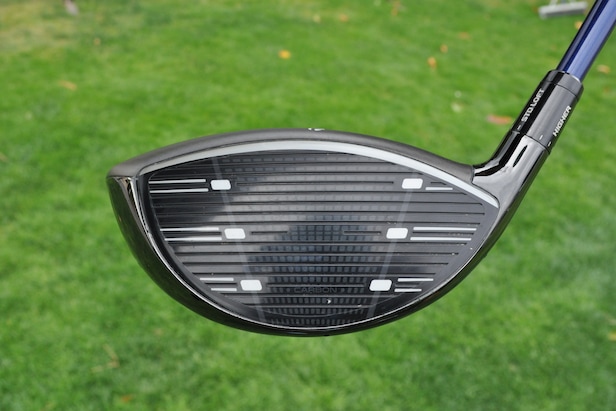
TaylorMade has been refining its carbon-faced drivers since the initial release of Stealth, reducing the penalty on mishits through meaningful spin retention. If a driver replicates the launch and spin numbers found on a “good” ball on a low toe strike, it makes it easier to keep the ball in play.
In our latest driver comparison test, we tested the last three generations of TaylorMade drivers on the Golf Laboratories swing robot, impacting nine different locations on the face—high (toe, heel, middle), low and middle—at 95 mph to determine how much spin retention makes a difference in your game.
What we found changes how you should think about which TaylorMade driver belongs in your bag—and it has almost nothing to do with the spec sheet.
The spin tax
Every driver produces different spin numbers depending on where the ball contacts the face. That’s not a flaw. That’s physics. High-face strikes launch higher and spin less. Low-face strikes launch lower and spin more. The question isn’t whether your spin rate changes on mishits—it always does—but by how much.
To measure that, we created a metric we’re calling the Spin Degradation Index, or SDEI: the average absolute spin change across all eight off-center zones compared a geometric center baseline. Think of it as a consistency score. The lower the number, the better.
TaylorMade Driver Spin Degradation Index SDEI = average absolute spin change across 8 off-center face zones vs. Mid Center baseline. 6 robot shots per zone · 54 shots per club · 94–96 mph club speed · Lower score = more consistent spin across the face. Source: Golf Laboratories robot testing · Client: Golf Digest · Gene Parente, Golf Laboratories
The results are stratified almost perfectly by generation. The Qi4D family—TaylorMade’s 2026 lineup—ranked 1, 2 and 3 overall. The Qi35 ranks 4, 5 and 6. The Qi10 ranks 7, 8 and 9. In this case, there was no crossover. Every Qi4D model is more spin-stable than every Qi35, which is more stable than every Qi10—regardless of whether you’re looking at the standard head, the LS, or the Max.
The gap between generations is not subtle.
What it really costs you
The Qi10 Max carries the worst SDEI in the entire test at 456 rpm. Its worst zone—low toe—produces 4,066 rpm. Its center baseline is 3,215 rpm. That’s an 851 rpm spike on a shot that, to the golfer hitting it, probably felt like a reasonable drive.
Using actual carry data from the test, every 100 rpm of excess spin costs roughly 1.4 yards of carry at this swing speed. Run the math on that 851 rpm spike and you’re looking at approximately 12 yards of carry loss on a low toe strike—before the elements get involved. Into a 15 mph headwind, that number grows exponentially.
The Qi4D Max, by contrast, produces just 495 rpm of excess spin on its worst zone. The carry difference between those two clubs on an identical low toe miss is somewhere in the neighborhood of five yards. It’s a relevant carry delta, especially if, for example, the bunker is in play.
Overspinners versus underspinners
Here’s where it gets nuanced—and where a blanket “upgrade to Qi4D” recommendation doesn’t make sense.
The Qi4D’s geometric center spin baseline is 2,450 rpm. For a faster swinger or a player who already fights too much spin—a slicer, a steep descender, anyone who watches their drives balloon into a headwind—that number is genuinely attractive. The mishit zones push them toward 2,900–3,000 rpm rather than 4,000. They stand the chance of staying in a playable window.
But for a 95 mph swinger who already launches the ball too low? A 2,450 rpm center strike runs the risk of making a marginal ball flight worse. The Qi35 at 2,992 rpm is the more forgiving option in that direction—better spin stability than the Qi10, and four yards more carry from the center.
The broader point is this: SDEI tells you how consistent a driver is across the face. Your current spin numbers tell you whether that consistency is centered around a rate that helps your ball flight or hurts it. You need both pieces of information to make the right call.
The real fitting argument
What the data makes undeniable is that the club you’re fitted for in a bay—where center strikes dominate—may perform meaningfully differently from the club you’re actually playing on the course.
The Qi4D family’s spin stability is a real engineering achievement. The question isn’t whether it’s better. The question is whether “better” is the right word for your game specifically—and that answer lives in your swing, your contact tendencies, and the spin rate you’re already producing.
This article was originally published on golfdigest.com