
It all started just before Christmas last year.
The MV Raider, a US-based merchant ship built in 1991 that had disappeared from shipping tracking websites in 2021, suddenly reappeared.
The boat was in Cristobal, a port town in Panama, Central America.
After being sold off to an “undisclosed buyer” four years earlier, the MV Raider was now registered under a new flag, the African nation of Togo.
It also had a new destination — Sydney, Australia.
According to the International Transport Workers’ Federation, workers were told the MV Raider was to be delivered across the Pacific Ocean to its listed new owner, a Brisbane-based manufacturer called Rosenbauer.
The problem was Rosenbauer had no idea it was coming.
“We sell big fire trucks,” a company representative told the ABC from their Brisbane office.
“I’d love to know where they’ve got [our] details from, the cheeky buggers.”
It is just one element in a three-month saga involving the MV Raider — a ship that traversed multiple Pacific countries and the Australian coast in an alleged plot to import cocaine into Australia.
And this week it all came to a head.
Six MV Raider crew members charged with smuggling cocaine
According to Australian Federal Police (AFP), in the four years the MV Raider disappeared it was being rebuilt by its “undisclosed owner” to incorporate secret smuggling tunnels, what the AFP called “smuggling hides”.
On Monday, after almost three months at sea, six members of its crew were charged with drug trafficking with police alleging the boat, at one stage, had almost six tonnes of cocaine aboard.
Experts say the journey itself shows the lengths alleged drug traffickers are going to bring product into Australia — and the amount of product being seized in Pacific waters — as cartels continue to target the cash cow that is Australia.
A ‘bizarre’ journey
According to the International Transport Workers’ Federation, an advertisement was put out on social media in December last year for crew to join the MV Raider for a 25-day journey to Australia.
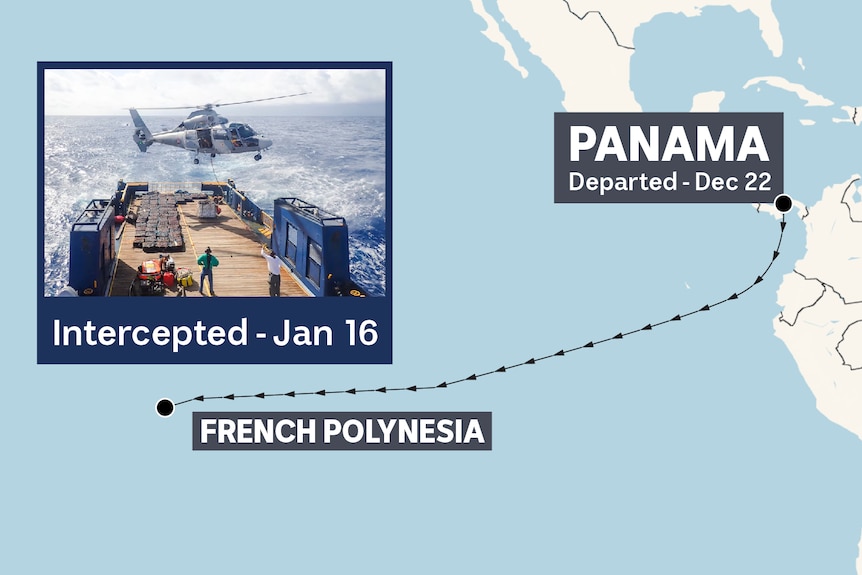
Eleven Honduran and Ecuadorian nationals boarded the boat, and according to ship tracking websites the ship set off on December 22, heading towards Sydney.
But it never got that far.
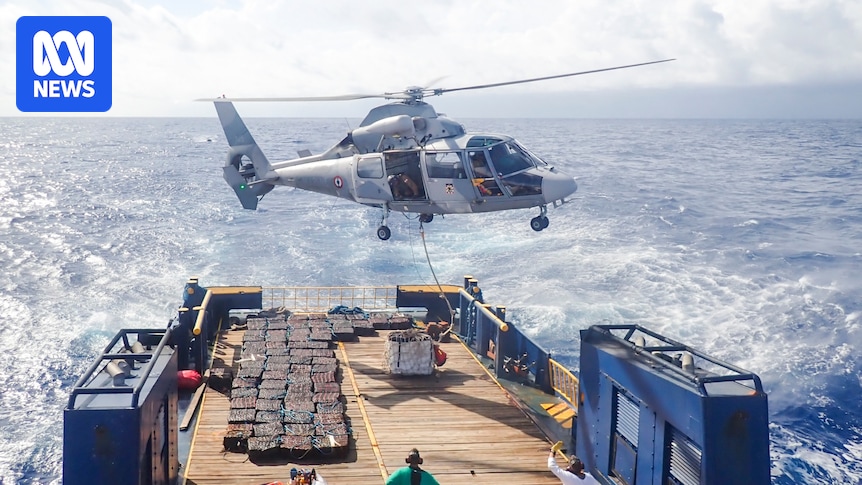
On January 16 it was intercepted by French authorities near French Polynesia.
The French Navy seized and dumped 4.8 tonnes of cocaine before releasing the MV Raider and its crew in January. (ABC News: Cordelia Brown)
The French say 4.8 tonnes of cocaine was found on board, worth about $1.5 billion in the Australian market.
Yet French Polynesian President Moetai Brotherson told the ABC “overcrowded prisons” prevented the French territory from prosecuting the crew.
“We leave it to the country of origin or the country of destination,” he told the ABC at the time.
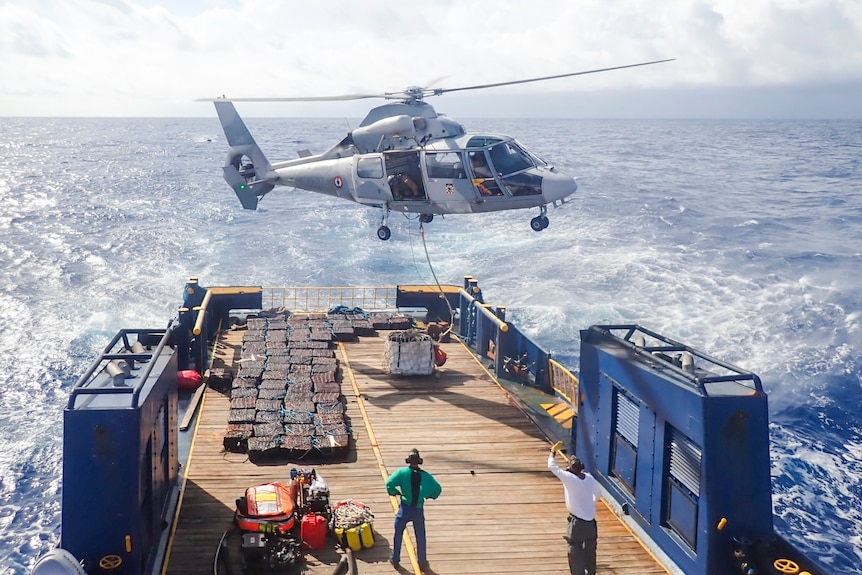
MV Raider first made headlines when nearly five tonnes of cocaine was seized from the vessel. (Facebook: French Embassy in Australia)
The 4.8 tonnes of cocaine was dumped overboard and the boat and its crew continued on their way.
But unbeknown to the MV Raider crew, according to the Australian Federal Police this is when its own investigation begun.
They allege one tonne of cocaine remained aboard in a smuggling hide deep in the boat’s bowels — cocaine that was missed by the French.
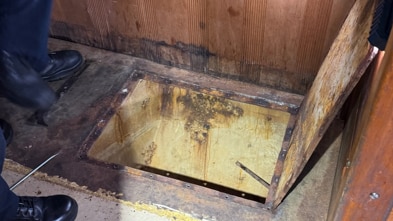
One of the secret tunnels police allege was used in the plot to import cocaine. (Supplied: AFP)
“This is actually fairly common [with the] lengths that narcotic smugglers go to hide this stuff,” said Jennifer Parker, adjunct professor with University of Western Australia’s Defence and Security Institute.
“On vessels I’ve seen false walls, false ceilings, false deck heads, things shoved in pipes, things weighted down in bilges, all sorts of things.”Seventh narco sub discovered in waters near Australia
Ms Parker, a former naval officer who served in the Middle East and the Carribean on counter-narcotics operations, said with the financial incentives on offer for smugglers they come up with all sorts of “weird and wonderful ways” to attempt to import product.
“Clearly drug cartels in South America have determined that the market in Oceania, and predominantly the market in Australia, is so lucrative that it’s worth their time investing in different ways, different types of vessels and different networks to smuggle these narcotics across the Pacific,” she said.
‘Nothing was found’
After the stop in French Polynesia the MV Raider continued sailing towards Sydney.
But on January 24, after transmitting a distress call for engine repairs, it was escorted into a port in the Cook Islands.
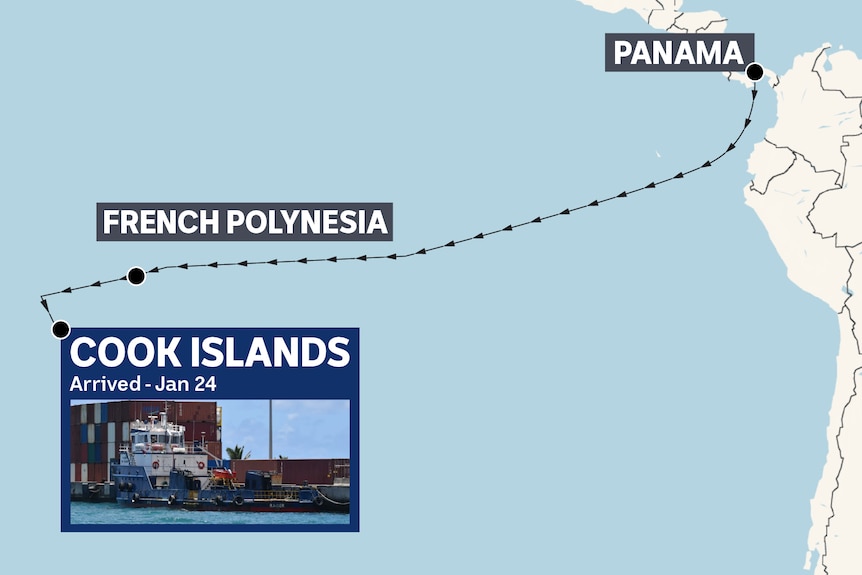
The vessel docked at Avatiu Port in the Cook Islands after entering Rarotonga waters under a distress call for engine repairs. (ABC News: Cordelia Brown)
Cook Islands Customs said border agencies conducted a search following its arrival and “nothing was found”.
The captain and crew were questioned and allowed to go ashore, under supervision, to obtain “essential provisions”.
At the time, Australian Federal Police declined to comment on whether they were tracking the vessel or planning to make arrests.
Again the crew and the vessel were released, and from the Cook Islands the MV Raider made its way to Sydney, the AFP alleges, with that tonne of cocaine still aboard.
On February 19 the MV Raider was 180 nautical miles off the NSW coast, near Wollongong when it was intercepted by NSW Police and Australian Border Force Officers.
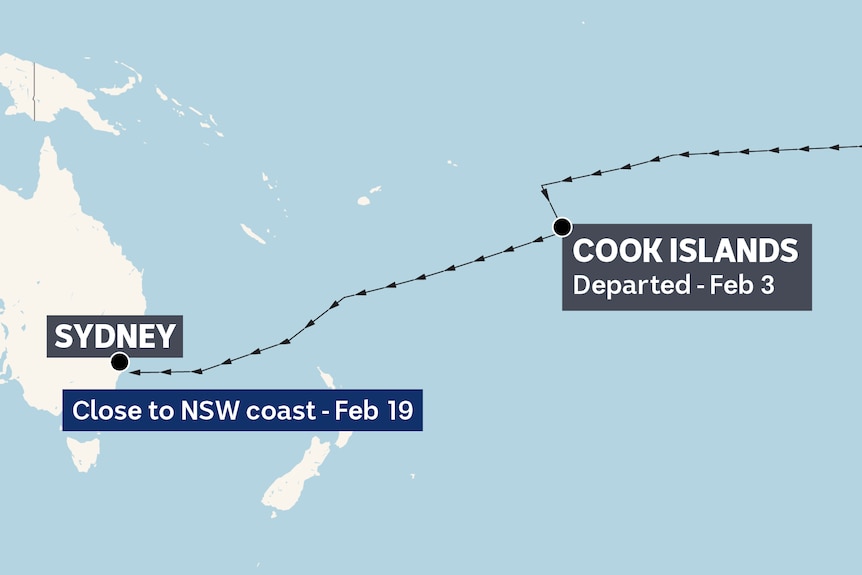
Tracking systems located the MV Raider in Australian waters near the NSW coast in late February. (ABC News: Cordelia Brown)
Despite embarking on a two-week journey towards Australia, in an unexpected twist on February 20, when only 150 nautical miles from its intended port of Sydney, the vessel made an quick turn north-east.
It declared its new destination as Noumea, the capital of French territory New Caledonia.
They interviewed the crew and advised them they would not be permitted entry to Australia.
The ABC understands it is alleged that the one tonne of cocaine hidden on the ship was still aboard at that time.
Recent media reports suggest that the AFP received intelligence about suspected additional cocaine onboard, soon after the seizure by French authorities, but it did not share this intelligence with NSW Police and ABF officers who ‘met’ the ship off the NSW coast in late February.
It is suggested the AFP allowed the MV Raider to sail unimpeded along Australia’s east coast rather than intercept it at the risk of the crew claiming asylum.
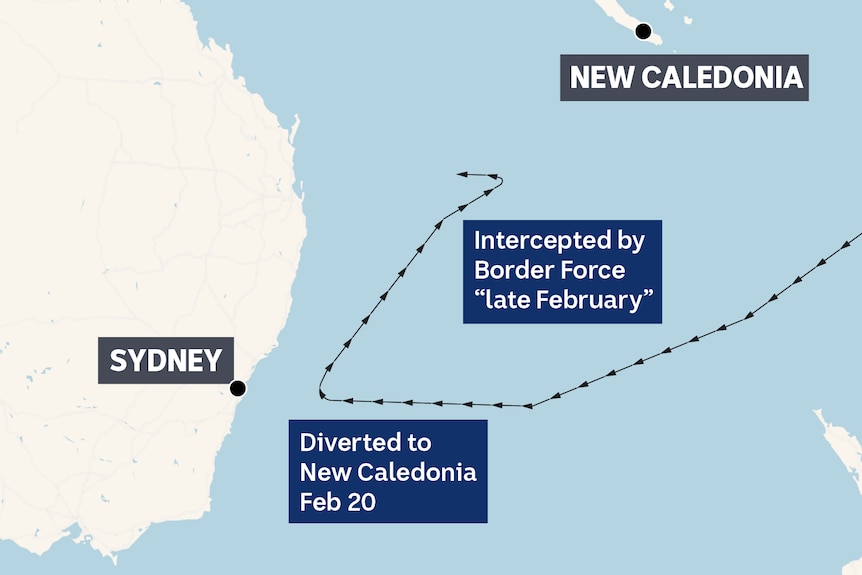
In late February ABF officers met the vessel off the NSW coast before the ship diverted to Noumea. (ABC News: Cordelia Brown)
For six days the MV Raider tracked towards New Caledonia, but on February 26, about 250 nautical miles off the coast of Rockhampton, it once again stopped and did a U-turn back towards Sydney.
In a press release, Australian Federal Police said it suspected an Australian-based crew operating on behalf of “a larger criminal syndicate” was looking to rendezvous with the MV Raider to conduct an “at-sea transfer” within Australia’s Economic Exclusion Zone.
It says it has evidence alleging six crew members were connected to “at least one drop-off of drugs within Australia’s territorial waters”.
The AFP said it seized a satellite phone which was allegedly used by senior members of the MV Raider crew to “communicate with the syndicate’s bosses based offshore”.
According to Ms Parker this is a common strategy.
“They plan to sit off the coast and rendezvous with a smaller vessel to bring those drugs into the country,” she said.
The ‘drop off’
With the vessel pointed toward Sydney, on February 26 it lingered off the coast for a week.
The ABC understands this is the time where the AFP alleges the “drop off” of the cocaine occurred.
While lingering outside Wollongong for days, the MV Raider then made a mayday call on March 12, with the crew saying they were short of water and food.
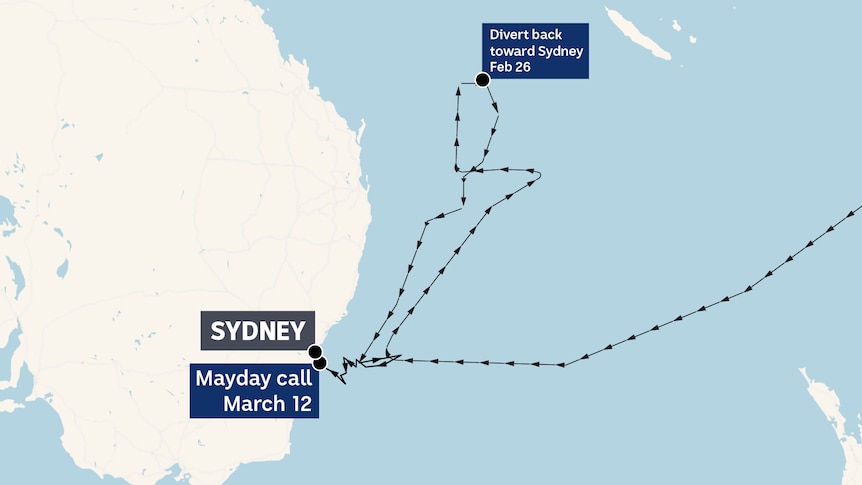
The MV Raider made another U-turn towards Australia and issued a distress call on March 12. (ABC News: Cordelia Brown)
Under international law Australian authorities are obligated to respond.
In its final journey, almost three months after setting out from Panama, the MV Raider was escorted into Snails Bay in Sydney Harbour.
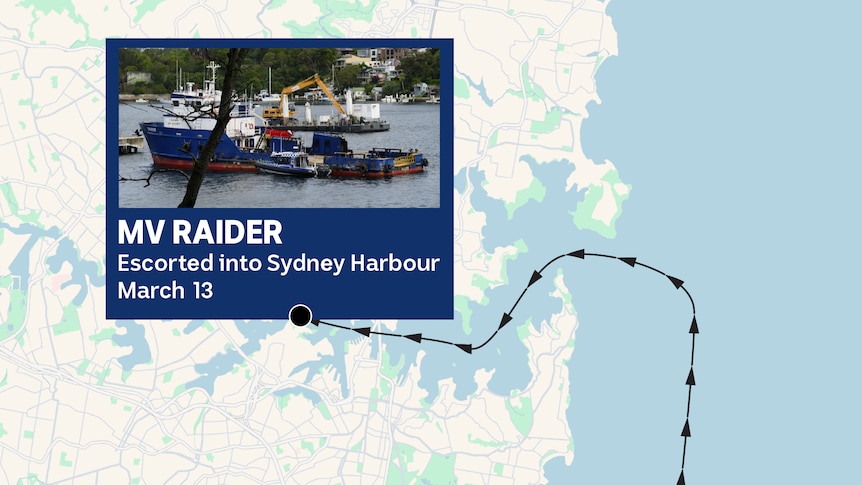
A tugboat escorted the MV Raider into Sydney Harbour to a mooring at Snails Bay. (ABC News: Cordelia Brown)
On March 19 the 11 crew were escorted to immigration detention.
And on March 30, six of the men were charged with drug trafficking.
The ABC understands of the five men who were not charged, three have been deported.
“One remains in Villawood [Detention Centre], last we heard, and there’s one that we can’t account for,” International Transport Workers’ Federation’s Ian Bray told the ABC.
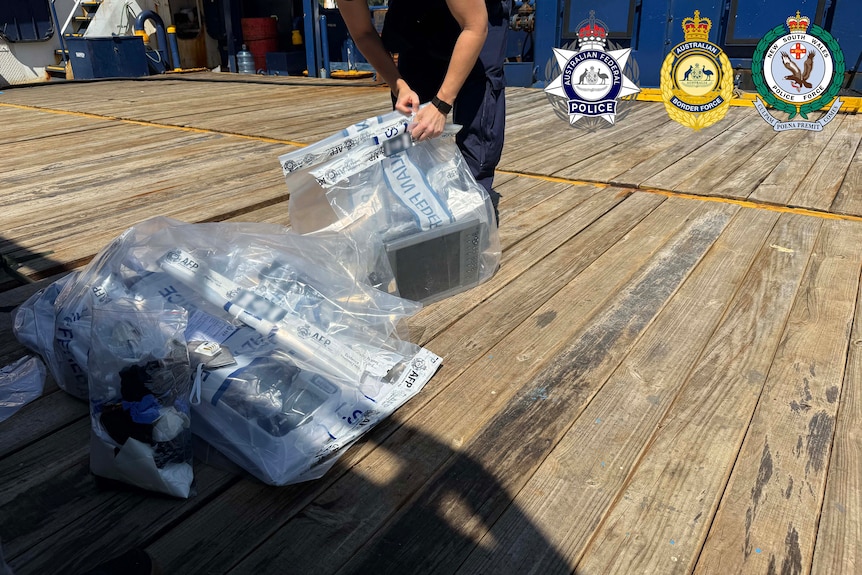
Police bagging evidence on the deck of the MV Raider. (Supplied: AFP)
Mr Bray said the organisation had been in touch with some of the crew’s families in Honduras and Ecuador and the organisation had “engaged legal representation” to look at the merits of the case.
“All the stories that you hear throughout 40 years of a working life as a seafarer, this would be in the top two most bizarre cases that I’ve had to deal with, or had any involvement with,” he said.
AFP Commander Brett James said investigations were continuing into what happened to the one tonne of cocaine — and the origin of the drugs — alleged to still be on the boat when it left Cook Islands.
“We will work with our international and domestic law enforcement partners to identify the criminal syndicates — and anyone else — involved in facilitating this alleged cocaine import,” he said.
The six men will reappear in court in May.