
Fuel will continue to flow from Japan into Australia under assurances given during recent talks between the two countries.
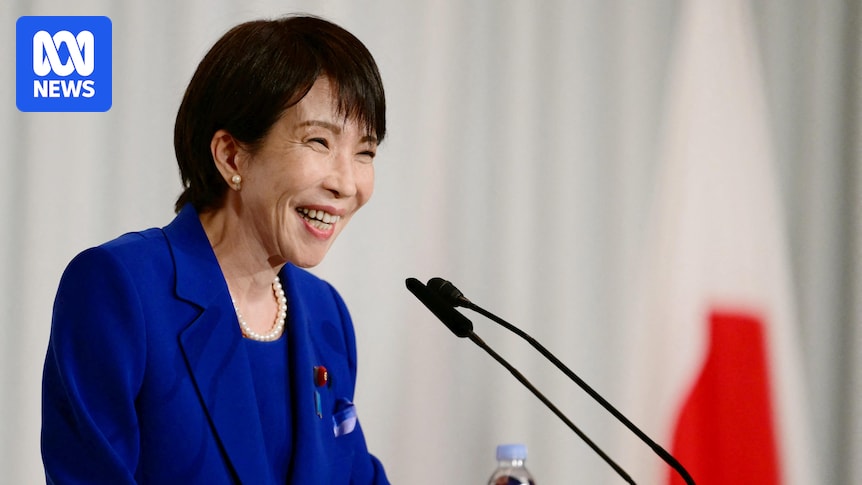
It comes as Japan’s prime minister Sanae Takaichi plans a trip to Australia to discuss conditions in the Strait of Hormuz as well as rare-earth minerals, according to reports by Japanese media.
That visit would come as the region’s leaders work to shore up fuel security and supply networks.
Prime Minister Anthony Albanese has not confirmed the visit.
“Any plans for visits to Australia from foreign leaders will be announced when appropriate,” a spokesperson said.
Assistant Trade and Foreign Affairs Minister Matt Thistlethwaite confirmed earlier that he had been in conversation with a Japanese counterpart about fuel in recent days.
“I met last week with the Japanese minister and requested that supply continue,” Mr Thistlethwaite told Sky News.
“They’ve given us an assurance that normal supply will continue.
“I’ve done a similar thing with the South Koreans, and they’ve given us assurances and Singapore as well.”
Further assurances being sought
Australia and Singapore had already signed a joint commitment to continue the trade of fuels.
The prime minister has reiterated that Australia will continue to be a reliable exporter of LNG into Asia and expects Asian partners to continue supplying Australia with the majority of its liquid fuel needs.
“Supply depends upon those relationships being adhered to,” he said during an address to the National Press Club on Thursday.
“We expect countries that supply us to stick to agreements which are there; we think it’s very important that the contracts that we have be fulfilled completely with countries in our region.
“That’s the quid pro quo, if you like, and I think that is very important as we go forward.”
Iran war updates: For the latest news on the Middle East conflict, read our blog.
About a fifth of the world’s oil supply has in the past been shipped through the Strait of Hormuz, which is currently being blockaded.
Asian markets have signalled they may need to look for crude oil from other sources, including Russia, if the strait remains closed.
Japan talks on horizon
The supply assurance from Japan followed comments by its ambassador to Australia, Kazuhiro Suzuki, who late last month urged caution about imposing a windfall tax on LNG exports over investor confidence.
Speaking at a Mineral Council event, Mr Suzuki indicated Japan’s domestic fuel reserves would be his country’s priority.
The ABC revealed the prime minister’s office has sought options for a new tax on gas and thermal coal exports ahead of the federal budget in May.
Australia sources just 0.7 per cent of its petrol and 6.8 per cent of its diesel from Japan, with the bulk of it coming from Singapore and South Korea, according to data published by the NRMA.
Japan is among the top five countries from which Australia sources refined fuels.
Australia now has fuel reserves equivalent to 39 days’ worth of petrol, 29 days’ worth of diesel and 30 days’ worth of jet fuel.
More than 50 fuel shipments are on the way to Australian import terminals and are due to arrive over the next month.
Imports being diversified
Mr Thistlethwaite said work being done to diversify Australia’s fuel sources meant some of those ships were inbound from the United States.
Australia gets 20.9 per cent of its crude oil and fuel needing refining from the US, making it the second highest contributor to Australia’s stocks, topped only by Malaysia.
“We’re covering all the bases to make sure that we diversify our supply and get as much through as we possibly can,” he said.
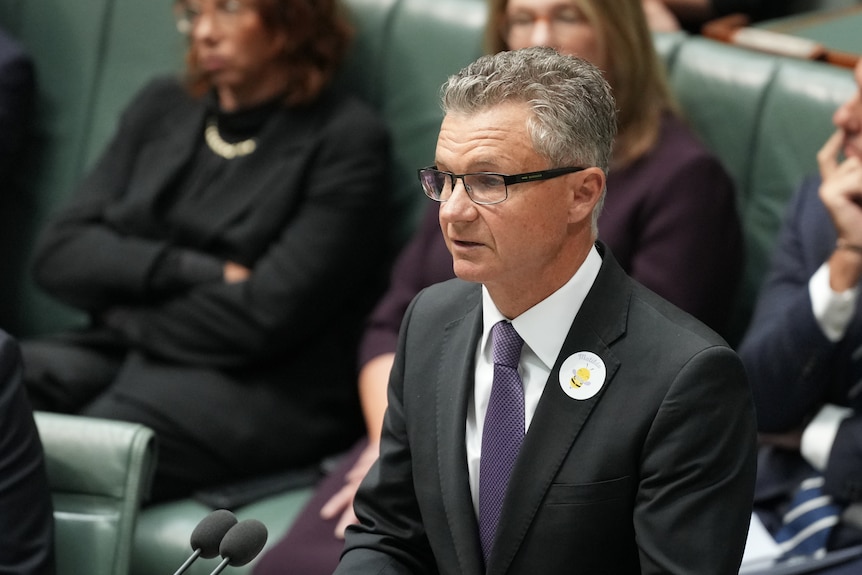
Matt Thistlethwaite says Japan has given assurances that normal levels of fuel will be supplied to Australia. (ABC News: Matt Roberts)
The NRMA’s Peter Khoury said the government’s decision to lower the flashpoint for diesel opened the door to more from the United States.
“We’ve diversified our imports, which is great given what’s happened in the Middle East,” he said.
He added the assurance given by the Japanese was important, “particularly beyond April”, when a potential fuel crunch point is forecast.
The shadow assistant minister for international development, Dave Sharma, said Australia should have done more to secure its domestic fuel supplies in years past.
“Our ability to rely on international supply chains to get our liquid fuels has gone down significantly,” Senator Sharma said.
He defended the former coalition government’s decision to store emergency fuel supplies in the US.
“Seaborne traffic between the west coast of the United States and Australia is still flying uninterrupted,” he said.
“Now, if we had an option between no reserves anywhere and some reserves in the United States, I would take the latter.”