
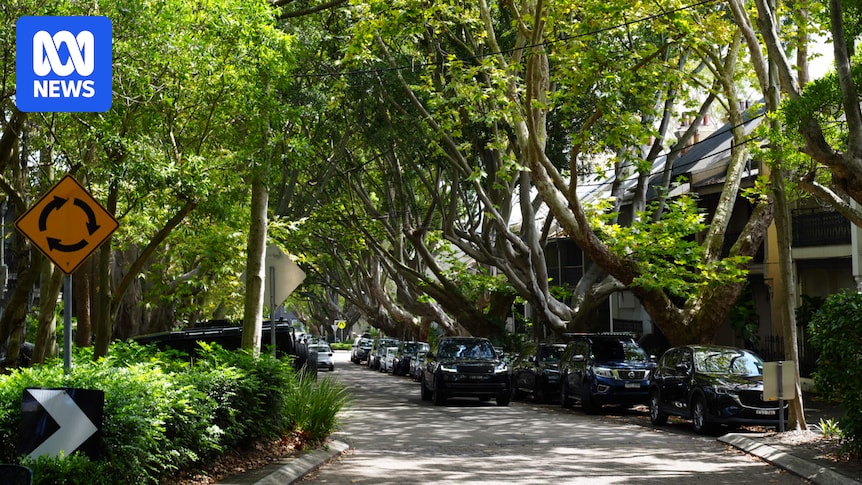
In the heart of the City of Sydney, Paddington’s streets are lined with London plane trees and weeping figs.
Entwined overhead, they shade the suburb’s heritage terrace homes and provide a cloud of lush, green canopy coverage.
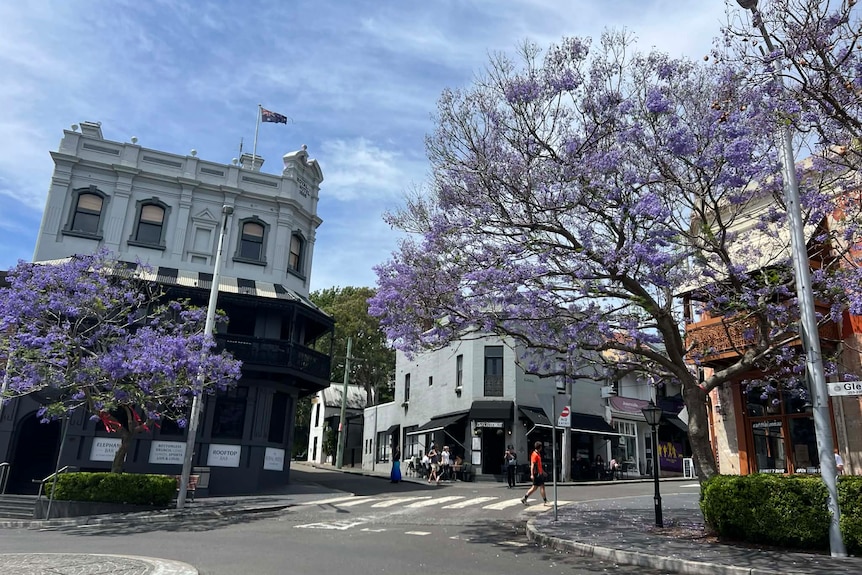
Paddington’s jacarandas explode in colour, typically between October and November each year. (Supplied: Susan Wyndham)
About a kilometre away in Centennial Park, more than 15,000 trees such as Moreton Bay figs and paperbark trees add to the inner suburb’s serenity.
While canopy coverage is being increased in the City of Sydney, one micro-level analysis has found a correlation between property prices in the local government area and the proximity of trees to homes.
The council says it is planting more trees to make the city “more liveable and resilient” by reducing urban heating, cooling buildings and improving overall air quality.
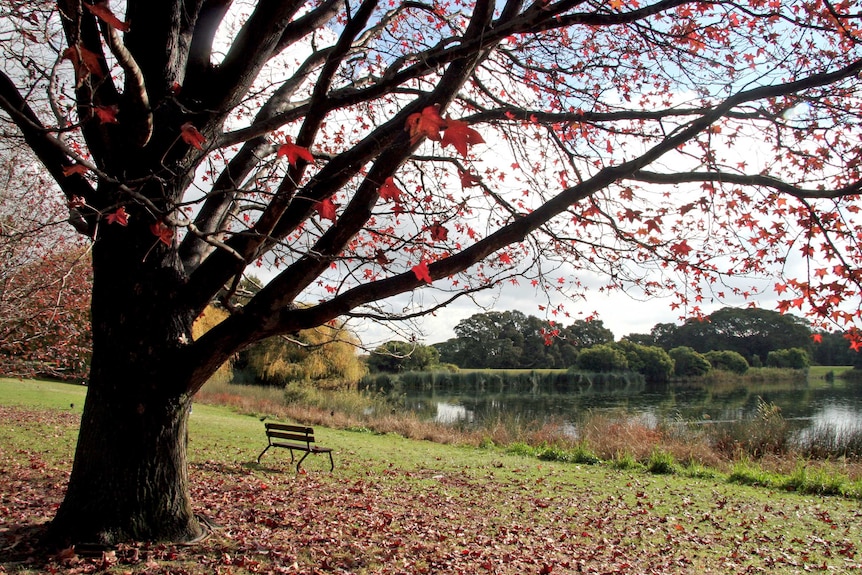
Sydney’s Centennial Park has thousands of different trees planted on public land. (Supplied: Chris Gleisner (Courtesy Centennial Park and Moore Park Trust))
The number of days per year with temperatures over 35 degrees Celsius are expected to double by 2050, according to forecasts released by the Climate Council.
The CSIRO, Australia’s national science agency, predicts the intensity of hot days will increase and the likelihood and length of periods of drought will rise.
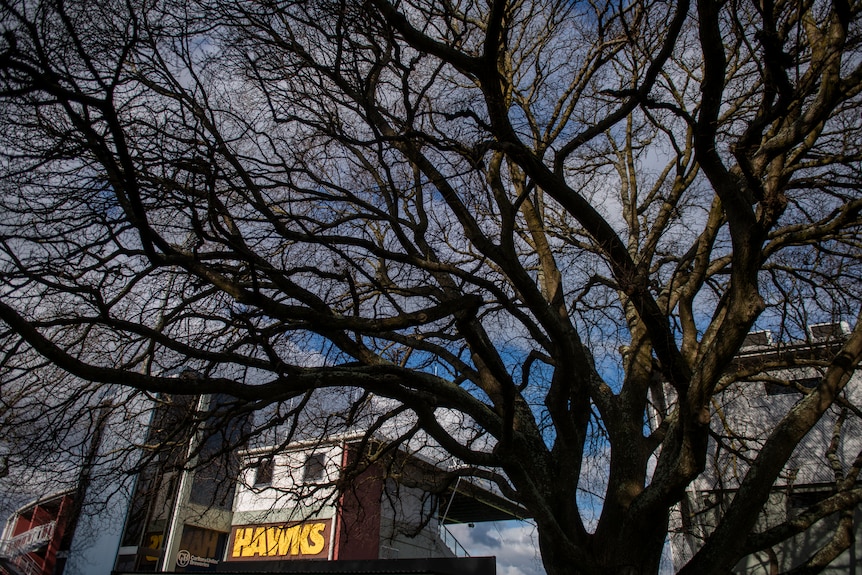
Local governments in capital cities across the country are planting more trees to address climate change. (ABC News: Morgan Timms)
Capital city councils are also boosting overall tree canopy coverage in a bid to combat the trend.
Some experts say the report’s findings highlight the complexities of balancing the planning of greener cities without interfering with existing infrastructure.
How trees could reduce house prices
The peer-reviewed report recently published in the Cities urban planning journal found street-side trees could affect a home’s value depending on their distance from the centre of the property.
A single tree planted within 10 metres of the centre of a home could decrease its sale value by 2.69 per cent, researchers found.
A tree located between 10m to 20m away could increase the price by 1.16 per cent.
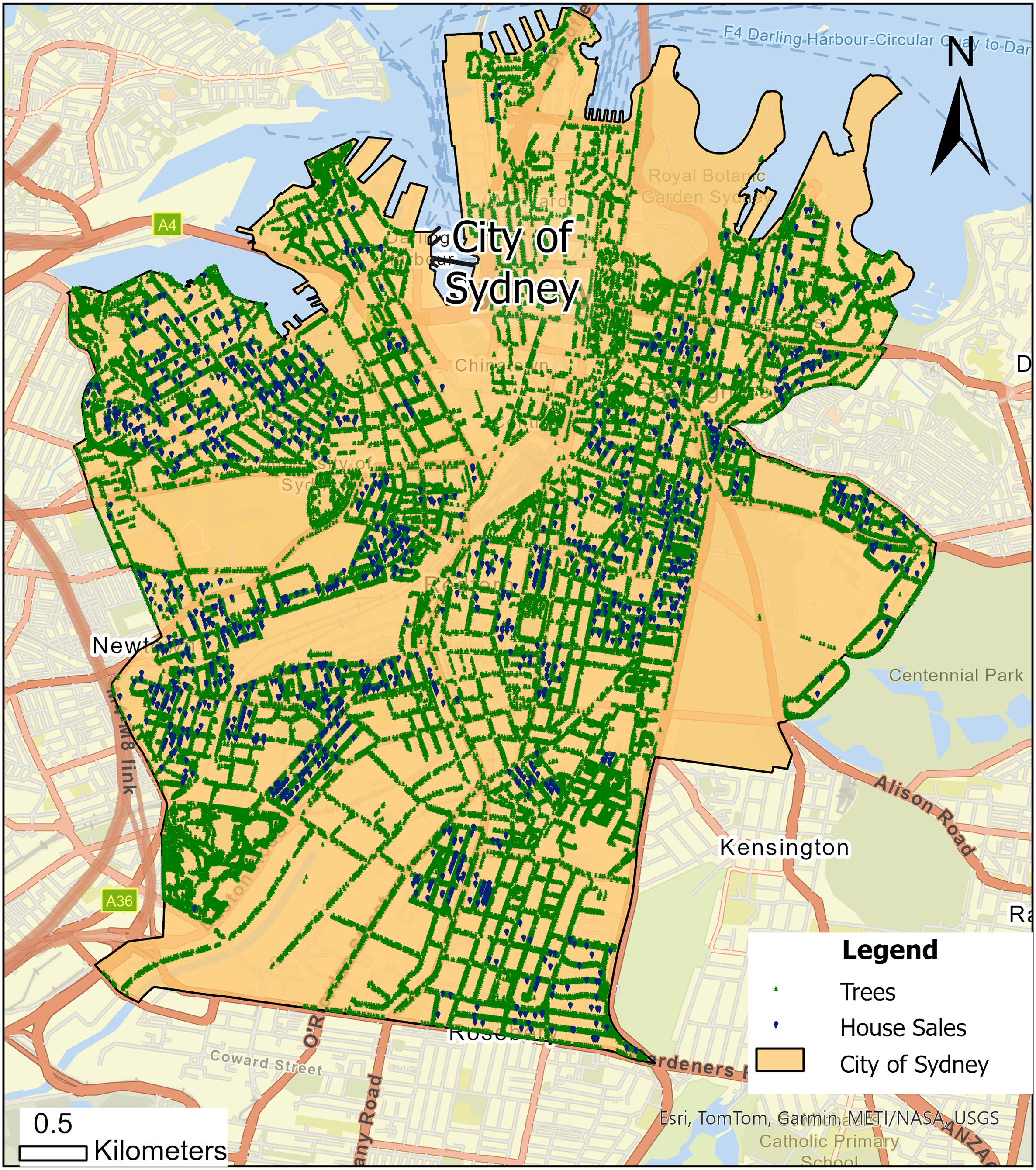
Researchers have done extensive mapping to show the exact location of public trees in the City of Sydney LGA. (Supplied: Song Shi)
The report calculated its findings by studying the link between the prices of 1,568 properties sold in the City of Sydney local government area between January, 2021 and August, 2024 and the council’s mapping of more than 48,000 street-side trees.
To determine the financial impact of the trees, researchers said they accounted for the influence on house prices of more significant factors such as the number of bedrooms, bathrooms, car parking options, land size and proximity to key services such as transport and schools.
During those years the average house price in that council area was $2,613,000, and concluded a single tree within 10m of the centre of a home could reduce a property’s value by $70,289.
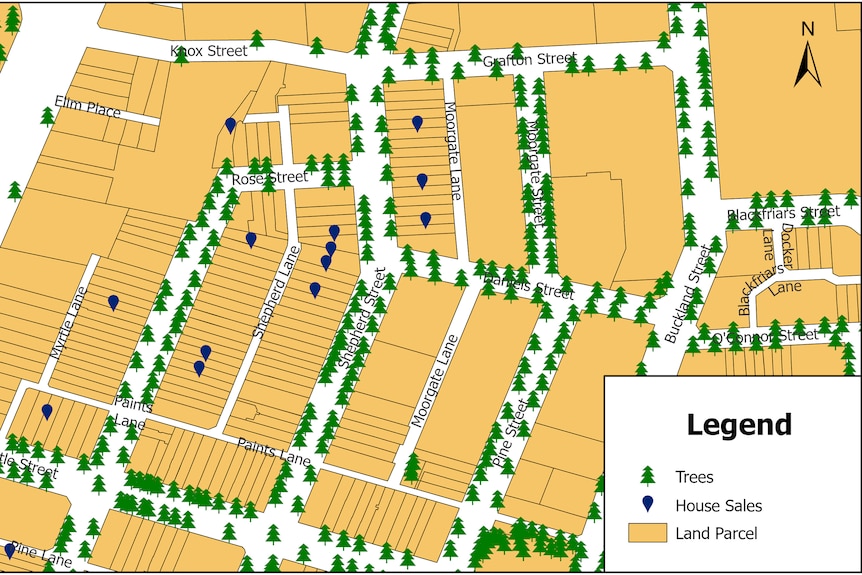
The mapping highlighted the proximity of trees to the front facades of properties in suburbs like Chippendale. (Supplied: Song Shi)
If it was between 10m to 20m away, the same tree could add up to $30,310 onto the house value.
The average property lot size in the LGA is 176 square metres and the average distance from the centre of a home to its boundary is about 8m, researchers said.
Only 129 properties sold between in the three-year period had trees located within 10m of the centre of the home, according to the report.
The LGA spans about 26 square kilometres and has a population of about 211,000, according to the 2021 Census.
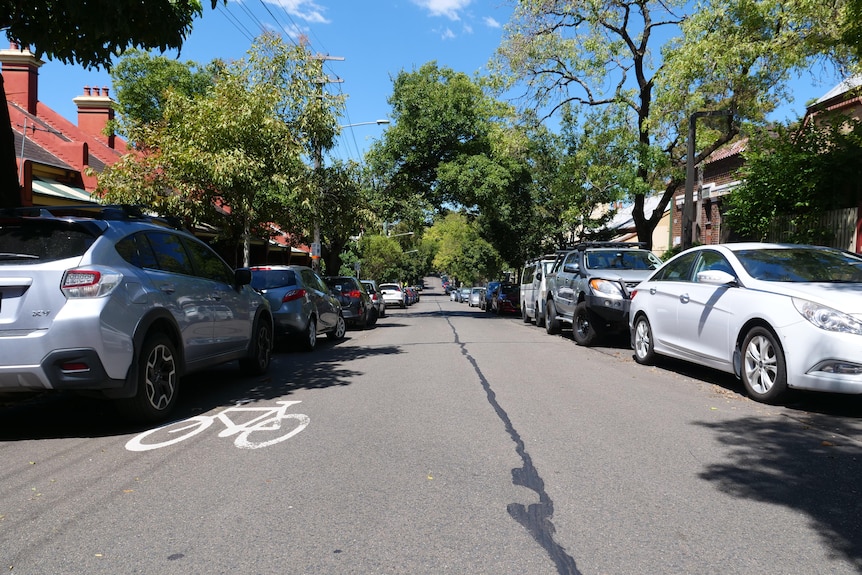
The City of Sydney council says at least 20 per cent of the LGA is covered by tree canopies as of 2024. (ABC Radio Sydney: Declan Bowring)
The area accounts for 0.21 per cent of the total area of Greater Sydney.
There was no data to suggest the trend occurred elsewhere in the 33 other local government areas of Greater Sydney, or in other capital cities, regions or rural areas.
University of Technology Sydney associate professor of property economics Song Shi, one of the study’s authors, said the findings provided an insight into the mindset of residents.
“This is a piece of evidence to show if you plant a tree in the right location, people like it,” Dr Shi said.
“If you plant a tree too close to a property in a city like the City of Sydney — it’s a pretty dense area — there’s a pretty strong resistance.”
He said the findings posed an “urban planning issue” facing the City of Sydney local government area.
“The city council needs to be aware of this potential resistance coming form their residents,” Dr Song said.
“If they know [where] their resistance comes from and how far the distance of this resistance is, then they [will] have a better design of the street or where they put a tree.”
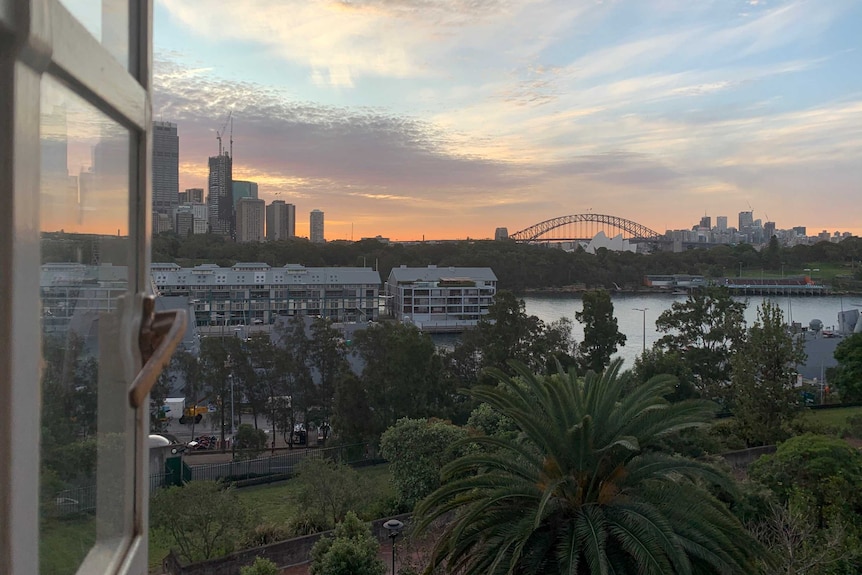
A view of tree coverage seen from a property in the inner Sydney suburb of Potts Point. (Supplied)
The report highlights three tree species that negatively impact the value of a home if planted too near.
Brush box, London plane and tuckeroo trees were associated with either extensive and potentially damaging root systems, hayfever concerns or vegetation litter.
Experts say the planning picture is complex
Matthew Ng from the UNSW City Futures Research Centre believes the report overlooks several key factors.
“It is quite a small number of houses in the overall picture in garnering value of properties,” Dr Ng said.
“They’ve got 129 properties only with trees that are within 10m, so that in itself should caution you from trying to extrapolate too much out of this.
“There’s a lot of individual characteristics like setbacks, frontages, how long the driveway is that needs to be considered.
“Ten metres is basically a micro location they’re looking at.”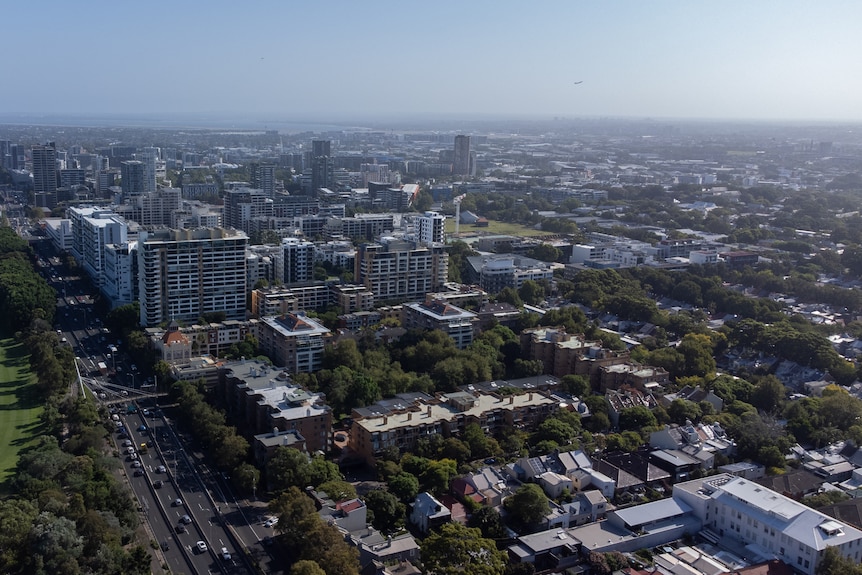
More than 1,500 properties were sold in the City of Sydney LGA between January, 2021 and August, 2024. (
ABC News: Shaun Kingma
)
However, Dr Ng agreed the findings highlighted the need for local councils to correctly plan where they plant trees.
“This needs to be considered with the species of the trees,” he said.
“You need to take into account the root system aggressiveness or how wide a mature canopy is going to grow.
“You’ve also got things like infrastructure that you need to worry about.”
Cameron Murray, the chief economist at Fresh Economic Thinking, said the findings were “not statistical truths, they’re just statistical patterns”.
Dr Murray said the trend might occur in other cities, but the financial impacts of trees planted too closely to houses would vary based on property prices in those locations.
The findings in Dr Shi’s report do not suggest the correlation between property prices and the proximity of trees to houses in the City of Sydney LGA also occurs elsewhere.
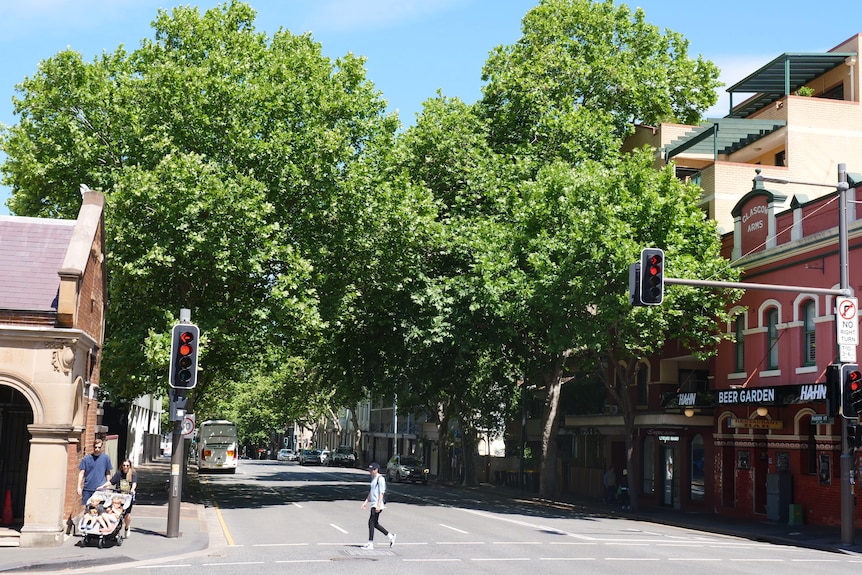
A plane tree that stretches over Harris Street in inner Sydney. (ABC Radio Sydney: Declan Bowring)
“These are very normal results. It’s very normal to pick a sample that shows a lot of variation in the thing you’re interested in and leave the rest of the sales out of it,” he said.
“This kind of street tree in some fancy City of Sydney neighbourhood is worth a lot because everything is worth a lot there.
“Every bit of extra amenity is worth more to people with more money than people with less money who live somewhere else. It’s not like you can multiply that number by every dwelling in Sydney.
“It reflects why we have conflicts in planning because people like trees, they prefer other people to pay for them.”
CBD councils work towards more tree coverage
The ABC asked urban councils across the country whether the findings raised concerns about planning.
Capital city council-set tree canopy goals
Sydney: 40% by 2050
Melbourne: 40% by 2040
Brisbane: 50% by 2031
Canberra: 30% by 2045
Adelaide: 40% by 2035
Darwin: 50% by 2030
Perth: 30% by 2036
Hobart: 40% by 2046
The local governments in every capital say they are working to make the cities greener by planting more tree coverage on public land including nature strips, footpaths, parks and open spaces.
Professor Elizabeth Mossop, the dean of the UTS School of Design, Architecture and Building and a landscape architect and urbanist, said councils typically used light detection and ranging (LiDAR) technology and satellite and aerial imagery to map canopy coverage.
“That’s the standard for how it’s done internationally,” she said.
“You can get a pretty accurate read from just about any sort of satellite technology.”
A City of Sydney spokesperson said more than 18,000 street trees were planted there in the last two decades and at least 20.9 per cent of the LGA had canopy coverage in 2024.
“Increasing canopy cover and greening is about making Sydney more liveable and resilient to a changing climate,” the spokesperson said in a statement.
In the City of Melbourne more than 80,000 public trees comprise a canopy covering at least 28 per cent of the LGA.
“Residents are offered the opportunity to provide feedback or object to new tree plantings through the community consultation process,” a spokesperson said.
“Locations for new tree plantings are based on a range of factors, with street trees typically planted between 10m and 20m from the property centre.”
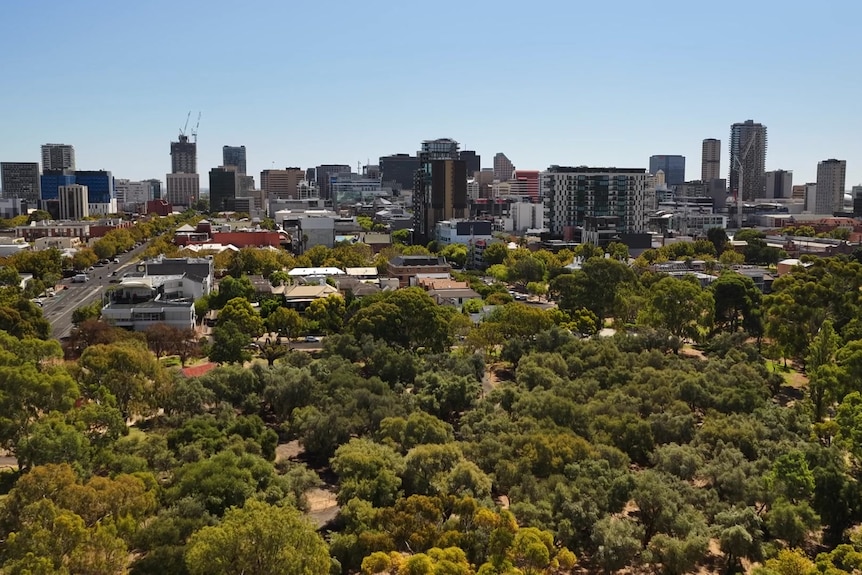
The City of Adelaide has a five-year “greening streets” plan to boost the CBD’s overall canopy coverage. (ABC News: Daniel Taylor)
Councillor Tracy Davis, the Brisbane City Council’s chair for environment, parks and sustainability, described the Queensland capital as “the leafiest capital city in Australia”.
The locations of street-side trees were planned around existing infrastructure such as driveways and power poles, a council spokesperson said.
The council had no update on Brisbane’s latest canopy coverage percentage.
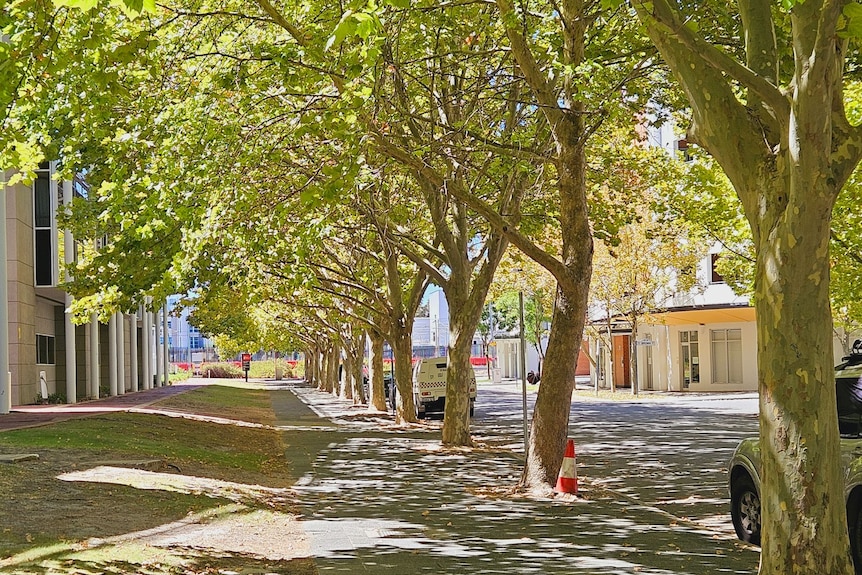
More than one-fifth of the City of Perth is covered by tree canopies, the council says. (ABC News: Greig Johnston)
In the City of Perth, 23 per cent of the LGA was covered by trees in 2024, a spokesperson said.
“A key principle within the city’s approach is the right tree in the right location,” a statement said.
“Species selection and planting design consider a range of factors including site conditions, available space, infrastructure, amenity, and the mature characteristics of each tree.”
The City of Adelaide said its overall canopy coverage reached 33 per cent in 2024 as part of a five-year “Greening Streets” plan.
Men claiming to be council contractors chop Bondi tree
“Potential financial impact on the city related to property valuation is expected to be unaffected by the placement and overall coverage of street-side trees,” a spokesperson said.
“It’s also worth noting that [South Australia’s] median house price is up 10.39 per cent over the past 12 months.”
A spokesperson for the City of Darwin said most homes there were built between 10 and 20m away from a street verge and would therefore not be impacted by close trees.
Darwin’s canopy coverage was impacted by Tropical Cyclone Fina in 2025 and damage assessments are ongoing, but tree planting factors in risk to public safety, infrastructure and the city’s liveability, a spokesperson said.
Canberra’s total canopy coverage dropped by 22.7 per cent in 2020 to 21.8 per cent in 2025 — mostly because older trees had reached the end of their lives.
Nature strip trees were planted according to infrastructure standards that set minimum clearance distances from homes, driveways, paths and kerbs, the spokesperson said.
The City of Hobart did not respond to the ABC’s questions by the time of publication.