
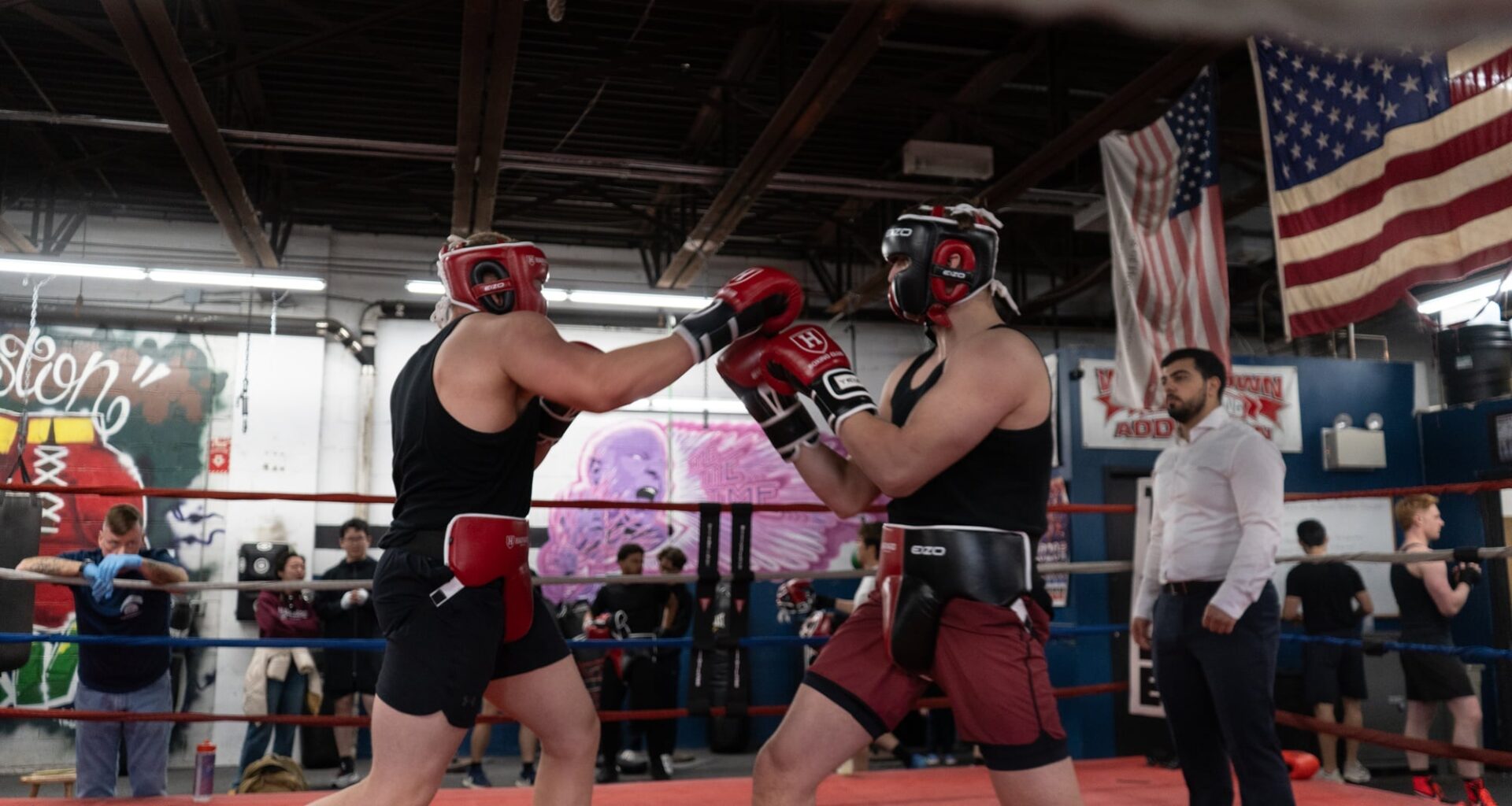
With 20 seconds left in the final fight, hollering spectators drown out the sound of red gloves striking against skin. In the ring, Harvard Law School’s Rafael Santa Maria in the red corner and Babson College’s Lenny Castillo in the blue corner, leave it all out on the ring. The crowd “ooh”s at the skillful dodges and landed jabs, while from the red corner, Head Coach Joe Lake interjects with instructions, motivation, then a countdown — “10 seconds!”
This is Fight Night, the Harvard Boxing Club’s showcase. The gymnasium where they practice each week has been repurposed: folding chairs fill quickly, so most of the approximately 60 people in the crowd — many of them here to support their friends — stand on every side of the ring among punching bags and other equipment.
Boxing Club President Aram Bagdasarian ‘27 calls time, and the fighters double over to catch their breath. He raises both fighters’ hands in the air, prompting whistles and resounding applause. At Fight Night, there are only winners.
Boxing exhibitions such as Fight Night are a long-standing tradition at Harvard. The sport has been part of campus athletic life since at least 1857. Former U.S. Presidents John F. Kennedy ’40 and Theodore Roosevelt, class of 1880, were both involved in boxing at Harvard, and training was even mandatory for students during World War II.
Over the years, Harvard’s boxing program has changed shape and fluctuated in popularity. The push to make boxing an official intercollegiate sport dates back to at least 1922, when 400 undergraduate students — including the captains of the football, hockey, baseball, crew, and track teams — signed a petition to the Harvard Athletic Commission. That year, around 250 Harvard boxers practiced daily at Hemenway Gymnasium.
But by 1938, intercollegiate boxing had suddenly disappeared. “No one can quite remember exactly why it was even given up,” The Crimson reported in 1956. Interest briefly resurged , but was soon crushed the National Collegiate Athletic Association stopped sanctioning the sport in 1961. The Harvard Boxing Team was then “demoted” to the Harvard Boxing Club, though members continued to train.
In the decades since, the National Collegiate Boxing Association has attempted to bring college clubs back into competition. Though Harvard’s club does not currently participate, under Coach Lake’s leadership, they are gearing up to eventually join.
Lake brings decades of experience. With 35 years training professional fighters, he has worked with world champions Sam Soloman, Dan Rosenblatt, and Mickey Ward, as well as Joe Rogan. Though he became head coach in 2024, Lake has long been at Harvard as the wrestling team’s striking coach, where he worked with Olympic bronze -medalist Bekzod Abdurakhmonov in the 2010s.
In 2020, boxing came to a brief halt due to the Covid-19 pandemic. But since then, intercollegiate boxing has again hit a resurgence. Lake thinks that this renewed interest is because, in a world where so much of life is readily available through a screen, “kids want to do something hard.”
“So they want to try boxing,” he adds.
This year’s club has several fighters new to the sport. For Harvard Divinity School student Jiamin Li, Fight Night marks her first ever boxing match. She says demonstrating her mastery of the fundamentals feels like a big accomplishment. “I think that’s the beautiful thing about boxing, is that it’s really all about mastering the fundamentals and the basics and learning how to move your body well.”
Li says she “came to the team and found it to be a very welcoming environment of people from all experience levels.” She was introduced to the team by her friend, Hank Young, also both in the Divinity School and showcasing their skills in a Fight Night match.
When Harvard fighters face their teammates in exhibition bouts, they often hug as soon as the referee calls time. Outside the ring, they cheer each other on.
Beyond beginners, the club also draws experienced fighters to continue their training. Bagdasarian, the Club president and referee at Fight Night, competed for the national boxing team back home in Armenia. Trained under the Soviet-style of boxing, he says he has continued to love the sport because of “the discipline that it requires, and the amount of action and full work and brain that you have to put into the fight itself to actually succeed.”
Amari Urquhart ’27 says he lost track of his childhood passion for martial arts during the pandemic. In college, the Boxing Club offered a way back. “It was a great way for me to stay fit but get also involved with a new community and tap back into my roots a little bit,” he says.
Members say that the club brings together a uniquely diverse group of students who foster each others’ success in and love for the sport. “We have people from all schools around, from all kinds of backgrounds, from all different types of different countries coming. And I think that’s what makes our Club really beautiful,” Bagdasarian says.
For Lake, boxing teaches lessons that extend beyond the ring. He thinks that later in their careers, students will continue to be fearless by recalling their experience boxing. He hopes that they remember these matches in difficult moments down the line, as proof of what they’re capable of. “I actually went in there and I got physical with someone. I fought with someone, and I held my own,” he says he hopes they remember.
At the start of each Fight Night match, fighters express their individuality through personalized intro songs. For Li, it is 360 by Charli xcx. The emcee introduces boxers with their chosen nicknames — from “The Ace” to “Unemployed But Needs The Money.”
Early in the night, many in the crowd seem unsure how to react to the intensity of the fighting. But by the final matches, the energy has shifted, and the audience shouts encouragement and reacts audibly to every throw.
As Fight Night ends, fighters file out holding flowers and chatting with friends who came to watch. They shake hands with their coach as they leave and thank him for his support.
Lake, after saying goodbye to a fighter, turns back to say how proud he is of everyone’s performances. “We’re only going to get better. And I can see the enthusiasm around the University.”
As Coach Lake puts it: “Harvard University’s Boxing Club is back.”
—Staff writer Nelli U. Rojas-Cessa can be reached at [email protected].