
Researchers from the University of South China and Purdue University have successfully employed artificial intelligence (AI) to create a new high-strength, ductile 3D-printable form of steel.
The new metal is also rust-resistant, cheap to make, and faster to produce. This is a big deal as making strong steel is typically something of a trade-off.
The stronger the steel becomes, the more brittle it typically becomes (i.e., it is easier to snap). Conversely, when steel is designed to be more ductile (flexible), it tends to become weaker.
This new steel, however, manages to combine both strength and ductility, which is a very rare achievement indeed. And all thanks to some innovative use of AI.
This, the team explains, was achieved by feeding the AI with 81 physical properties of metals. That included, but was not limited to, atomic size
electron behavior, and sound speed through metal, etc.
Using AI to design stronger steel
Using this information, the AI was tasked with looking for patterns that could help make strong yet flexible steel. After some time, the AI managed to design a new alloy using iron, chromiun and small amounts of other metals like nickel, manganese, copper, silicon, aluminum, and carbon.
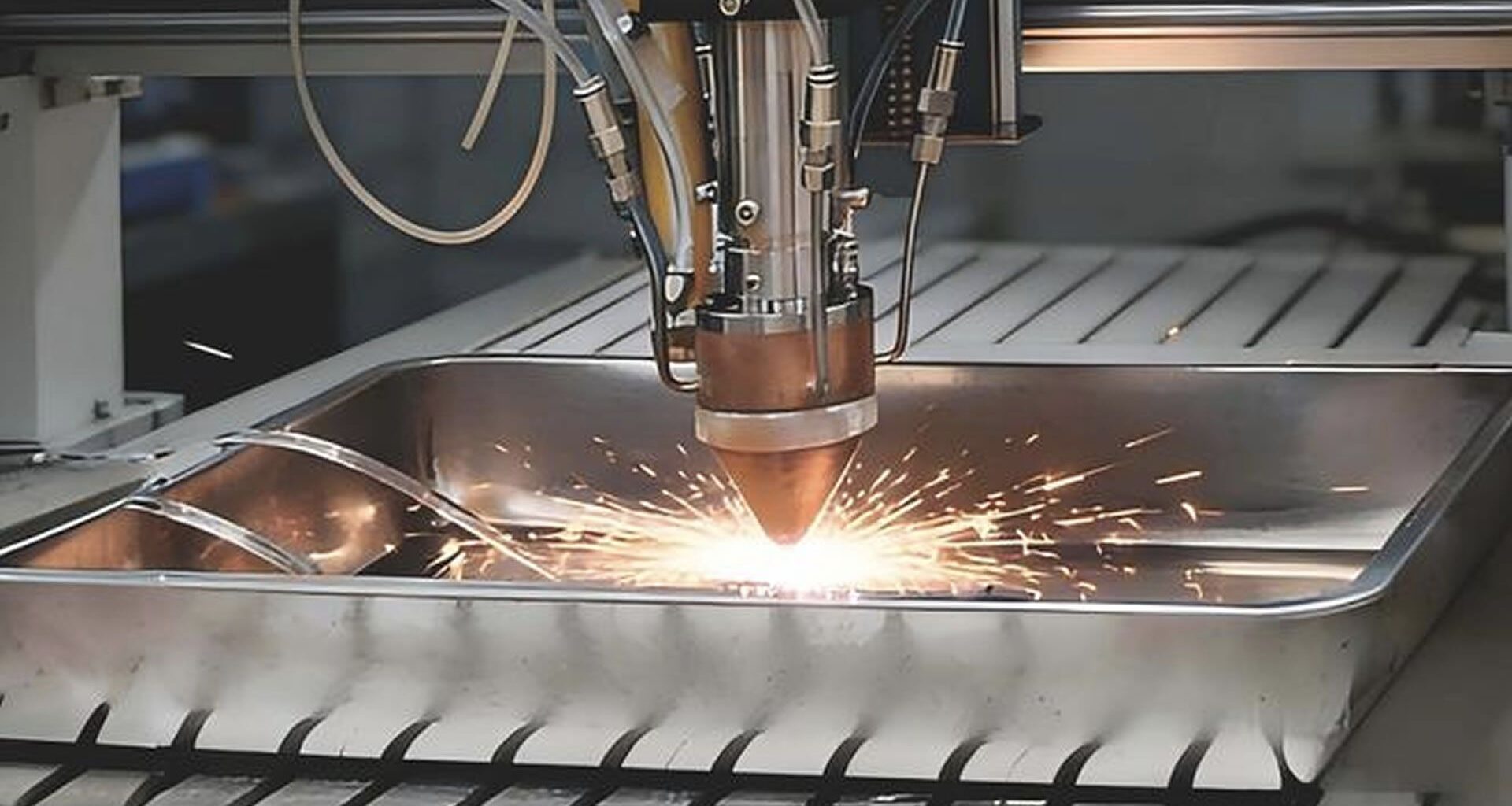
All of these are non-exotic and generally relatively cheap too, which is a bonus. Using this mix, the team then used a special laser metal 3D printer called Laser Directed Energy Deposition (LDED) to create parts using the new alloy.
This process sees laser melt metal powder and then build parts layer by layer. It is widely used in aerospace, military, and heavy engineering. Following the printing process, the team found that the parts only needed 6 hours or so of treatment, which is a surprise, as typically most high-performance steels need multiple heat treatments to finish.
This can take days, and is generally very expensive, energy- and time-intensive. A big win-win all around.
According to the team, the new alloy is both strong and flexible thanks to thin nano-particles inside its structure. These particles help stop cracks from spreading when the metal is put under stress and strain,
The alloy also has some “shock absorber” zones that can take the stress and deform instead of the metal snapping. According to the team, the new alloy is also rust-resistant thanks to some of its included metals.
Interesting industrial applications
Typically, in steel, inclusions like chromium tend to get locked away in carbides over time. This leaves weak spots where rust can form and proliferate if not treated.
In the new alloy, chromium is kept evenly spread in the metal, with copper particles helping push chromium back into place if it moves. This provides the alloy with much improved corrosion resistance, even rivalling stainless steel.
As for its physical properties, under testing, the team found that the new steel has a strength of around 1,730 MPa, which is very impressive. It also has a ductility of 15.5% stretch before breaking. That’s something like a 30% improvement over the metal’s raw, printed state.
This is impressive and could be very significant for industries like aerospace, military, energy, and heavy engineering. It could, for example, help to produce lighter and more durable aircraft parts.
Its anti-corrosion properties (and strength/ductility) could also be very valuable for things like offshore wind turbines, oil and gas pipelines, etc.
You can view the study for yourself in the journal International Journal of Extreme Manufacturing.