

Venus, once seen as one of the most inhospitable planets in our Solar System, is now the subject of a growing scientific debate. Despite its extreme surface conditions, including blistering temperatures and immense atmospheric pressure, recent research suggests that life may be possible in its upper atmosphere.
In 2020, a team of scientists discovered phosphine, a gas associated with biological processes, in the clouds of the second planet. This finding sparked the idea that microbial life could exist in Venus’s atmosphere.
Further studies, including research conducted by MIT scientists, have added weight to this theory, showing that the building blocks of life could survive in the planet’s acidic clouds, prompting a reexamination of Venus’s potential to support life.
Harsh Landscapes, but Could the Atmosphere Support Life?
The Earth’s Twin surface has long been considered a lethal environment for life. Its thick atmosphere, made up of 95 percent carbon dioxide, traps heat, creating surface temperatures that reach around 464°C (867°F). The atmospheric pressure is 92 times higher than Earth’s, making the surface conditions nearly impossible for any Earth-like organisms to survive. However, a closer look at the upper atmosphere paints a different picture.
According to the new research published in Molecules, MIT researchers, the upper atmosphere, where temperatures range from 0 to 50°C, provides a more temperate environment. In this region, organic compounds such as amino acids and dipeptides have been shown to remain stable, even in the planet’s acidic clouds.
 Venus’ clouds or gases visible from outer space. Credit: Shutterstock
Phosphine: A Clue in the Quest for Extraterrestrial Life
The 2020 discovery of phosphine in Venus’s clouds captured the attention of scientists. Phosphine is a gas typically associated with biological activity, as it is produced by anaerobic life forms; organisms that thrive without oxygen. The detection of phosphine raised the possibility that life could exist in the clouds of Venus, where conditions are less extreme than on the surface.
While the presence of phosphine does not confirm the existence of life, it indicates that its clouds may offer conditions suitable for life. Based on research by MIT researchers, follow-up studies have shown that essential life molecules, such as nucleic acid bases, remain stable in the sulfuric acid-rich atmosphere of Venus.
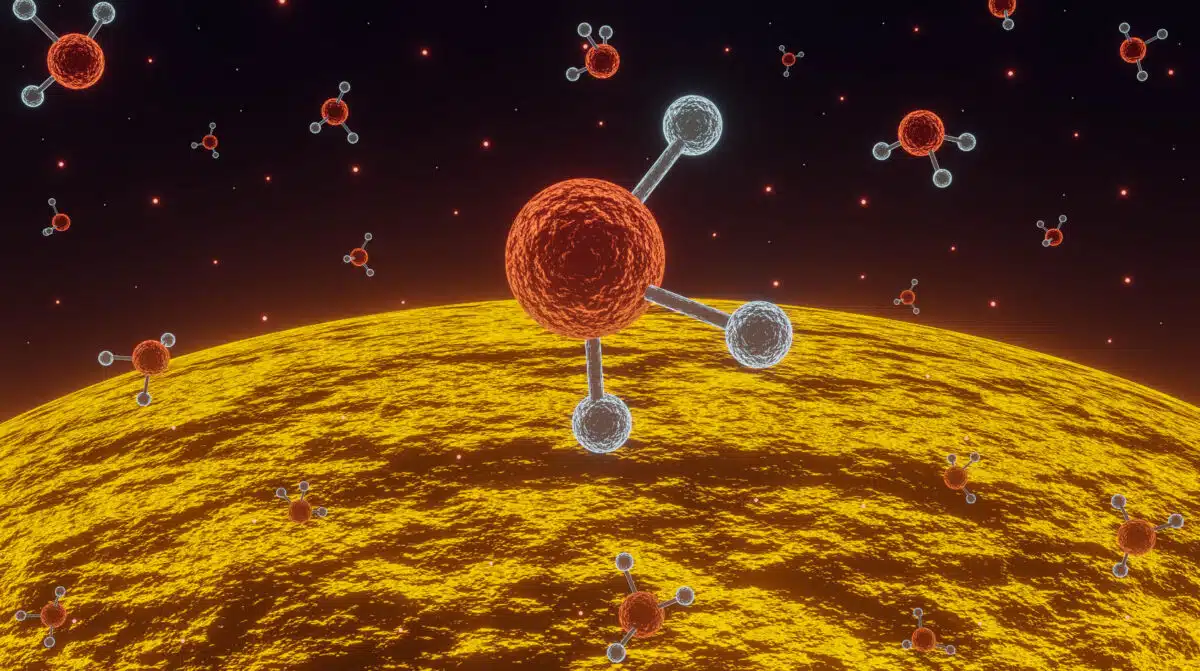 Illustration depicting phosphine molecules (swamp gas) in the clouds of Venus. Credit: Shutterstock
The Vital Piece to Venus’ Building Blocks
One of the most intriguing aspects of the search for life on Venus has been the study of cyclopentanes. These five-membered ring structures, which resemble the sugar backbone of DNA, have been identified as potential candidates for supporting life in Venus’s clouds. MIT researchers have examined whether cyclopentanes could serve as a substitute for the sugar molecules found in DNA, a key component of genetic material.
“Life requires far more sophisticated molecular structures—particularly complex polymers—to perform biological functions. In particular, the need for genetic polymers with functional and structural properties similar to RNA and DNA seems to be the universal requirement for life, regardless of life’s underlying chemistry,” the research team explained.
The study revealed that cyclopentanes could function as a replacement for the sugar component of DNA. This finding is significant because it suggests that Venus’s environment could support genetic-like structures critical for life. As the researchers explained:
“Identifying genetic polymers that resist degradation in concentrated sulfuric acid becomes a critical step to study the possibility of life in environments where sulfuric acid is a dominant liquid.”
While Venus has traditionally been considered a barren, lifeless world, recent discoveries suggest that its upper atmosphere may be more hospitable than previously imagined. With evidence of organic molecules and the identification of structures similar to those in DNA, Venus is becoming an intriguing target for future space exploration.