
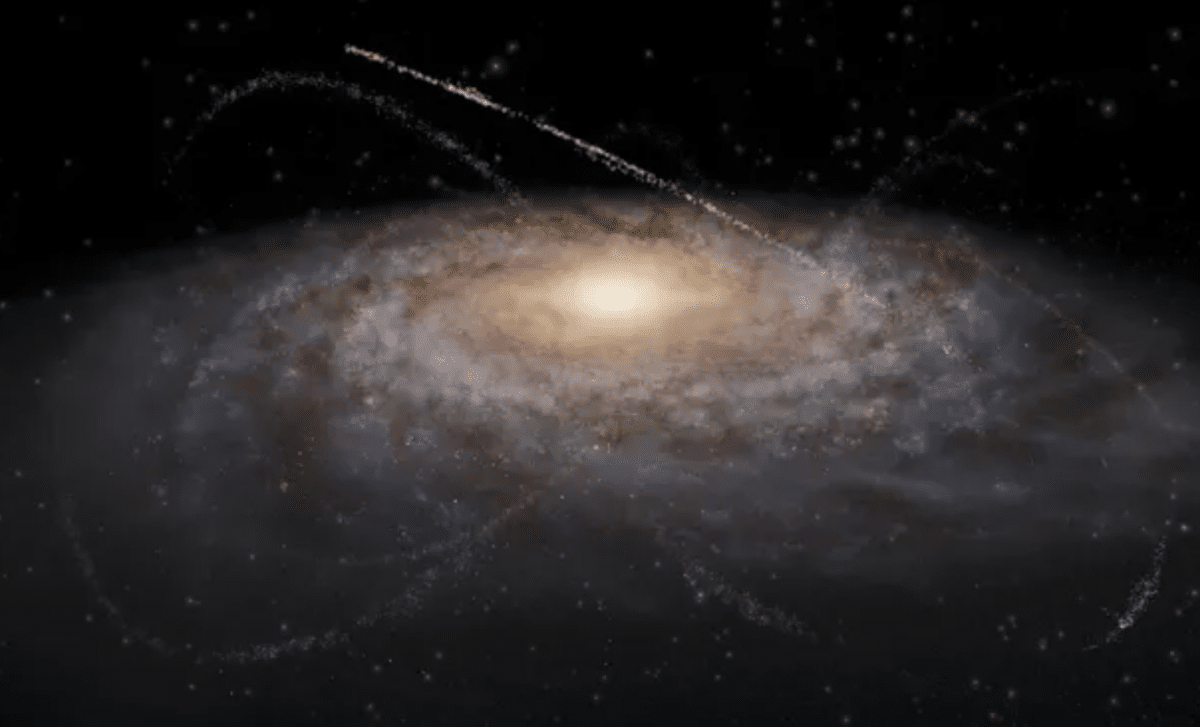
Astronomers have identified dozens of previously hidden star streams in the outskirts of the Milky Way. These long, faint ribbons of stars, remnants of ancient galaxies and star clusters, could unlock the mysteries of the galaxy’s evolution and the elusive dark matter that holds it together. The new study, led by the University of Michigan’s Yingtian “Bill” Chen, uses innovative algorithms to expand our understanding of the Milky Way’s structure and dynamics.
Hidden Star Streams Revealed
For years, astronomers have sought to uncover the hidden secrets of the Milky Way’s outer regions. Now, thanks to a new study published in The Astrophysical Journal, a major breakthrough has been made. Using data from the European Space Agency’s Gaia mission, a team of scientists has identified 87 new stellar stream candidates in the outer edges of our galaxy. These star streams, which are the remnants of destroyed dwarf galaxies and star clusters, offer astronomers an unprecedented opportunity to study the forces that shaped the Milky Way and its elusive dark matter.
The findings were made possible by the development of a novel algorithm, called StarStream, created by the study’s lead author, Yingtian “Bill” Chen. Unlike previous methods that focused solely on visual patterns, StarStream uses a physics-based model to predict the location of these star streams. This approach resulted in a dramatic increase in the number of identified stellar streams, from fewer than 20 to 87, vastly improving the sample size for further research.
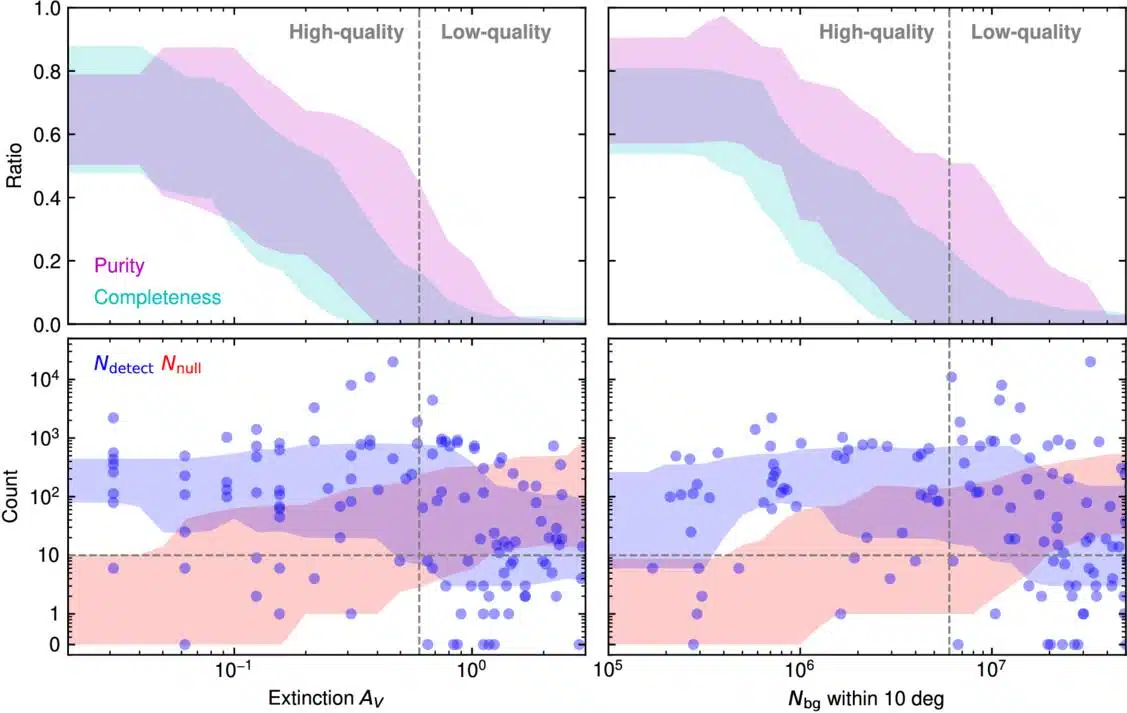 Detection quality metrics of StarStream by C25. Top row: purity (magenta) and completeness (cyan) as functions of the progenitor’s extinction AV (left) and background density as characterized by Nbg within the 10° search radius (right). Bottom row: number of detections in the null test (Nnull; red) as a function of AV and background density. We also show the number of actual detections when applying StarStream to MW GCs as blue lines, with individual detections shown as circles. Shaded regions represent the 25%–75% ranges, smoothed by a Gaussian kernel with bandwidth = 0.2 dex for AV and 0.4 dex for Nbg. We show our threshold for high-quality detection, AV < 0.6 and Nbg < 6 × 10⁶, as vertical dashed lines. We also show the horizontal line to indicate the minimum selection threshold Ndetect = 10.
Credit:The Astrophysical Journal,
Why Star Streams Matter: Mapping the Milky Way’s Mass
Star streams are more than just visually stunning phenomena; they are powerful tools for understanding the Milky Way’s mass distribution, including its mysterious dark matter halo. According to the study’s co-author, Oleg Gnedin, a theoretical astrophysicist at the University of Michigan, these streams provide valuable insight into the gravitational forces that have shaped their paths.
“It’s like riding a bike with a bag of sand, only the bag has a hole in it,” Gnedin said. “Those grains of sand are like the stars left behind along their trajectory.”
The stars that make up these streams are remnants of galaxies or star clusters that have been torn apart by the Milky Way’s gravitational forces. As these streams drift through space, their shape and movement serve as a record of the forces that have acted on them over time, making them ideal for mapping the galaxy’s mass. This is especially important for studying dark matter, an invisible substance that accounts for a significant portion of the Milky Way’s mass but has never been directly observed.
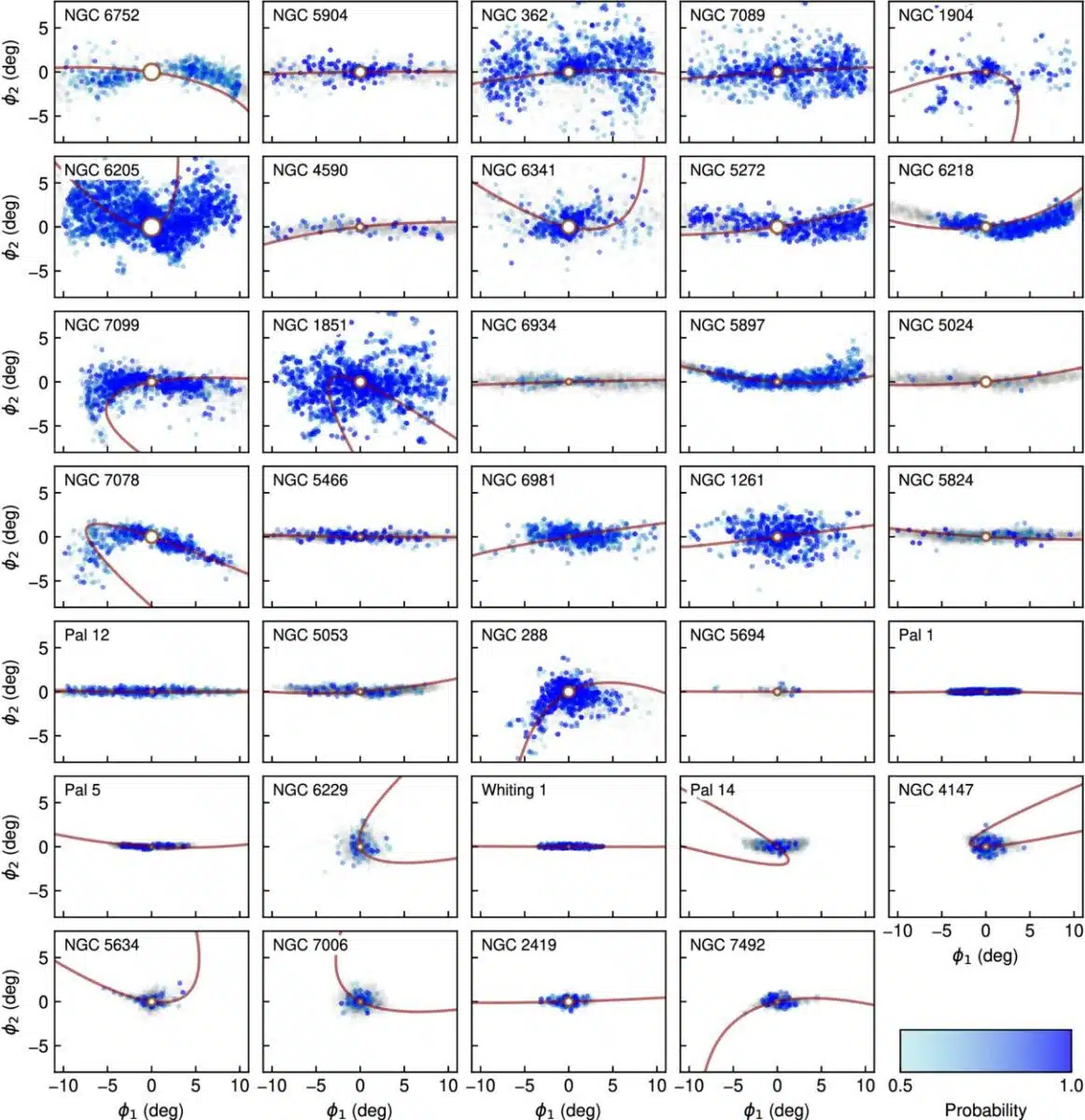 Detections of stream members (blue circles) around 34 MW GCs in the high-quality sample (AV < 0.6 and Nbg < 6 × 10⁶). We show these streams in the great circle frame (ϕ1–ϕ2) centered on the progenitor GC. Streams are placed in descending order of the length r90. Each star is color coded by the stream probability, as indicated by the color bar. The tidal radius of the GC is shown as the brown circle. We show orbits of progenitor GCs as solid brown curves, projected in the same great circle frame. For comparison, we also show the simulated streams (gray symbols).
Credit:The Astrophysical Journal,
The Role of Technology in This Discovery: The StarStream Algorithm
One of the most exciting aspects of this discovery is the innovative algorithm that made it possible. Chen’s StarStream algorithm works by applying a physics-based model to predict the locations of stellar streams, rather than relying solely on visual identification. This method is a significant departure from traditional techniques, which often missed streams that didn’t fit neatly into expected patterns.
“It turns out that it’s a lot easier to find things when you have a theoretical expectation of what you’re looking for when you have a simple phenomenological picture,” Gnedin explained.
The algorithm uses known physical principles to search for star streams that may not be as visually distinct but are still present in the data. This is why so many more streams have been identified in the new study compared to previous efforts.