
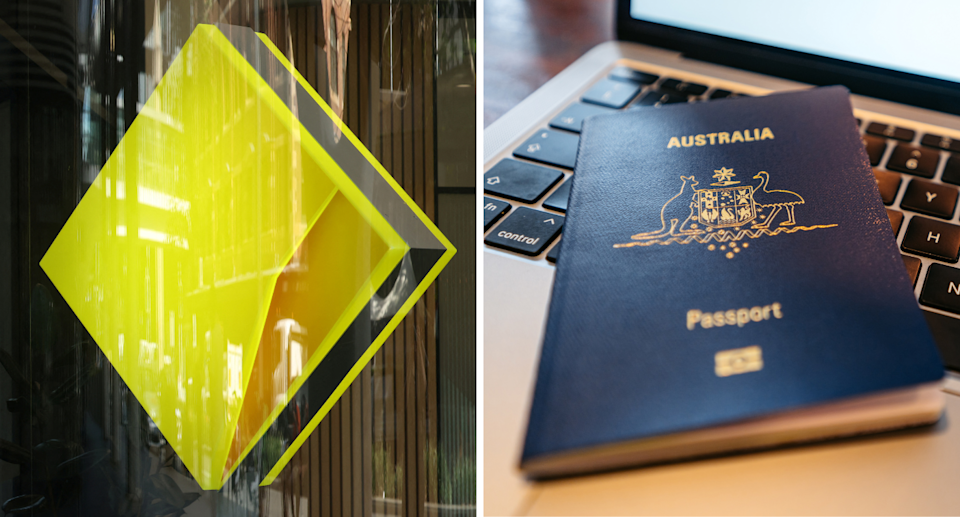
 New Commonwealth Bank customers can now use their passport to quickly verify their identity in the bank’s app. (Source: Getty)
Aussies can now join Commonwealth Bank in under a minute by tapping their passport against their phone. The Big Four bank has introduced a new way for customers to sign up to the bank and verify their identity using near-field communication technology (NFC).
Most Aussies already use NFC technology on a daily basis, including to tap their card at checkout or pay with their phone or smartwatch. All current Australian passports are ePassports and come embedded with an NFC chip which stores the passport holder’s biometric data, including their photo and personal data.
CBA general manager of customer identity and digital security, Sascha Thiel, told Yahoo Finance more than 2,700 customers had used the new app feature since it initially launched at the end of January.
RELATED
“It’s a really simple, safe, secure way to prove your identity online. The real benefit for customers, it’s super fast. You could join the bank now in under one minute,” Thiel said.
Previously, customers needed to provide two document types to prove their identity, such as a passport and a driver’s licence, when applying digitally.
Now, they just need to scan their ePassport when using NFC in the app.
“The technology can read the cryptographically encrypted data direct from the ePassport to then populate the application form and also unlock the government-issued biometric, or the selfie, that’s stored and encrypted in the chip,” Thiel explained.
“We ask the customer to take their own selfie. We can then match the two to confirm it is the customer, and the customer is who they say they are as well.”
Do you have a story to share? Contact tamika.seeto@yahooinc.com
 Customers use their phone to scan their passport chip and then take a selfie to check everything matches. (Source: Commonwealth Bank)
Several banks now require new customers to take a selfie when opening accounts online to confirm their identity.
NAB introduced the requirement for select products in September. New customers scan their identification document, like a driver’s licence or passport, and hold their phone up to their face to match the image.
The application form is then pre-populated with data from the identification document, which the bank said reduces onboarding time by around 50 per cent.
NAB group chief operating officer Les Matheson said it was a “simple and fast way” to protect customers against fraud and scams by making it harder for criminals to open fraudulent accounts.
ANZ Plus also uses selfie verification for customers when they set up an account, reset their PIN and increase their payment limits.
Thiel said the bank’s ePassport move and selfie requirement would similarly help combat scams and “synthetic identity fraud”, which is where criminals combine real and fake information to create fake identities.
“Having really strong levels of identity verification and assurance levels upfront definitely combats fraud and scams and money muling because we have a higher level of assurance that the customer is who they say they are,” she said.
Thiel said CBA does not store the cryptographically encrypted information that is unlocked.
Australia was one of the first countries to introduce ePassports in 2005.
Now 20 years on, all Aussie passports are ePassports and more than 180 countries have passports with an NFC chip.
Thiel believes CBA is the “first in Australia” and the first in Asia Pacific to use the ePassport capability in banking, with only a few banks globally currently doing it. However, she expects adoption will increase over time.
“It’s technology that we use every day, and we’re applying it now to a banking context,” she said.
The app feature is currently only available to those in Australia. The bank plans to expand it to those who are overseas later in the year, so people moving to Australia can also utilise the technology.
Get the latest Yahoo Finance news – follow us on Facebook, LinkedIn and Instagram.