
Australian taxpayers have helped nearly 50,000 migrants purchase new homes since mid-2023 under just one generous scheme available to non-citizens.
A viral social media post over the weekend has reignited debate online over whether the taxpayer-funded grants should be restricted to Australian citizens only.
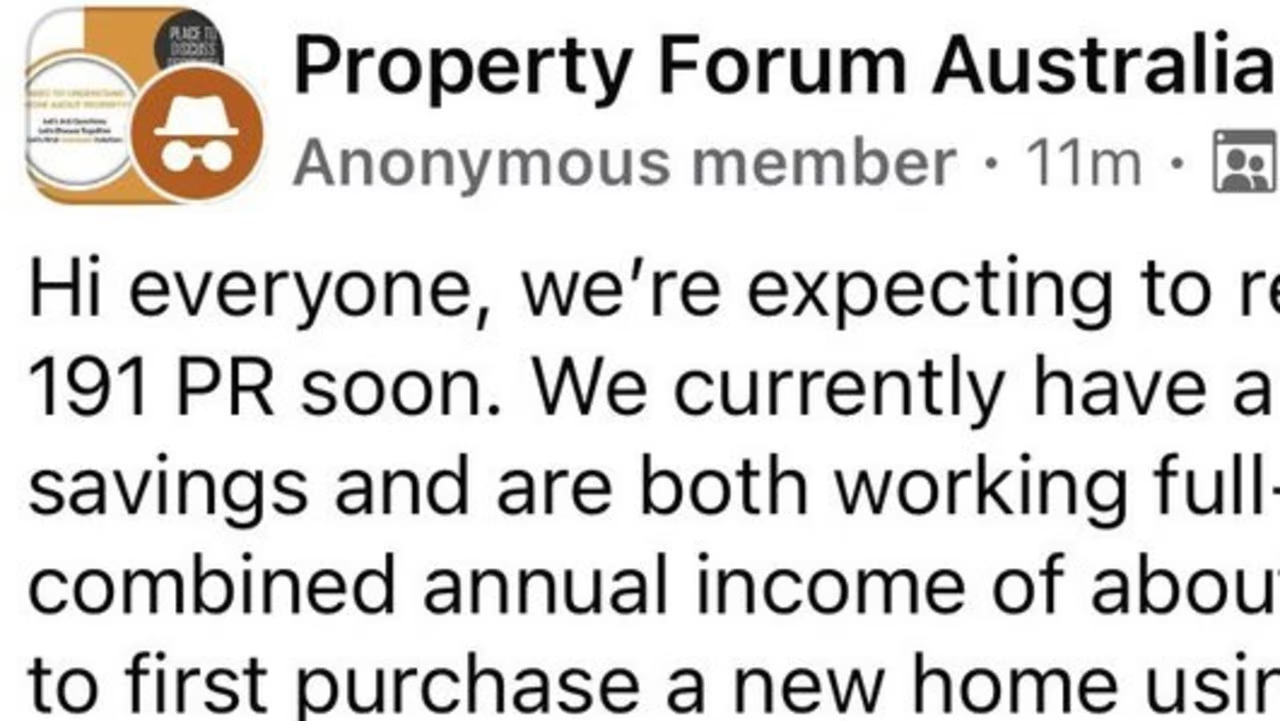
“Hi everyone, we’re expecting to receive our Subclass 191 PR soon,” an anonymous user posted in the Property Forum Australia Facebook group.
“We currently have around $200,000 in savings and are both working full-time with a combined annual income of about $180,000. Our plan is to first purchase a new home using the First Homeowner Grant, and then, 3-6 months later, but an investment property. We just wanted to check whether this strategy is realistic and achievable with our current income and savings.”
MORE: ‘Flipped’: Next Aus migration hotspot exposed
An image of the post went viral on X after being shared by user Nath Sparky, who wrote, “New migrants don’t push up demand of house prices … oh wait.”
Permanent residents in Australia can access a range of first homeowner grants.
The First Home Owner Grant (FHOG) Scheme, introduced in July 2000 to offset the effect of the GST on home ownership, is a one-off $10,000 grant that has been available to both Australian citizens and permanent residents since it launched.
The national scheme is funded and administered by each state and territory under their own legislation, but no publicly available data exists on how many non-citizens have accessed the FHOG.
Last financial year, NSW paid 972 First Home Owner Grants worth a total of $9.74 million, according to Revenue NSW.
MORE:Sad update on what to expect in Aus in 2027
Meanwhile the federal government’s 5% Deposit Scheme, first introduced in 2020 as the First Home Loan Deposit Scheme, expanded eligibility to permanent residents in mid-2023, sparking a flood of applications.
As of this month, more than 48,000 permanent residents have used the scheme — or nearly one in five of the total since its inception.
Under the scheme, administered by Housing Australia, the government acts as a guarantor for the remaining 15 per cent of the deposit, allowing the first homebuyer to avoid paying lenders mortgage insurance (LMI) while remaining responsible for all costs and loan repayments.
The 2% Deposit Scheme, offered to single parents or legal guardians, is also offered to permanent residents.
However only Australian citizens are eligible for Help to Buy, a shared equity scheme which sees the federal government contribute up to 40 per cent of the cost of a new home and 30 per cent of an existing home.
Last week, Housing Australia announced that since eligibility for the 5% Deposit Scheme was expanded in mid-2023 to include permanent residents and joint applicants, “more than 48,000 permanent residents have been supported, along with over 2700 family and friend group applicants purchasing a home together — demonstrating the Scheme’s responsiveness to the needs of modern households”.
Access to the scheme was further expanded in October through the removal of income caps, increased property price caps and the introduction of unlimited places.
“This represents a significant milestone for Housing Australia and the Australian government 5% Deposit Scheme,” Housing Australia chief executive Scott Langford said in a statement last week.
“Working closely with Participating Lenders, the Housing Australia team has successfully scaled the Scheme from 10,000 places in its first year in 2020, to supporting more than 300,000 Australians today to take this important step towards the security of home ownership.”
Housing Australia said since 2020, the scheme had resulted in close to 30,000 new homes built, contributing to Australia’s housing supply.
Emma Jarman, executive leader of the 5% Deposit Scheme, said the agency was proud of the outcome.
“Our very first participant in 2020 was a teacher purchasing their first home in regional NSW,” she said. “Since then, thousands more have been able to enter the housing market sooner — including the 300,000th and 300,001st participants, a young couple purchasing their first home in Sydney.”
Figures from the Australian Bureau of Statistics (ABS) show new first homebuyer loans rose 6.8 per cent in 31,783 in the December quarter, driven by the expansion of the 5% Deposit Scheme and introduction of the Help to Buy Scheme.
“There was strong growth across all borrower-types this quarter,” ABS head of finance statistics Dr Mish Tan said in a February statement.
“The number of first homebuyer loans rose 6.8 per cent, investor loan numbers rose 5.5 per cent and the number of owner-occupier non-first homebuyer loans rose 3.6 per cent. This was the largest rise in the number of first homebuyer loans since the December quarter 2023, and their value increased by 15.5 per cent.”
Independent property researcher Cameron Kusher noted that migrants could still access Australian first homeowner grants even if they already owned property overseas.
The 5% Deposit Scheme stipulates only that to be eligible, the applicant must be “a first homebuyer or have not owned a property or land in Australia in the last 10 years”.
The FHOG excludes those who have “owned a home or other residential property in Australia, either jointly or separately, before July 1, 2000”.
“I once asked the ABS if they knew if migrant buyers were accessing first home buyers grants and if they knew whether these migrant buyers already had homes overseas,” Mr Kusher wrote on X.
“They said they did not know. I suspect anyone buying their first property in Australia largely has access to FHB grants.”
He added that “the issue isn’t about migrants having access to the scheme when they get PR, it’s not being able to check if these migrants already own homes elsewhere”.
“Why should we be helping FHB (of any race or nationality) that already own home elsewhere?” he wrote.
Housing Minister Clare O’Neil has been contacted for comment.