
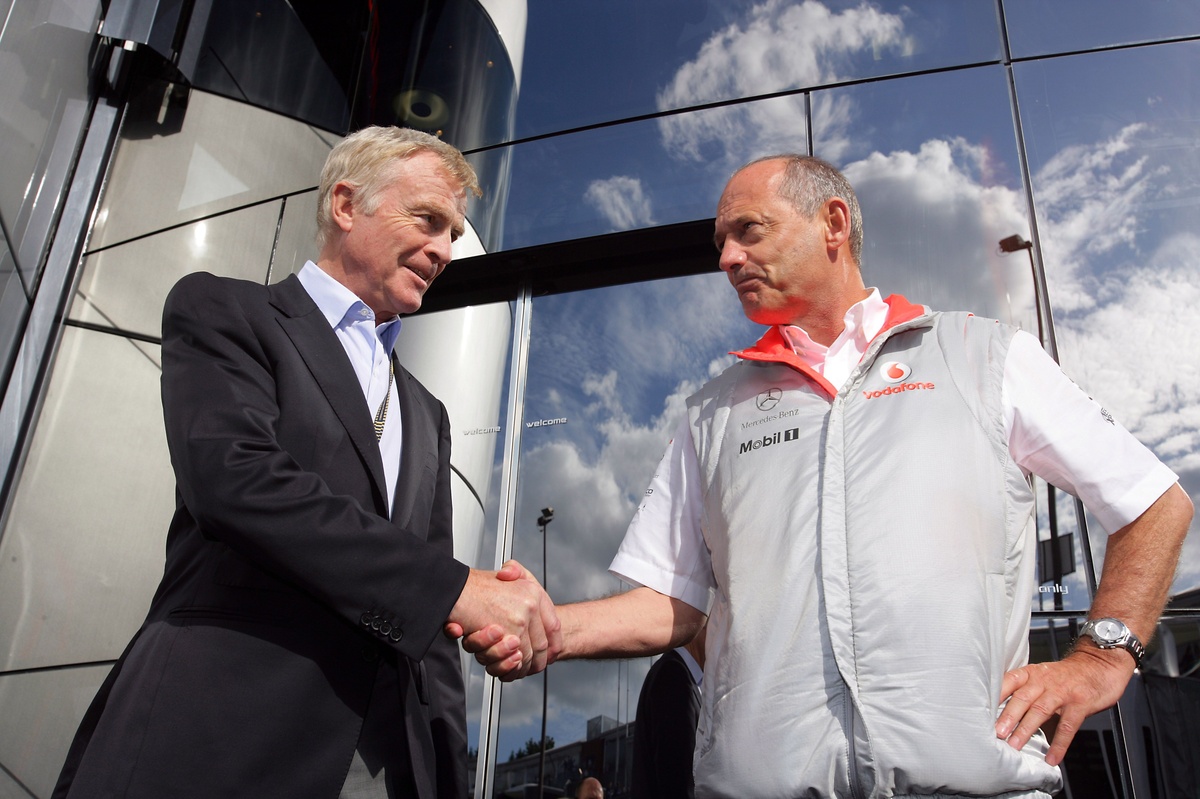
Every time a Formula 1 car takes to the track, a band of furtive photographers will be tasked by each team to take specific shots of their rivals’ handiwork. No sooner has the camera button been pressed than the image is on its way to the photographer’s paymaster. By the time the car in question has completed its lap, the required close-up is already under intense scrutiny in an opponent’s technical department many miles away.
This is just as acceptable as, say, Adrian Newey chewing the end of his pencil while taking a good look at the rear of a rival’s car when exposed to the world on the starting grid. If Newey produced a tape measure and got down on his hands and knees, that would be a different story. There’s an unspoken etiquette that draws the line between snooping and stealing.
Back in 2007, rogue employees from McLaren and Ferrari drove a coach and horses across this demarcation boundary in a brazen manner that shook F1 to its core. No one had seen it coming. Least of all Ron Dennis, the authoritative team principal at McLaren.
In truth, Dennis and McLaren had been focused on an in-house battle that was proving increasingly tricky to manage in 2007. It was Lewis Hamilton’s debut season in F1. It had been anticipated that he would play the dutiful novice to Fernando Alonso, the double world champion having been signed for his experience and readiness to take the fight to Ferrari.
That theory had been blown apart at the first corner of the opening race in Australia when Hamilton cheekily ran round the outside of his team-mate. Hamilton had since won two grands prix and was leading the championship going into Silverstone. But plans by the media to major on this intriguing story were put on immediate hold by an astounding press release from McLaren on the Tuesday before the British GP.
In stark terms, the statement said a senior official at McLaren was under investigation regarding the receipt of technical information from Ferrari. McLaren intended to make no further comment. If anything, such formal reticence merely kicked the paddock rumour machine into overdrive in the urgency to discover who, what, where and when. Particularly the first two.
It did not take long for the name of Ferrari’s Head of Team Performance Development to emerge. Nigel Stepney had a long and distinguished history in F1, having started as a mechanic with Shadow in 1979, worked his way up to chief mechanic with Benetton and been instrumental in Ferrari’s run of success under the auspices of Ross Brawn. As Michael Schumacher rattled off a string of victories, Stepney was credited with running the race team’s slick internal organisation. When Brawn took a sabbatical following the retirement of Schumacher at the end of 2006, the restructuring of Ferrari’s technical department did not meet Stepney’s approval, particularly the appointment of the former head of human resources as Brawn’s replacement.
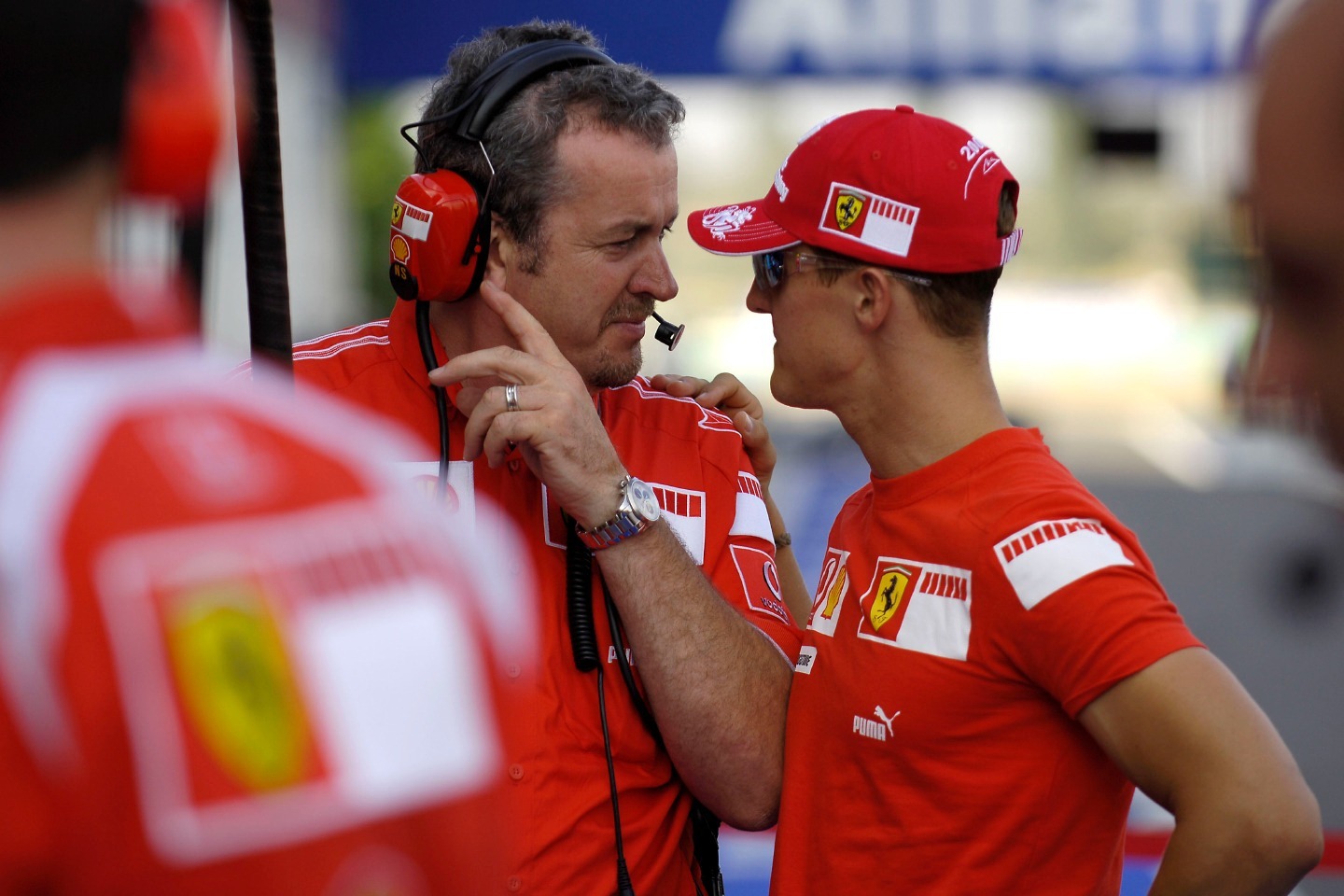
Stepney enjoyed success at Ferrari with Schumacher and Brawn, but things soon turned sour
Photo by: Ferrari
Stepney’s dissatisfaction had escalated rapidly. That frustration became public in February 2007 when a perfectly timed call by Autosport’s Steve Cooper elicited Stepney’s admission that he intended to leave, despite a year remaining on his contract. The subsequent publication of this news had not gone down well with Ferrari. Then the story took a more sinister twist.
Prior to the Monaco GP in May, Ferrari alleged that one of its F1 cars had been sabotaged by the addition of powder to the fuel tank. Stepney’s name was connected with a formal complaint to the Modena District Attorney. Few in F1 believed that Stepney – had he been minded to knobble a car – would have chosen such a crude method. Nonetheless, this formed the backdrop to McLaren’s bombshell press release prior to the British GP. If Stepney was being fingered as the culprit in Maranello (thanks to a subsequent Ferrari statement naming the Englishman), who was on the receiving end in Woking?
Mike Coughlan was McLaren’s chief designer. The Englishman had learned his trade with various teams, among them Benetton, where he had worked with Stepney. Unlike Stepney, however, there was no reason why Coughlan should be disaffected after five productive years with McLaren. The intrigue accelerated at Silverstone when it became clear that Ferrari had instructed private investigators to visit Coughlan’s home in Surrey, the tip-off having come from another unlikely source; a photocopy shop in nearby Walton-on-Thames.
The majority verdict was that McLaren had indeed been in possession of information belonging to another team, but there was insufficient evidence to prove that this had been employed by McLaren for its own ends. That would change thanks to another extraordinary turn of events nine days later in Hungary
The manager of the reproduction business had been asked by a customer (Coughlan’s wife) to transfer the content of a 780-page printed manual onto more manageable disks. Ninety-nine times out of 100, this would have been done without demur. But the print man knew enough about F1 to appreciate the sensitive nature of the material he had been asked to handle. It’s not every day that a modest photocopy shop gets to deal with a wealth of sensitive technical detail ranging from wind tunnel data, reports on test sessions, drawings of the 2007 Ferrari and a breakdown of budgets and the innermost workings of one of the world’s leading F1 teams. A call to Maranello confirmed suspicions that this was far from Ferrari’s normal way of working.
One of motorsport’s biggest scandals, to be commonly known as ‘Spygate’, had just erupted. The subsequent tsunami effect would engulf F1 and come close to tearing McLaren from its reputable roots.
The implications were so serious that the World Motor Sport Council examined the case at the FIA’s HQ in Paris on 26 July. The majority verdict was that McLaren had indeed been in possession of information belonging to another team, but there was insufficient evidence to prove that this had been employed by McLaren for its own ends. That would change thanks to another extraordinary turn of events nine days later in Hungary.
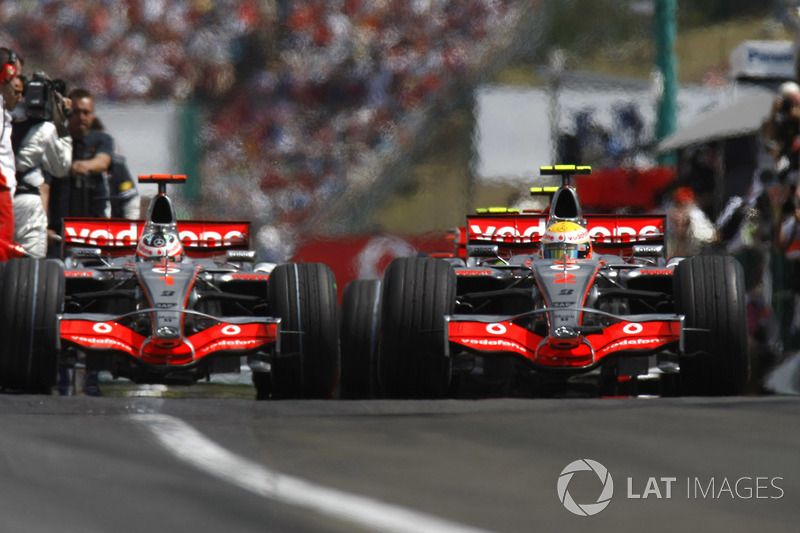
The events of Spygate were heightened by the very public falling out between Alonso and team boss Dennis at the Hungarian GP
Photo by: Steven Tee / Motorsport Images
Qualifying in 2007 involved a convoluted sequence of events that required the drivers in each team to follow an agreed plan that would benefit one driver over the other on alternate weekends. Tension within McLaren, heightened by Hamilton leading Alonso by two points at the head of the championship, went off the scale when Hamilton reneged on the agreed sequence and Alonso responded by holding up his team-mate – for which the Spaniard later received a grid penalty. Furious that Hamilton had gone unpunished, Alonso threatened to make public a series of emails on his laptop if Dennis did not provide the preferential treatment Alonso believed was his due.
Dennis was stunned, not only by such intimidating behaviour, but also by the existence and content of emails he knew nothing about. The communications in question had apparently been exchanged earlier in the year between Alonso and McLaren test driver Pedro de la Rosa as they discussed information that had come from Nigel Stepney, via Mike Coughlan. Alonso would later apologise for his capricious behaviour, by which time Dennis had done what he felt was the right thing by informing the FIA of this latest development.
Finally armed with hard evidence, the WMSC reconvened in Paris on 13 September. After an all-day sitting and powerful legal arguments from all sides, the council found that McLaren was not guilty of incorporating Ferrari’s details on its car, the MP4-22. But it was agreed that possession of the information had bestowed McLaren with a “significant sporting advantage”. For this, McLaren was stripped of team championship points and fined $100million; a record amount for any indiscretion, never mind a charge characterised by inconclusive phrases such as “insufficient evidence”, “impossible to quantify” and “some degree of advantage was confirmed”.
The hearing had revealed that, during the first three races in March and April, Alonso and de la Rosa had been aware of information concerning the technical set-up of the 2007 Ferrari and its operation. Coughlan had supplied these details from conversations and SMS texts with Stepney.
Despite criticism over the hefty fine, FIA president Max Mosley claimed that McLaren had got off lightly and the drivers were fortunate not to have been stripped of their championship points. Mosley would later reveal in his autobiography that the latter choice would have heaped vitriol on the FIA for ruining one of the best championships in years.
The drivers’ title, as it turned out, went to Kimi Raikkonen, the Ferrari driver winning by one point at the final race after taking advantage of the squabbling between Alonso and Hamilton.
Read Also:
It was, as Mosley noted, a convenient result that ruled out accusations of a win for McLaren being distorted by information it should never have had. But as an example of duplicity in sport, Spygate remains far beyond any crafty image captured by the most inventive and daring photographer today.

Watch: Autosport Retro – Spygate 2007 and The Biggest Fine in F1 History!
We want to hear from you!
Let us know what you would like to see from us in the future.
– The Autosport.com Team