
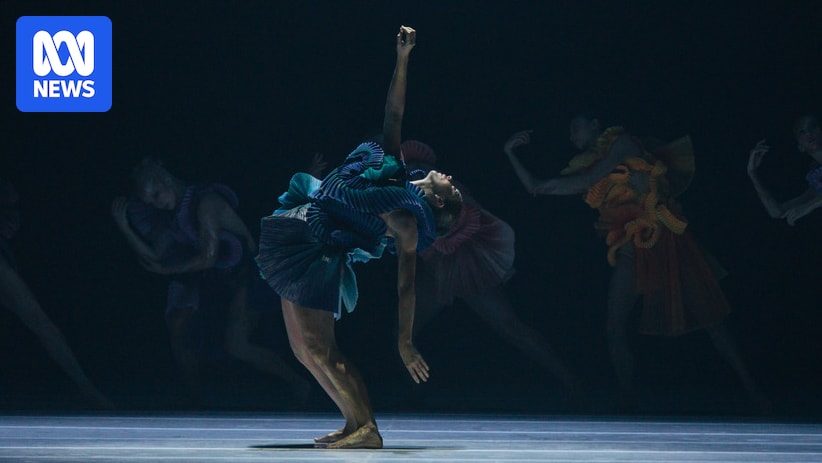
In 1997, Frances Rings was in her early 30s when she danced with the Australian Ballet.
The Mirning dancer and choreographer was part of the ensemble of Bangarra Dance Theatre, Australia’s leading Indigenous dance company, when the two companies collaborated on Rites at Melbourne Festival.
The company’s then-artistic director Stephen Page choreographed the show, which combined classical ballet technique with embodied Indigenous dance, set to Russian composer Igor Stravinsky’s The Rite of Spring, to look at how natural forces shape the landscape.
It went on to tour not just Sydney but New York, Paris and London.
“It was a real game-changer,” Rings tells ABC Radio National’s Awaye! “Two unique companies, both steeped in tradition, were coming together to share the stage and share story.”
Now, Rings leads Bangarra as the company embarks on a new collaboration with the Australian Ballet — its first full-length production, Flora, which opened this week in Sydney.
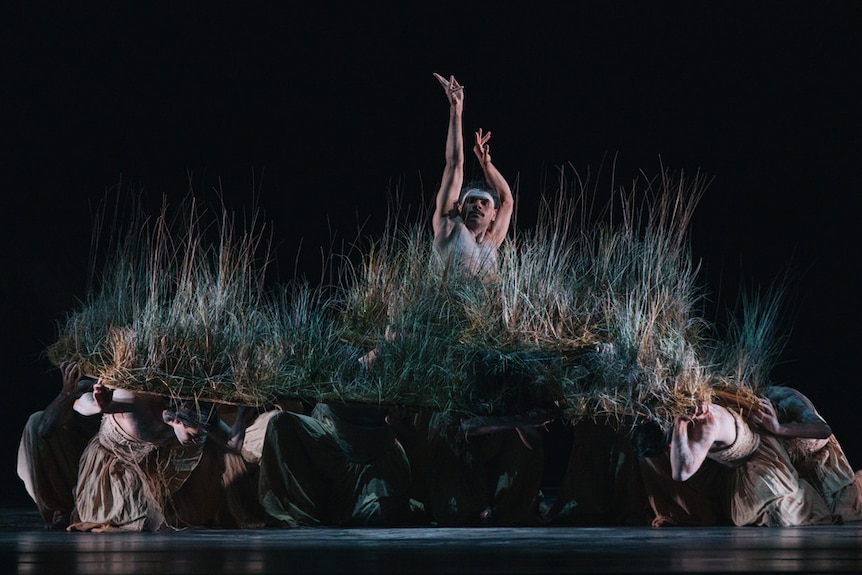
In February, Bangarra won the Golden Lion for lifetime achievement at the international dance festival Venice Danza. (Supplied: Australian Ballet/Kate Longley)
Making Rites
Rites premiered as Bangarra was rising to mainstream recognition, with the company going on to help produce the Indigenous section of the Sydney Olympic Games Opening Ceremony in 2000.
“People were paying attention and audiences were coming to see what this company does,” Rings says.
On the first day of rehearsals, Page warned the dancers collaborating with Australian Ballet would be different, maybe even uncomfortable.
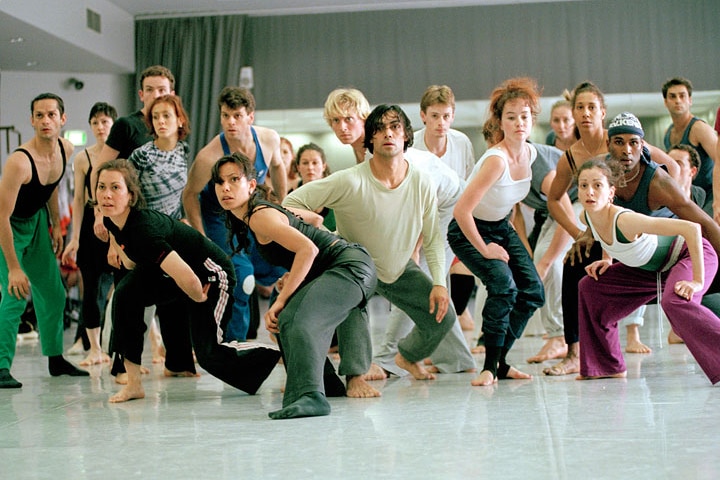
Frances Rings (centre left) with dancers from Bangarra Dance Theatre and the Australian Ballet in rehearsals for Rites in 1997. (Supplied: Bangarra)
Rings recalls he told them: “We have to find a meeting place. We have to move through the discomfort of being so familiar with our own way of telling stories and our own language and movement vocabulary and make space to incorporate what they have to offer.”
It was about “reconciling our own identities to come together to find a shared voice”, she says.
Rings remembers it being silent in the rehearsal room when the dancers from both companies met for the first time.
She wondered: “How are we going to bridge this incredible gulf between not only our two companies, but between [Indigenous and non-Indigenous communities]?”
Listen to Frances Rings on Awaye!
That was made possible by Yolngu songman and cultural consultant Djakapurra Munyarryun, who also starred in Rites. At that first meeting, he sang a song and played the yidaki (didgeridoo) for the dancers.
“He guided us through that process [of meeting] and difficult moments,” Rings says. “He held this incredible space for each of the companies.
“His voice and him playing the yidaki gave us the opportunity to let go and step into the story.”
A songman for Flora
Like Rites, Flora, choreographed by Rings, combines classical ballet technique with Bangarra’s award-winning Indigenous-led storytelling. This time, the work explores plant life in Australia and the relationship between flora and Indigenous peoples.
For Flora, Rings invited a different songman to collaborate with Bangarra and the Australian Ballet: ARIA-winning Kalkadunga composer and musician William Barton.
Barton plays yidaki and guitar, and is known for his collaborations with orchestras around Australia and the world.
When he was 11, he learned the yidaki from his uncle, Arthur Peterson, an Elder of the Wannyi, Lardil and Kalkadunga peoples. Within a year he left school to dedicate himself full-time to music, and by 17 was invited to collaborate with the Queensland Symphony Orchestra.
Since then he’s forged an impressive career, including performing for the British royal family, and with musicians as diverse as Jimmy Barnes and the late Gurrumul in New York.
“William is an incredible artist,” Rings says.
“Much like Djakapurra, he’s just so generous with the way he sees what he does as the place to bring traditions together and create a shared language.”
Barton brings his understanding of working with orchestras to Flora — something brand new for Rings.
It’s part of how Flora is a “meeting place of traditions”, pairing the classical scores expected from the ballet with Bangarra’s embodied choreography.
World-famous yidaki player meets world-renowned string quartet
Hearing a stripped-back version of the score for the first time, Rings admits she felt “terrified”.
“I was like, I don’t think I can do this. It’s beyond me.”
But Barton encouraged her to push through her self-doubt. “[He said] it’s going to sound better. Trust me, it’ll be amazing,” she recalls.
“I had to educate myself, but I love it now.”
Collaborating to make change
Rings feels she, Barton and the dancers from both Bangarra and the Australian Ballet are ready now for the challenge of a work like Flora — one that requires close collaboration not just between artists but between arts institutions.
“It’s all about timing and knowing when it’s right,” she says.
Since before the Voice to Parliament referendum, Rings had been in conversation with the ballet’s artistic director, American-born choreographer David Hallberg.
The two came to lead their respective companies within a few years of each other — Hallberg in 2021, and Rings in 2023.
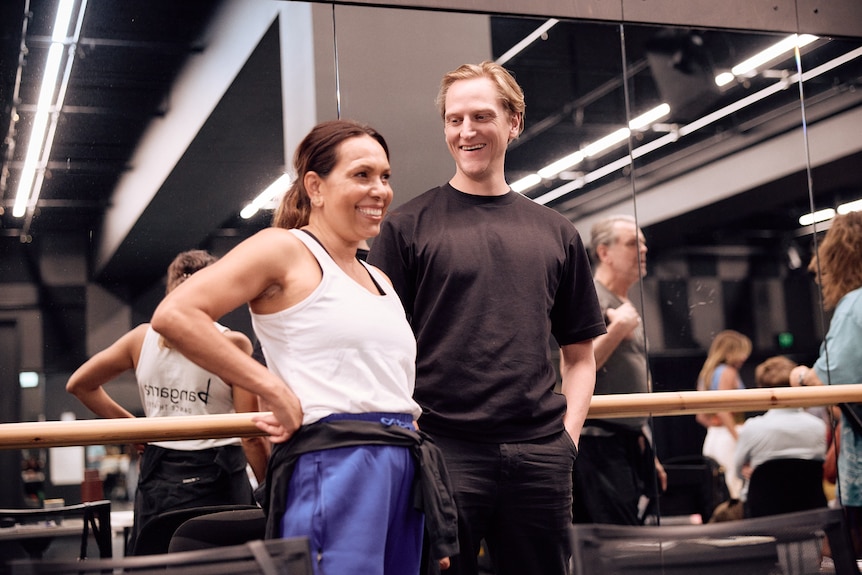
Rings with Australian Ballet artistic director David Hallberg during rehearsals for Flora. (Supplied: Australian Ballet/Daniel Boud)
They talked together about the history between the two companies and what they wanted to do in their new roles, with Hallberg — who Rings describes as “very curious” — reaching out to Rings for insight into her company’s culturally embedded process.
“He loved Bangarra,” Rings says. “It was like nothing he’d ever seen before.
“He was in awe of First Nations peoples and our relationship with Country and our communities, and the way we tell our stories.”
It was during these conversations that Rings suggested the two companies collaborate again, as they had on Rites.
“We were both keen to explore it,” she says.
But it was the failed referendum that proved a turning point.
“I was fired up a little bit,” Rings says.
“I felt disappointed in myself and I felt disappointed I didn’t have a better awareness of what the other side of Australia thought about First Nations people, history and futures.
“I said: ‘We have to do this. We have to reach out to each other’s audiences. We have to use our platform as a moment of change.'”Beauty and truth-telling
Bangarra and the Australian Ballet resolved to work together on a new, full-length show.
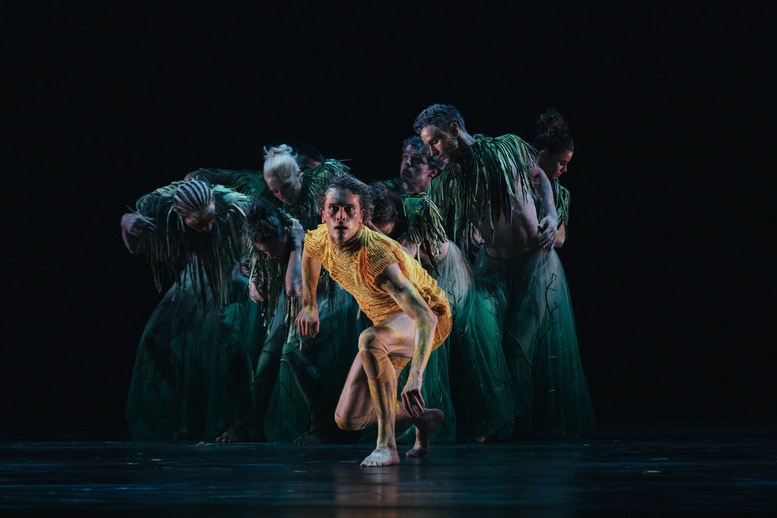
Australian Ballet principal artist Callum Linnane is one of the stars of Flora. In June, the Ballarat-born dancer will leave the ballet to join the prestigious Hamburg Ballet. (Supplied: Australian Ballet/Kate Longley)
While the truth-telling that forms one part of the Uluru Statement from the Heart would undeniably be part of Flora, Rings was quick to reassure Hallberg it would “also be about beauty”.
“It can be about celebrating this unique diversity of flora that we have,” she says.
Flora highlights the kinship between Indigenous peoples and plants.
“They hold a deep cultural significance,” Rings explains. “They nourish us. They are indicators for seasonal change that ensure survival and knowledge.
“They are used for our expressions, for our ceremonies, for tools, transportation, for shelter.”
Rings stresses there’s also a political message beneath that celebration. Almost 1,500 species and subspecies of plant are currently listed as threatened by the federal government, with 35 deemed extinct.
“We are in a climate emergency,” she says. “There are important messages that we need to share and that we need to tell.”
The link between plants and First Nations cultures also ties back to the impacts of colonisation, which are still felt by Indigenous peoples today.
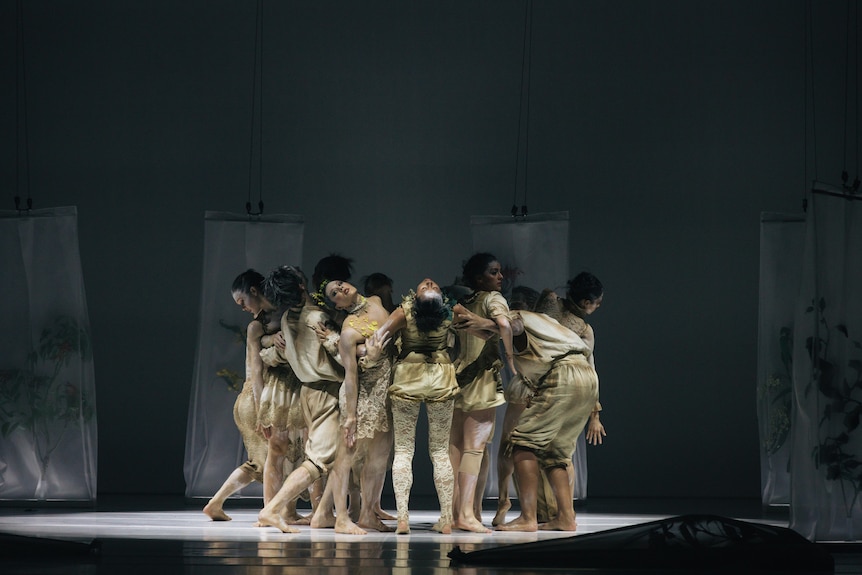
Meriam Mir Samsep fashion designer and artist Grace Lillian Lee — who last year took her clothes to Paris Fashion Week — created the costumes for Flora. (Kate Longley/supplied by Bangarra Dance Theatre)
“Through the lens of flora, we’re able to look back at that impact and trace that from first contact, when Joseph Banks stepped ashore and was collecting plant specimens to take back that are still housed in the British Museum,” Rings says.
“[Flora] is this journey: It celebrates the beauty, the uniqueness of what flora symbolises to us, but also a parallel journey of what colonisation has done to flora and to people.”
Rings hopes Bangarra’s usual audience is excited to see something a little different, and that the ballet’s regular attendees are moved by Flora.
“I hope they open their hearts and their minds to our First Nations stories, to our messages, to our world views, that they see the beauty of what our stories are,” she says.
“At the centre of that is an important message about caring for Country and how that is everybody’s responsibility.”
Flora is at Sydney Opera House until April 18.