
Save
You have reached your maximum number of saved items.
Remove items from your saved list to add more.
AAA
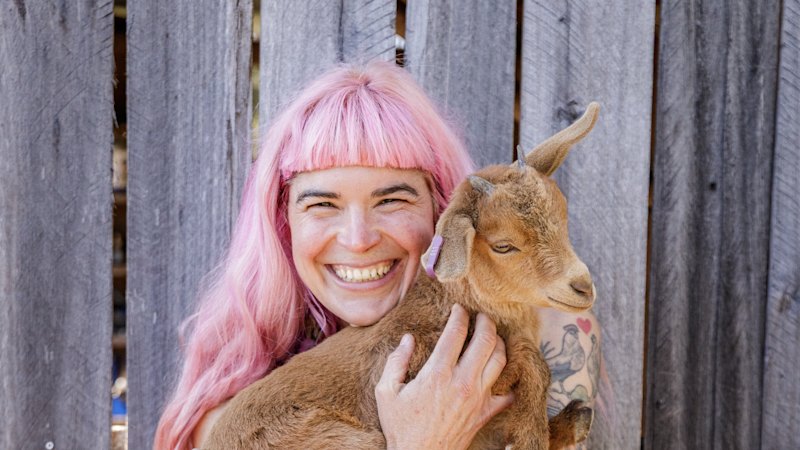
Hannah Molonley, the effervescent Gardening Australia presenter, has always had her hands in the dirt: growing up in inner-city Brisbane, she helped out in her dad’s urban herb nursery. Her mum, meanwhile, worked as a research librarian at the Native Title Tribunal, and by default, Moloney says, she absorbed a strong sense of social and environmental justice.
As well as her TV gig on the long-running ABC series, Moloney works as a permaculture designer and educator, and a climate activist. But she’s never didactic; you can’t imagine her ever lecturing someone about anything, even if they were actually doing it incorrectly, or pushing her ideology onto anyone.
Perhaps that’s why she had so many responses to a survey she sent out seeking answers from everyday Australians about why they garden. Many of us grow our own food when we could simply walk to the supermarket, or cultivate a garden when we could visit a local park. Moloney has been pondering the “why” of these things for decades.
For her new book, Why We Garden, her third after Good Life Growing in 2023 and 2021’s The Good Life, she asked people what it is that draws them to gardening. She also spoke to friends, neighbours and the odd well-known Australian.
“Through my work with Gardening Australia, I see a lot of gardeners, and hundreds of gardens every year, and it’s … incredible the degree we go to, to have a garden,” she says over Zoom from her home in Tasmania.
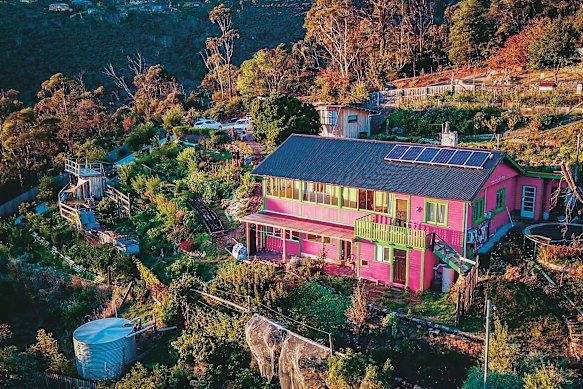 Hannah Moloney’s bright-pink Hobart home. Natalie Mendham
In 2013, Moloney, her partner, Anton, and their daughter, Frida Maria, moved to a .4-hectare property just outside Hobart. Tasmanians (and Gardening Australia fans) will likely know it – it’s the bright-pink house perched on a steep hillside that they have converted to a thriving mini farm, with edible forest gardens, vegetable gardens, an orchard and a clutch of ducks, chickens and goats. They’ve used every scrap of space to grow or nurture everything from bees to vegetables and flowers that they share with the local community.
But as Moloney discovered in her research for the book, just as much pleasure can be derived from even the smallest of spaces. “Whether it’s a balcony or a backyard or a paddock, we put so much time, energy and resources, all of it,” she says.
Moloney is inside her pink house when we talk, a philodendron tendril trailing down behind her, although she professes to be not so great with indoor plants. “But inside, outside, whatever it might be, plants are beneficial,” she says.
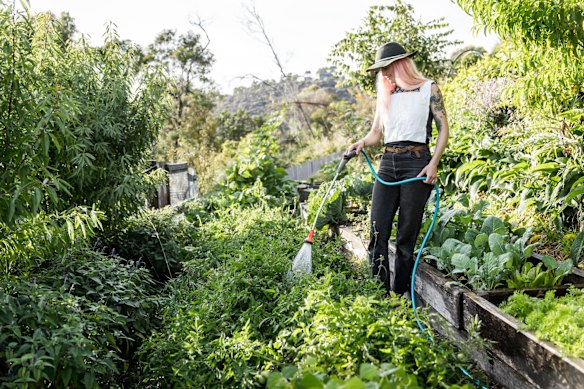 Moloney in her Hobart garden.Natalie Mendham
“There is something else for me in having contact with the original soil and being outside. I think there’s an extra something special there – but indoor gardens are also beautiful and can be absolutely beneficial. I’d never want people to think, ‘oh, it’s not worthwhile because I haven’t got an actual patch of earth’ – it’s always worthwhile. The science behind the benefits has been around for decades, but I don’t think it’s very … valued, like a range of things in our culture.”
She’d like to see this kind of science embedded into education systems, as a way to help people “live well in the world”.
Leveraging her “pretty chunky” social media following, Moloney began canvassing people a couple of years ago. “I also talked to a few dozen people face-to-face: friends, colleagues and some well-known Australians, just asking why they make the time to garden. I wanted some of the more unlikely gardeners as well. Some of those are pretty obvious, but others are like, oh OK, I didn’t know that person gardens,” she says.
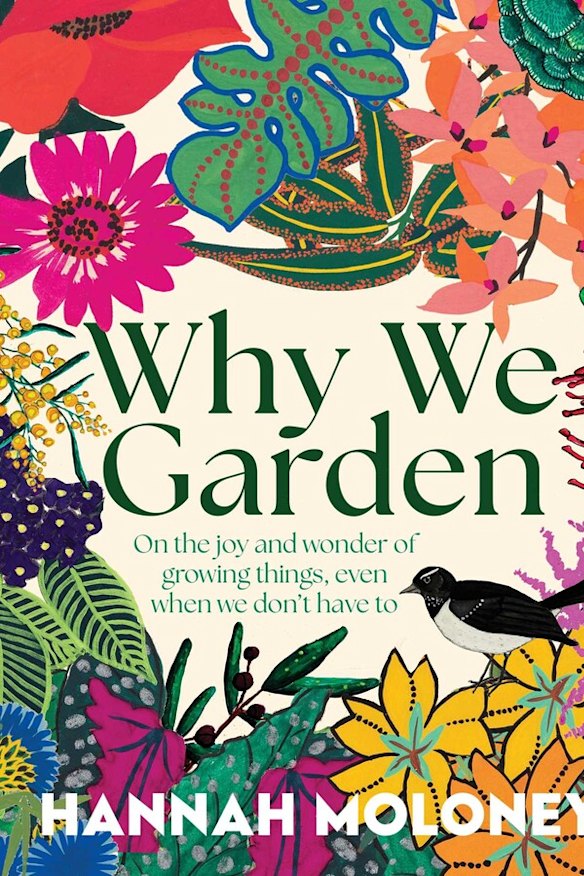
Why We Garden blends philosophy, environmentalism and Indigenous and agricultural history, among which are sprinkled her survey responses from 1500 people.
The book is divided into the reasons for gardening – among them, “for our minds”, “for our bodies”, “to connect with nature” and “to build community” – but by far the most popular response on Moloney’s multiple-choice questionnaire was “for joy”. A whopping 94.6 per cent of people gave this answer, as Moloney says in the book, “a big fat tick”.
Other respondents told her they had started pottering to work their way through grief; some found connection through community gardens, and others began growing food to save money.
TAKE 7: THE ANSWERS, ACCORDING TO HANNAH MOLONEYWorst habit? Leaving and losing garden tools all over our large garden!Greatest fear? That my daughter dies before I do.The line that stayed with you? “Never doubt that a small group of thoughtful committed individuals can change the world. In fact, it’s the only thing that ever has.” – Margaret Mead.Biggest regret? Seeing property on the west coast of Tasmania advertised for $5000 in 2001 and not buying it.Favourite book? Guess How Much I Love You by Sam McBratney. My mum gave this to me as a teenager when I was having a tough time, just a couple of short years before she died – it is deeply treasured.The artwork/song you wish was yours? Any painting by Gwenneth Ngilingili Blitner, an incredible Bornanang-Warmutjan artist – I covet her work.If you could time travel, where would you choose to go? I’d go back to when they were making the internet and make them put in some kind of magic, permanent infrastructure so it could only be used for doing good.
Author Tim Winton talks about gardening as an old instinct, a “body memory of being broke and anxious”, while musician Clare Bowditch says she draws from the lessons and creativity a garden can give us. She tells Moloney that “you only have to make the smallest effort and the creativity of nature will meet you halfway there and then some. That it doesn’t abandon you, that it’s ever present, that it’s often sitting there waiting to be enjoyed and made use of and again back to that generosity”.
Journalist Laura Tingle explains how she finds gardening can focus her mind: “In your darkest moments, it’s so absorbing. You’re drawn into all this stuff that’s happening around you all the time while you’re not even watching.”
Moloney’s life has always revolved around gardening, both personally and professionally, and while she finds it an act of resistance (she sees it as a form of solution-based activism), a way to grow her own food, and to connect with culture and history, she’s an enthusiastic advocate for the benefits of digging in the soil for mental health.
She writes candidly that before Why We Garden was fully under way, she found herself in the “dark and boring hole that is self-doubt”.
“I bloody hate that hole, but I find myself there now and then,” she writes. “The ongoing voice I have in my brain is that I’m worthless and nothing I do could possibly be of use to the world, so why even bother. I was on the verge of canning the whole thing.”
As well as drawing on the voice of her younger self, “Little Hannah”, Moloney talks about how time in her garden helps, “digging something, planting something, mulching something, lying on the ground and breathing in the earth and patting goats – reminds me that I am the least and most interesting thing in this ecosystem of life we live in”.
The book includes research and data about how important access to green space can be. “Being outside, doing a thing, is proven to be wildly useful, and that’s why I’ve shared stories about how it’s helped me with some tricky situations and chronic health issues,” she says. “It cannot be underestimated. It’s not going to solve everything and make everything rosy and hunky-dory, but it can make things a little better. Ok, I still don’t feel great, but I’m a little better. It’s why so many GPs are increasingly telling people they need time in nature.”
Related Article
Moloney talks animatedly about the increase in new housing estates being built with little green space (“I have a real bee in my bonnet about that”), writing (“It’s been an unexpected delight in my career!“), and how she hopes Why We Garden might inspire people to keep – or even start – gardening.
“I think this book is a remembering of the place that gardening holds in humanity’s evolution – the past, the present and also how it can help us into the future,” she says. “I hope it reminds people that (gardens) are not just lawns and agapanthus – no judgment! – but also the significance of gardening. Not just in providing delight or feeding us or for relaxing in, but also the incredibly political role gardens play in evolution, and how we can be in the world.”
She hopes it might also make readers think about access to nature more broadly, not purely through farming and gardening.
“Often gardening is our only access to nature because most people in Australia live in urban centres, and it’s our only point of access. I’d love people to embrace and acknowledge that, oh yes, this little 10 metres or whatever they have, that’s earth! Often we forget that cityscapes are still landscapes,” she says. “But it’s in our DNA.”
Why We Garden (Affirm Press) is out now.