
LOS ANGELES — Sitting in the reserve section more than two hours before first pitch, decked in Dodgers gear, there was no mistaking Luis Guzman for anything but a diehard fan.
His grandfather moved from Brooklyn to Los Angeles when the team made its 1957 cross-country migration. His father took him to games at Dodger Stadium, the iconic park in Chavez Ravine that the Dodgers have called home since 1962.
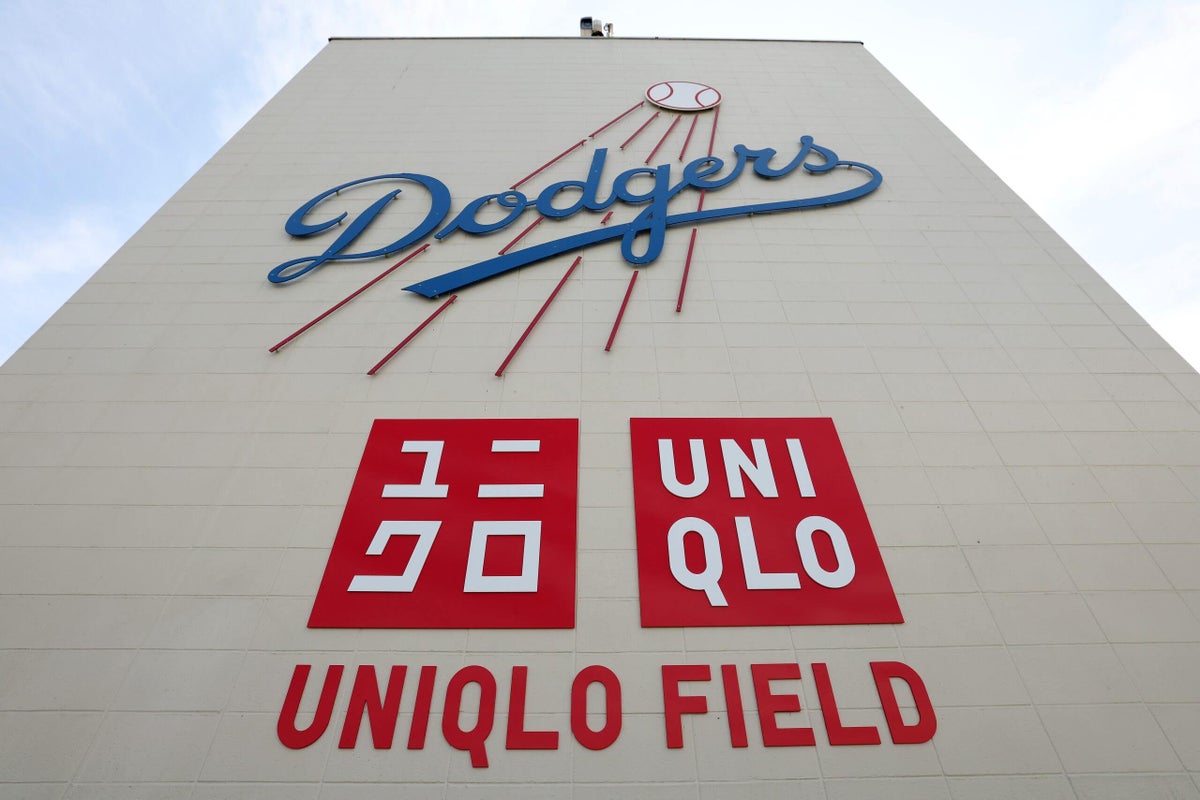
On this late-March evening, Guzman was there with his own son; but something was notably different when compared to the park’s previous 63 seasons. Now, seemingly everywhere Guzman looked, there was corporate advertising, telling him that this was no longer Dodger Stadium at Chavez Ravine; it is now Uniqlo Field at Dodger Stadium.
It’s on the outfield wall. It’s painted on the third base and first base lines. It’s on the concourse. It’s plastered on the front of the Vin Scully Press Box. It lights up the ballpark in center field when the sun sets. It’s everywhere. And to some longtime fans, that is jarring.
“It’s, uh, surprising,” Guzman said. “It’s always been Chavez Ravine, for so long. History, you’re losing a lot of history.
“I love this (stadium). For me, it’s always going to be Chavez Ravine, they can put whatever name they want on it. It’s a bit sad, but everything has to move on.”
As this season began, the Dodgers announced a naming rights partnership with Uniqlo, a Japanese clothing company.
Uniqlo was willing to pay an exorbitant amount to associate itself with one of the world’s most popular sports brands. The five-year deal, which The Los Angeles Times reported was for “more than” $125 million, represents a significantly higher average annual value than other MLB stadiums whose ballparks are strictly named after the company sponsor.
“With Uniqlo, we have established a historic partnership that we’re very proud to present in our ballpark,” Dodgers president Stan Kasten said in a statement announcing the partnership.
“It is a great honor to partner with the Los Angeles Dodgers — such a prestigious, world-class team,” wrote Uniqlo founder Tadashi Yanai.
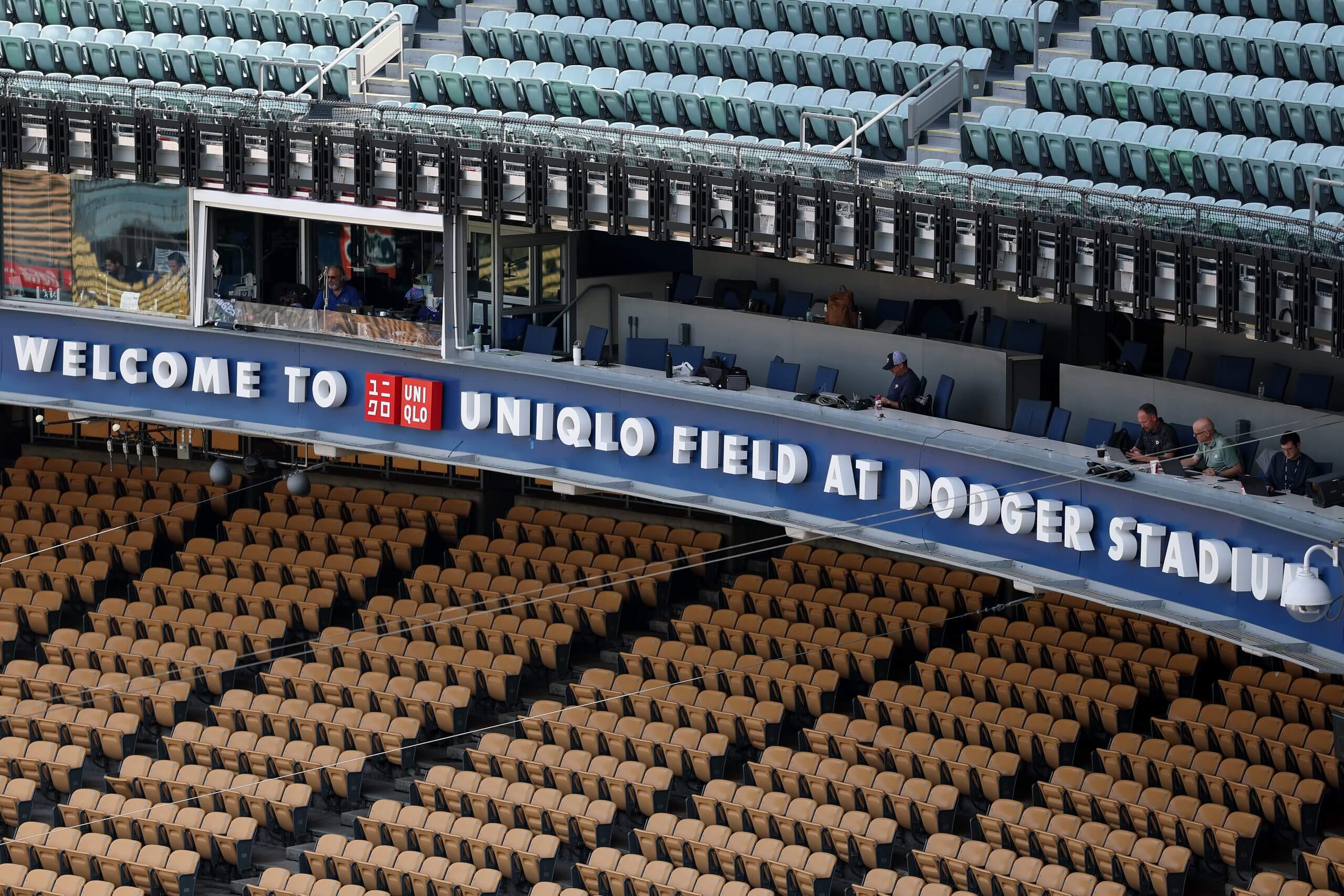
The Uniqlo Field branding is festooned around Dodger Stadium. (Luke Hales / Getty Images)
It’s a deal that, when looked at in the context of other naming rights deals, seemed to be too good for the Dodgers to pass up. But it’s also one that some fans have expressed may subtract from what makes Dodger Stadium, in its old and beautiful way, so celebrated.
“Fenway Park is the home of the Red Sox,” said economist and author Andrew Zimbalist. “If you diminish Fenway Park, then maybe you’re also diminishing the Red Sox in some symbolic way, that might be significant. The Dodgers have made a different calculus.”
More than two-thirds of all big-league ballparks are under some sort of naming rights deal. The eight holdouts are Yankee Stadium, Fenway Park, Nationals Park, Angel Stadium, Oriole Park at Camden Yards, Wrigley Field and Kansas City’s Kauffman Stadium — though the Royals are looking to build a new stadium, and with it, the possibility of securing a naming rights deal.
For certain venues that are viewed as truly untouchable, that type of partnership isn’t a viable option. Wrigley Field has been the name of the Chicago Cubs’ stadium for exactly 100 years, and though Wrigley remains a major candy and chewing gum manufacturer as part of Mars, Inc., the name is not considered to be a corporate sponsorship. Yankee Stadium, home of a franchise defined by its stringent traditions, doesn’t appear to be a candidate for change.
Neither is the aforementioned Fenway Park. The Red Sox have preserved the name of the stadium, while prioritizing brand partnerships in and around the ballpark. Though the team did not rule out ever selling the rights to their century-old venue, they made clear it is not a priority.
“For us, Fenway Park sits in its own category,” Red Sox executive vice president Troup Parkinson said in an email. “It’s part of the identity of the team and the city. The bar for anything that would change that is incredibly high, and truly not something that has ever been a focus internally.”
But the Red Sox aren’t the Dodgers. At least not at this moment in baseball history. And when it comes to teams that have entered the naming rights space, none of those deals look quite like what the Dodgers have done in 2026.
For one, this deal lasts only five years — far shorter than the 15 to 30 years common to most partnerships. And most naming rights deals in baseball are traditionally nowhere near this expensive. Tropicana pays the Tampa Bay Rays between $1-$1.67 million per year for its 30-year naming rights deal, signed in 1997. Even baseball’s most modern naming deal, Daikin Park in Houston, cost the HVAC company just $140 million over 15 years.
In New York, another major market, CitiBank pays the Mets $20 million per year over a 20-year period. That’s still $5 million per year cheaper than naming the playing surface for Hollywood’s hometown club.
Perhaps the most company-friendly deal exists in Colorado, where Coors Brewing Company continues to own the naming rights in the Mile High City for almost nothing. According to The Denver Post, Coors paid an up-front fee of $30 million in 1995 to become a limited partner, and now owns the rights in perpetuity.
“Coors is an icon here in Colorado,” former CEO Pete Coors told The Athletic. He authored the deal more than 30 years ago. “Having our name associated with it obviously makes us feel good. Whether it’s worth it? You tell me what an advertising dollar is worth, and you could make a lot of money. Because nobody knows.”
The reason this Uniqlo deal is so expensive is not rocket science. The Dodgers are a global brand, one whose value has risen 17 percent to $9 billion in the past year, according to Sportico. Their earning power went from around $500 million in 2021 to more than $900 million in 2025; that’s $100 million more than the next-highest club.
This is a team that is capitalizing on a moment. They’ve raised ticket prices, food prices, tour prices and parking prices on fans. They infamously now charge $75 for a refillable Shohei Ohtani souvenir cup. Supply and demand is an undefeated reality.
The Dodgers are spending money, making money and operating in what is a different financial universe.
“(They) are the preeminent team in baseball, and they’re a worldwide brand,” Zimbalist said. “Because of their players, and perhaps the best player ever in Shohei Ohtani — because of that connection in Japan — they have an additional amount of leverage. It is completely anomalous.”
But what is all that money actually buying for Uniqlo?
“A Dodgers fan is not going to say, ‘Hey, I’m taking my son to Uniqlo Field at Dodger Stadium.’ They’re just not going to say that,” Zimbalist said.
He isn’t alone in thinking that. Even the Uniqlo Founder told The Los Angeles Times it’s “a very natural reaction” for fans to eschew the first half of “Uniqlo Field at Dodger Stadium”. And for many in the ballpark during the first series of the season, processing the change was still a work in progress.
Some like it, some don’t. Others don’t really care.
“I kind of get it, but …” said Miguel Paniagua, before his voice trailed off.
“To me it’s Dodger Stadium,” said Leticia Martinez. “I was kind of hoping it would stay that way, and not have a sponsor.”
“It’s disgusting,” said Danielle Medina, a season-ticket holder for nearly a decade. “A lot of ballparks are just advertising. I always said to myself, this is great, because Dodger Stadium doesn’t do that. Now it’s nothing but advertising. … Why are we paying so much in ticket prices?”
For those who like the change, it’s rooted in an understanding that this is reflective of what the team has built. While other franchises pinch pennies on the roster, the Dodgers have spent in ways no other club would even contemplate.
“At the end of the day, they’re putting a good product on the field,” said lifelong fan Juan Barba. “They’re investing back into the team. So if they have to go and get more money and more sponsorships, it’s part of the game.”
“I think it’s great,” said Lily Gomez, a supporter for more than 40 years. “They can put a big sign up, it’s fine. We have attention. We’re No. 1 right now. People are trying to attach themselves to that.”
But when asked if that means the field’s new name will ever become part of her lexicon, Gomez’s answer is swift, and, perhaps, reflective of what makes this particular partnership so one-of-a-kind in the most complicated way possible.
“No,” she said. “Dodger Stadium.”