
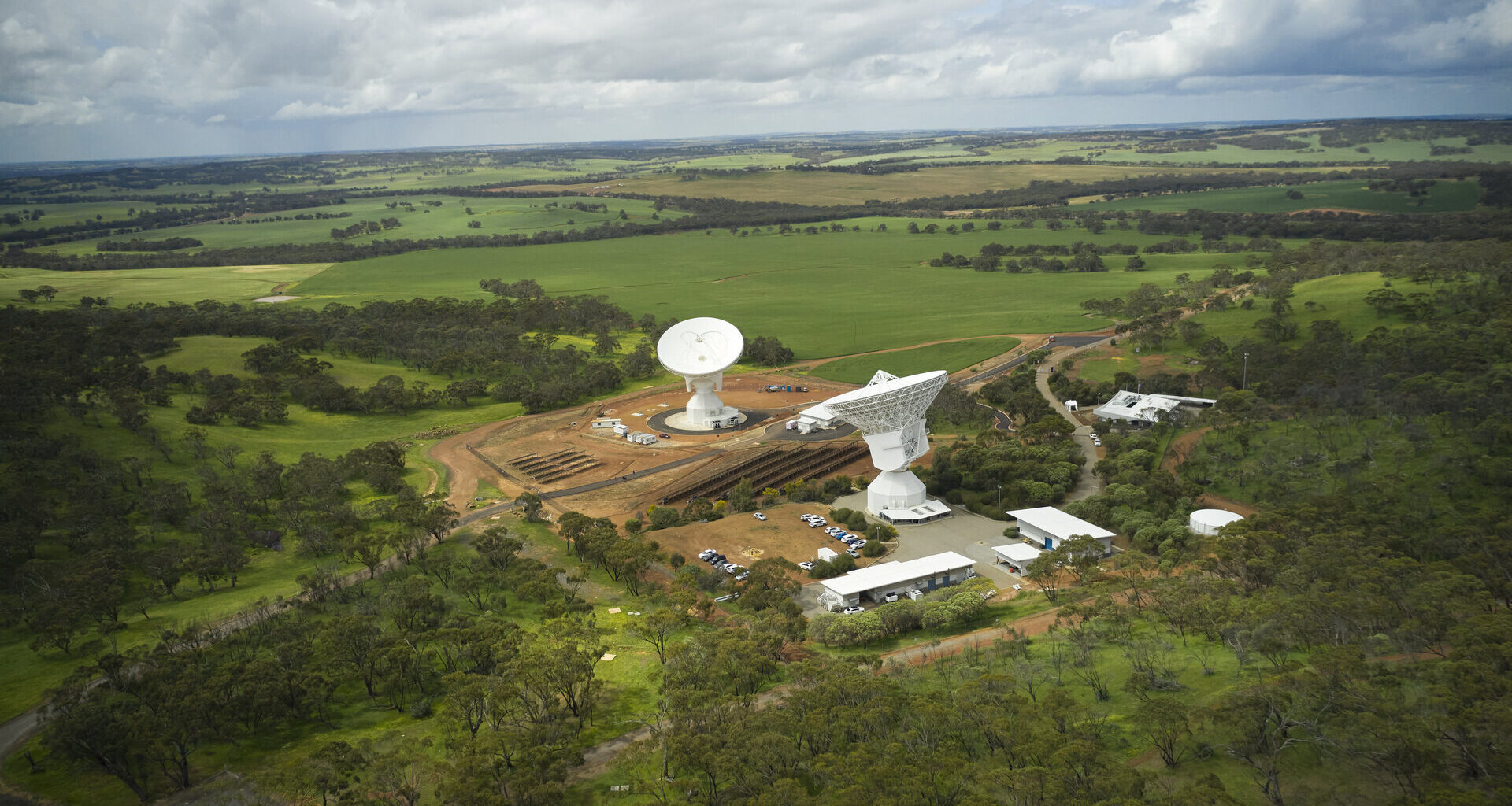
On 1 April 2026, ESA brought its fourth deep space antenna into full operations at New Norcia in Western Australia. DSA 4 gives Europe a significantly stronger grip on spacecraft venturing to the furthest reaches of the Solar System.
The 35-metre dish is ESA’s third deep space antenna in the southern hemisphere. It joins existing dishes at the same Australian site and in Malargüe, Argentina, along with a counterpart in Cebreros, Spain — all part of ESA’s Estrack ground station network.
From First Signal to Full Operations
Engineers inaugurated the antenna on 4th October 2025, then spent months calibrating dish mechanics, radio frequency stages, power systems and timing equipment. On 1st April, the team tracked Euclid, ESA’s dark matter telescope, as the antenna’s first operational contact.
“After so much testing, experiencing the moments when the antenna finally goes online is very rewarding,” said Harald Ernst, a New Norcia station engineer who worked with DSA 4 teams from before commissioning began.
Cooling to Near Absolute Zero to Catch Whispers From Space
DSA 4’s engineers built the system around one central problem: the further a spacecraft travels, the fainter its signal becomes. To tackle this, the antenna chills its receivers to minus 263 degrees Celsius using cryogenic technology. At that temperature, background electrical noise drops sharply, so the system detects transmissions that would otherwise vanish entirely.
A 20-kilowatt radio transmitter handles the outbound side. That output roughly matches the power a small car draws while accelerating onto a motorway. Because radio signals weaken with distance, much like ripples spreading across water, that level of power ensures commands reach spacecraft clearly, even across billions of kilometres. DSA 4 also supports downlink in X-, K- and Ka-band, with K-band uplink capability to follow.
Two Dishes, One Virtual Giant
Two 35-metre antennas at New Norcia now unlock a significant bonus. Together, they can function as a single, larger virtual dish, boosting sensitivity to faint signals beyond what either achieves alone. Additionally, if one antenna needs maintenance, the other keeps coverage intact. ESA’s Network Operations Centre in Darmstadt runs all Estrack stations remotely, around the clock.
DSA 5 Already in Planning
ESA member states approved funding for a fifth 35-metre antenna at the November 2025 Ministerial Council. So while DSA 4 opens a new chapter, Europe’s ground infrastructure is already looking beyond it.
 Published by Kerry Harrison
Kerry’s been writing professionally for over 14 years, after graduating with a First Class Honours Degree in Multimedia Journalism from Canterbury Christ Church University. She joined Orbital Today in 2022. She covers everything from UK launch updates to how the wider space ecosystem is evolving. She enjoys digging into the detail and explaining complex topics in a way that feels straightforward. Before writing about space, Kerry spent years working with cybersecurity companies. She’s written a lot about threat intelligence, data protection, and how cyber and space are increasingly overlapping, whether that’s satellite security or national defence. With a strong background in tech writing, she’s used to making tricky, technical subjects more approachable. That mix of innovation, complexity, and real-world impact is what keeps her interested in the space sector.