
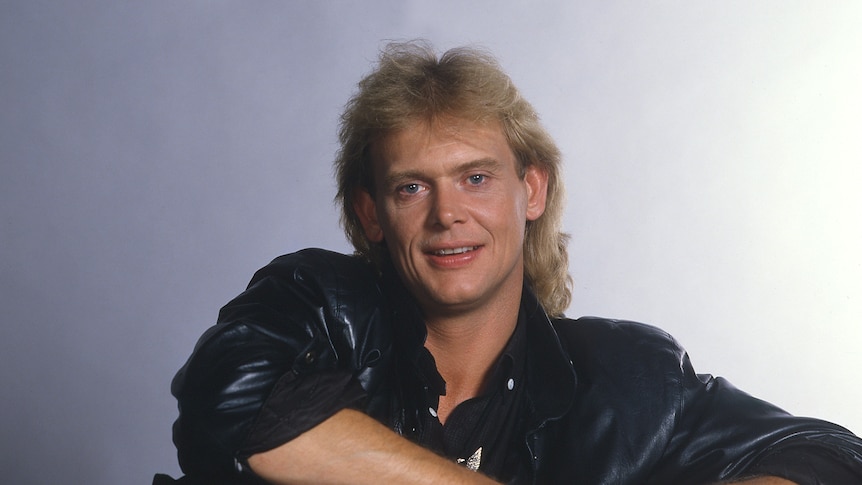
How did John Farnham, Australia’s perennial pop sweetheart, find one of his most popular songs unexpectedly implicated in current debates over hate speech legislation?
It began when Queensland artist James Hillier — also known as “Nordacious” — created a series of artworks. One depicted the arrest of 18-year-old woman who was wearing a singlet with a recently banned phrase printed on it during a protest in Brisbane. The woman at the centre of the artwork is flanked by two large policeman who have hold of her arms. (She was subsequently released without charge.)
A second artwork depicted Queensland Premier David Crisafulli wearing a blue tie with the Star of David on it, pointing at a state map and saying: “from Brisbane River, to Moreton Bay: I’ll decide what you can say”.
The third work shows Farnham’s smiling face and glorious eighties bouffant, along with slices of watermelon and the words “River to the Sea” — a line from his 1988 chart-topping song “Two Strong Hearts”:
We’ve got two strong hearts
We stick together like the honey and the bee
You and me
We’ve got two strong hearts
Reaching out forever like a river to the sea
Running free.
Two weeks after Queensland passed legislation outlawing use of the phrases “from the river to the sea” and “globalise the intifada” in certain contexts, Hillier said the police got in touch him. They were following up on a complaint they had received about the use of a banned expression.
The legal basis of these actions
Queensland’s Fighting Antisemitism and Keeping Guns out of the Hands of Terrorists and Criminals Amendment Act 2026 amends the Criminal Code to make it an offence to publicly recite, distribute, publish or display a “prohibited expression” in a way that “might reasonably be expected to cause a member of the public to feel menaced, harassed or offended”. The penalty for this offence is a fine or two years imprisonment. The only two expressions that are specified in the legislation are “from the river to the sea” and “globalise the intifada” — slogans frequently used by pro-Palestinian protesters.
The offence provision does create a “reasonable excuse” defence . It provides that a person can argue that they used the phrases for “a genuine artistic, religious, educational, historical, legal or law enforcement purpose”. At the same time, the “evidential burden is placed on the defendant” to show that such a “reasonable excuse” applies.
This is why banning these phrases is deemed so controversial: the legislation is focused on slogans that are political in nature — it is what lawyers call “content specific” rather than setting out general laws prohibiting hate speech. Concerns along these lines were voiced in submissions made by academics and civil society advocates to the Queensland Parliament’s Justice, Integrity and Community Safety Committee. Many of these submissions expressed apprehension about banning slogans that have such contested meanings: some groups understand the slogans as emancipatory calls for resistance, while others experience them as expressions of hate.
The effects on artistic freedom
James Hillier said that when police told him they were investigating a complaint involving the use of banned expressions, they did not specify which artworks they were referring to. Erring on the side of caution, he removed the three pieces from his website he thought were most likely to fall afoul of the legislation. It has been reported that police are also investigating a mural in South Brisbane by Sydney-based street artist Scott Marsh, which likewise features John Farnham, slices of watermelon and the lyrics “river to the sea”. The lyrics have become the centre of a graffiti war, being painted over and reapplied repeatedly.
We believe these images featuring so iconic a figure as John Farnham are provocative contributions to the public debate over the expression “river to the sea”. As such, they are doing precisely what art is meant to do. Farnham’s likeness adds a jarring, almost comedic dimension to the artwork, in the way it juxtaposes the ultimate “good bloke” with a highly contentious phrase. Moreover, the use of his actual lyrics highlights how the meaning of words can change over time and the difficulty of trying to control their use. Finally, the image of Premier Crisafulli and the ironic adaptation of “river to the sea” as a commentary on Queensland politics (“from Brisbane River, to Moreton Bay …”) is a more direct artistic intervention that frames the government’s actions in an authoritarian light.
In our view, all three of the images Hillier removed from his website should be covered by the “artistic” exemption in the new laws, and the playful, intelligent manner in which they offer their critiques should be deemed valuable in a healthy democracy. But rather than contesting what should be considered legislative overreach, Hillier decided to take the images down.
Social cohesion or social coercion?
It is not surprising that this was the outcome. The prison sentence attached to charges under Queensland’s laws is enough to intimidate most people. Add to this the fact that artists in Australia are, on the whole, a precarious, vulnerable group — that is, unlikely to have the time or resources to fight lengthy, costly court battles with the state — and the result is a situation where police might anticipate an easy win.
Hillier’s decision to go to the media to describe his experience, however, has resulted in his artworks being disseminated far more widely than would otherwise have been the case. And yet this is a double-edged sword: on the one hand, the prospect of police action has assisted the spread of the artistic critique of these laws; on the other hand, it also reinforces the message that the laws are, in fact, being enforced.
What has happened to James Hillier and Scott Marsh demonstrates how laws like this are likely to have a broad chilling effect on free speech and artistic expression. In addition to Hillier removing his artworks and the lyrics being covered up on the mural, some media reports have been censoring their own reporting — for instance, by beeping out the supposedly offending lyrics. The uncertainty around the application of the laws, particularly until someone has the resources to challenge them in the court system, will likely lead to further self-censorship, even in instances where this may not be warranted. Will, for example, any Queensland radio station dare to play “Two Strong Hearts” now, even though it is clearly not a song about Palestine? Why take the risk?
Want the best of Religion & Ethics delivered to your mailbox?
Sign up for our weekly newsletter.
Over the last two years, musicians have lost work or faced campaigns to see them stripped of awards for calling for an end to the suffering of Palestinians. Galleries have removed Palestinian works, theatre workers have lost commissions and libraries have stopped writing workshops, among many other examples. On the flip-side, there have also been campaigns targeting venues that put on shows by artists who are vocally supportive of Israel, and calls for Australia to join the countries boycotting this year’s Eurovision competition over Israel’s inclusion. On the whole, however, these have been grassroots campaigns, and there has been much more state power behind the push to silence pro-Palestine voices.
Laws that make it illegal to say specific phrases, when combined with an atmosphere of increased surveillance, new anti-protest laws being rolled out across the country and the passage of federal hate-speech legislation, are not creating an environment for healthy debate and open artistic expression. Making concerned citizens ask themselves whether speaking out about the plight of Palestinians will land them in jail is a sign that we’ve moved beyond social cohesion and are approaching something closer to social coercion.
Will the act of silencing John Farnham be the point at which we stop to ask ourselves if we have gone too far?
Catherine Strong is an Associate Professor in Popular Music at RMIT University’s School of Media and Communication.
Maria O’Sullivan is an Associate Professor at Deakin Law School.
Posted 7h ago7 hours agoThu 9 Apr 2026 at 11:38pm, updated 7h ago7 hours agoThu 9 Apr 2026 at 11:40pm