
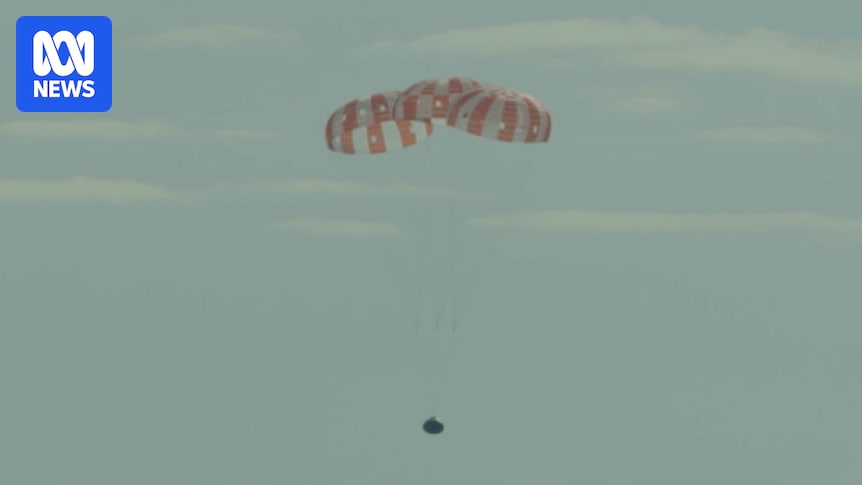
The four astronauts who have travelled farther from Earth than humans have ever been before are preparing to re-enter the atmosphere in a “fireball”.
The crew from NASA’s Artemis II is due to splash down off the coast of San Diego, California, in the Orion capsule, just after 8pm, Friday, local time, (10am, Saturday AEST).
During the 10-day mission, the Artemis II cruised along a path that took them past the shadowed, lunar far side to become the farthest-flying humans in history.
Mining on the Moon is closer than ever, but challenges remain
The four astronauts — Victor Glover, Reid Wiseman, Christina Koch and Jeremy Hansen — on Monday reached a record-breaking distance from Earth of more than 405,000km, surpassing the previous record held by the Apollo 13 crew for 56 years.
On the trip back home, they will reach speeds of up to 40,000 kilometres per hour as they enter Earth’s atmosphere, a high-risk phase of the mission that will put Orion’s heat shield to the test as it gets battered by intense atmospheric friction.
How fast does the Orion travel?
Since the Orion capsule, called Integrity, separated from the main rocket, it has orbited the Moon.
The Orion capsule will be travelling at about 40,000km/h when it nears the Earth’s atmosphere.
When it moves from space into the atmosphere, friction creates temperatures of more than 2,500 degrees Celsius.
Artemis II is about to orbit the Moon. Here’s how
Superheated plasma builds up around the capsule, which is protected by a heat shield, within seconds.
According to NASA’s podcast about Artemis II, the shield is designed to shed intense heat, but as the spacecraft flies through the atmosphere, Orion briefly loses communication and the astronauts see flashes of plasma outside the windows.
Writing for The Conversation, Chris James, hypersonics lecturer at the University of Queensland, said the Orion capsule will re-enter the atmosphere moving at more than 30 times the speed of sound.
“A shock wave will envelop the spacecraft, creating air temperatures of 10,000 degrees Celsius or more — about twice the temperature of the surface of the Sun,” he said.
“The extreme heat turns the air that crosses over the shock wave into electrically charged plasma.
“This temporarily blocks radio signals, so the astronauts will be unable to communicate during the harshest parts of their descent.”
How will the capsule slow down?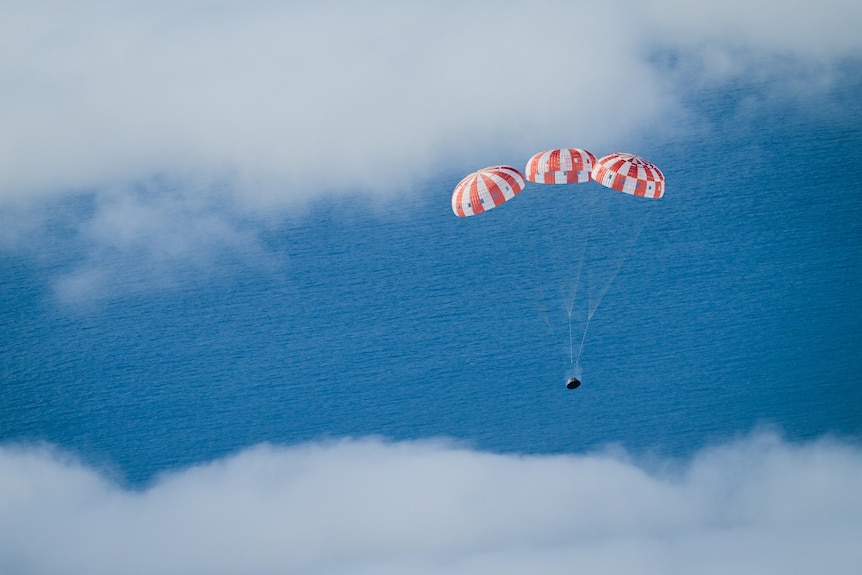
Orion will be slowed down from more than 40,000km/h to about 30km/h thanks to a series of 11 parachutes deployed at just the right time. (Supplied: NASA, Josh Valcarcel)
As Orion descends, it is slowed down by a series of 11 parachutes, which are deployed in stages.
By the time it reaches Earth’s surface, Orion is travelling about the speed of a fast cyclist, about 30km/h.
At 42 minutes before splashdown, the crew module separates from the service module.
Orion enters the Earth’s atmosphere, 120,000 metres above the surface, 13 minutes before splashdown.
Once the capsule has made it through the re-entry stage, part of its protective cover will be cast off to make way for the parachutes.
Parkes Dish 50-year lunar legacy
When the capsule reaches an altitude of 6,700 metres, two 7-metre-wide parachutes should be deployed.
That should slow the capsule down to nearly 500km/h.
But that’s still really, really fast, so there will be more parachutes.
Once the spacecraft gets to 3000 metres, three 3-metre-wide pilot parachutes will deploy.
And this will pull the final three main parachutes, which are more than 35 metres wide.
NASA said this should slow the capsule down from an estimated 209km/h to about 27km/h.
Which way up will the Orion be when it hits the water?
NASA says Orion could land upright, on its side, or upside down.
But if it lands on its side or upside down, it won’t stay that way for long because five airbags are set to inflate at the top of the spacecraft.
That’ll flip the capsule the right way up to allow the crew to exit safely.
Are there any concerns?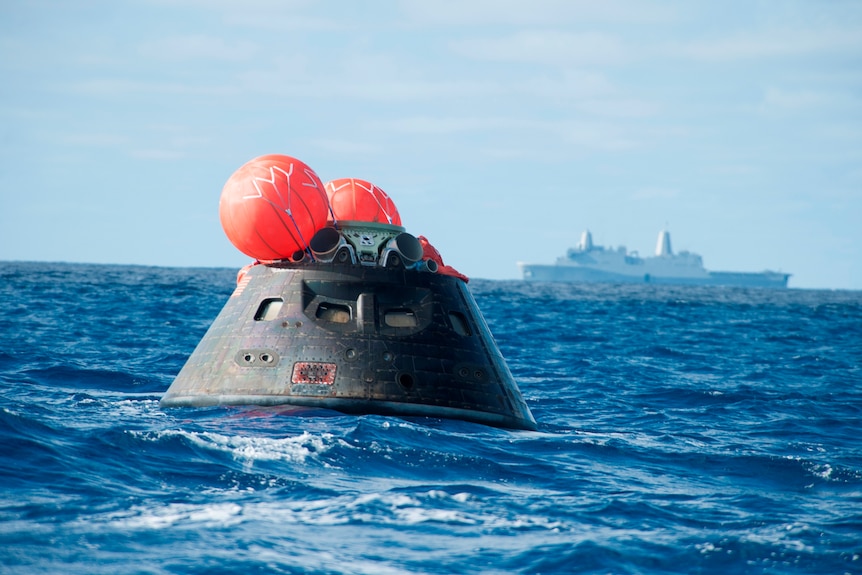
After the uncrewed Artemis I splashed down, scientists found more than 100 cracks and craters in the heat shield. (Supplied: NASA, Anthony W Gray)
A former NASA engineer believed the heat shield may not be up to the task and said the mission was “playing Russian roulette” with the astronauts’ lives.
Charlie Camarda, an engineer with NASA for two decades who flew on the first shuttle after Columbia exploded on re-entry in 2003, said there were similarities between Artemis II and the two space shuttle disasters (Challenger in 1986 and Columbia in 2003).
“We kept flying until it wasn’t safe … we never fixed the problem,” he said.
Artemis capsule boost puts astronauts moon-bound
In 2022, the Artemis I mission flew around the Moon with test dummies.
The heat shield on that Orion capsule experienced damage, and NASA engineers found more than 100 cracks and craters on its surface.
But, because it was an uncrewed mission, the re-entry procedure was different from the one that Artemis II will follow.
NASA administrator Jared Isaacman said he had “full confidence” in the heat shield, following an investigation.
What’s changed since the Apollo missions?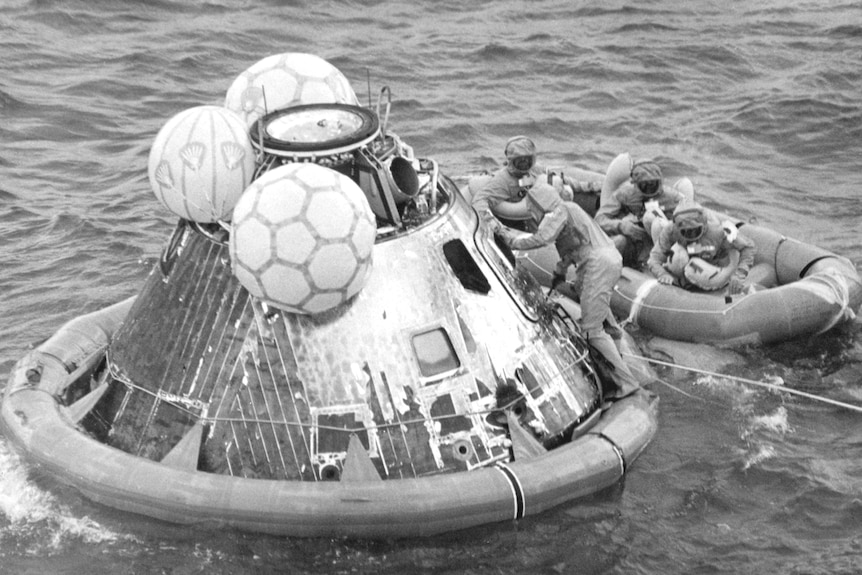
Much has changed since the Apollo 11 splashed down, but the material used for the heat shield on the base of the Orion is similar. (Supplied: NASA)
While there have been quite a lot of advances in space travel since Apollo 11 first took men to the Moon in 1969, the heat shield on the base of the Orion is made from a material called Avcoat and is a re-engineered version of the shield used in the Apollo missions.
The Apollo spacecraft re-entered Earth’s atmosphere at approximately 35,000km/h, but the Orion capsule will be returning at an even faster speed, approximately 40,000km/h.
This will be the fastest re-entry ever attempted for a craft with astronauts on board.
Has anything ever gone wrong during a splashdown?
In 1961, NASA astronaut Gus Grissom flew aboard the Liberty Bell 7, a ballistic test flight, which was the second US manned suborbital spaceflight.
He was in the air for just over 15 minutes, but when the small capsule he was in splashed down in the Atlantic Ocean, the hatch popped open and it began taking on water.
Artemis II’s lunar fly-by in pictures
The plan had been for a navy helicopter to hook and pick up the capsule, lifting it out of the water so that Grissom could climb out and be pulled into the aircraft.
After the hatch blew off prematurely, Grissom had to swim for his life as the capsule sank, with water filling his spacesuit, making it heavier.
The helicopter abandoned the sinking Liberty Bell and picked up Grissom, winching him to safety just in time.
How are the astronauts going?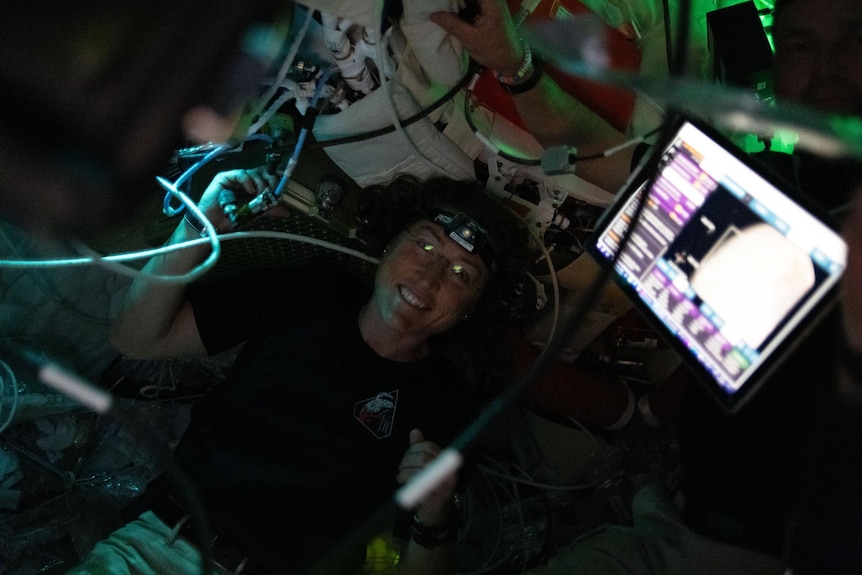
Christina Koch and her fellow crewmates spent approximately seven hours taking turns at the Orion windows capturing science data to share with their team back on Earth. (Supplied: NASA)
In a press conference from space before Orion began its descent, Artemis II mission pilot Victor Glover said he had been thinking about re-entry since he was assigned to the mission on April 3, 2023.
“There are so many more pictures, so many more stories, and gosh, I haven’t even begun to process what we’ve been through,” he said.
“Riding a fireball through the atmosphere is profound as well.”
Following splashdown, recovery teams will retrieve the crew using helicopters and deliver them to the USS John P Murtha.
Once aboard, the astronauts will undergo post-mission medical evaluations in the ship’s medical bay before travelling back to shore to meet with an aircraft bound for NASA’s Johnson Space Center in Houston.
Will you be able to see Orion on its way back to Earth?
Physicist at Curtin University’s School of Earth and Planetary Sciences Martin Towner told the ABC that, while Orion will travel over eastern Australia on the way back to Earth, at that point it will be more than 10,000km above the surface, far above the atmosphere, during the daylight, so we won’t be able to see anything.
The ABC will be live-blogging the Orion’s final hours back to Earth from 7am AEST on Saturday morning.