
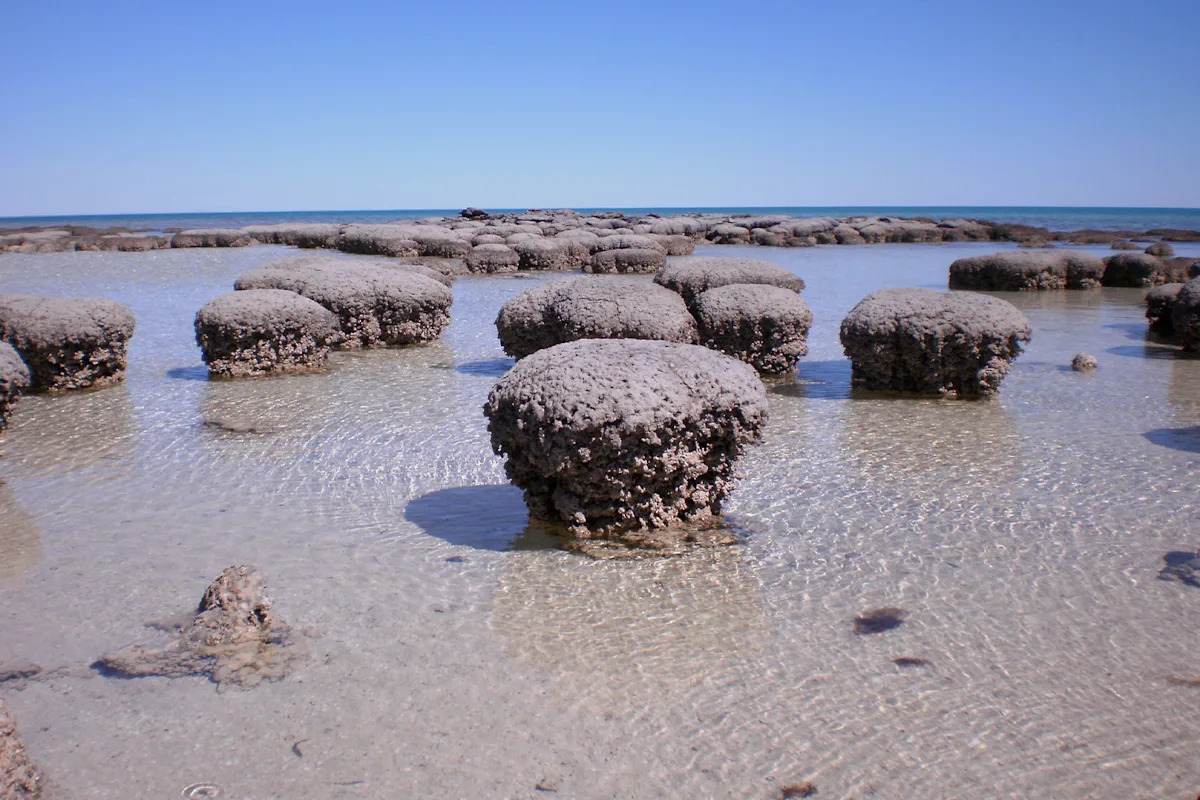
In 2019, scientists collected a small sample of microbes from rock-like structures on Australia’s west coast and cultured them in a lab.
Years later, they looked inside the bottle they’d been growing in and witnessed a behaviour that had never been seen in human history.
A study into this event was published overnight.
University of NSW evolutionary biologist Associate Professor Brendan Burns explained the team were excited to watch as an ancient microorganism physically interacted with a bacterium.
Remarkably, a similar relationship is believed to be a precursor to the creation of complex life on Earth over 2 billion years ago.
“It was really cool,” Burns told Yahoo News.
“It was found by one of our collaborators looking through a microscope, which can be an unforgiving sort of work.
“What they’re doing is like looking for a needle in a haystack, poring through images of the microbes, and sometimes bang, something like this appears.”
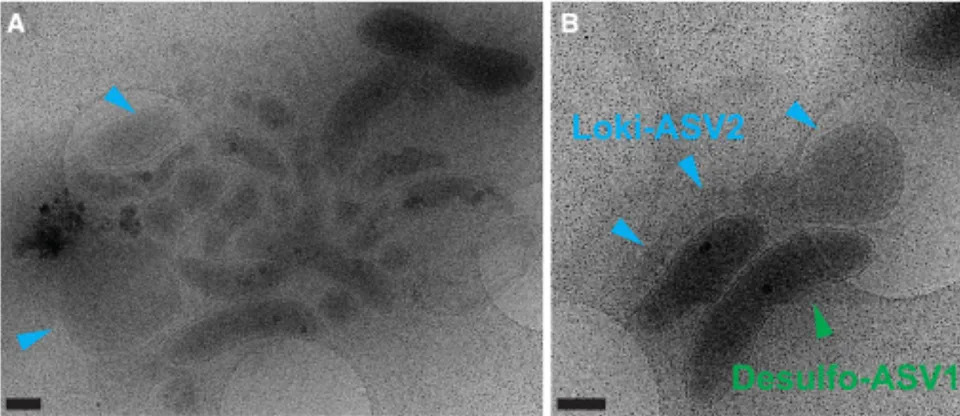
Images taken through a microscope show Asgard archaea interacting with bacteria. Source: Current Biology
Human life thought to have originated through similar process
The bacterium in the lab was seen using tiny tube-like structures to physically interact with a basic lifeform called Asgard archaea.
“It’s been hypothesised to have occurred, but in terms of actually visualising this direct connection, we’ve never seen it before,” Burns said.
Scientists are excited because it’s long been theorised that a similar relationship between another ancient Asgard archaea and a bacterium became so close that the two fused.
This rare event created eukaryotes, the complex cells that make up all animal and plant life.
“It’s probably one of the most major steps in evolution, going from an Earth that’s dominated by bacteria and these small microbes called archaea, to the world that we see today with larger forms of life,” Burns said.
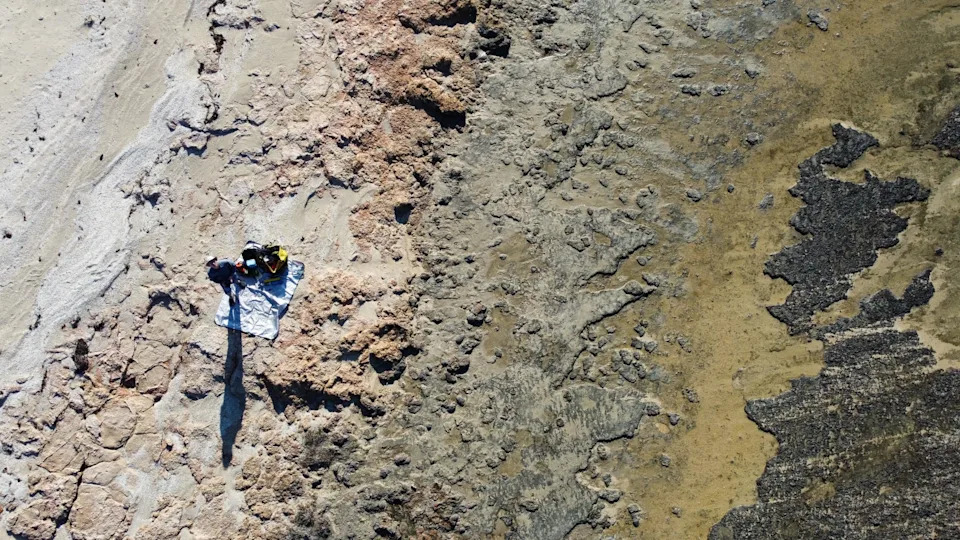
Researchers scouring the Shark Bay coastline for microbes. Source: Brendan Burns
‘Apartments’ on Aussie coast housing billions of microbes
The Asgard archaea was collected with the bacterium at Shark Bay in Western Australia.
The coastline is famous for its numerous stromatolites, which resemble strange rock formations, but instead they are layered communities of microbes.
“They just look like a pile of rocks, but they’re actually really dynamic,” Burns said, comparing them to “apartment blocks” that humans live in.
“You’ve got microbes living at different layers, and they exchange goods and services and interact,” he added.
“One microbe produces something that another microbe uses, and that becomes part of their life.”
Could the two lifeforms in the lab fuse?
Studying the microbes in stromatolites has long given scientists an understanding of how early life existed, and now it’s hoped they could help decipher the emergence of complex life.
The microbes were collected as part of a joint project between the University of NSW, the University of Technology Sydney, and the University of Melbourne.
And the research was published in the journal Current Biology.
The specific Asgard archaea that was documented interacting with the bacterium was named Nerearchaeum marumarumayae, which combines the name of the Greek sea god Nereus with the local Malgana Indigenous word “marumarumayae”, which means ancient home.
Although the microbes collected from the stromatolites are interacting with each other, Burns doesn’t think they’ll be witnessed fusing together.
He notes this could take hundreds of thousands to millions of years to occur.
“I’m not naive enough to think that we’re going to suddenly see a new eukaryotic being formed. If that occurred, it would have to be one of the fastest forms of evolution you’ve ever seen,” he said.
“But maybe we’re seeing the early steps as to how they kicked off.”
Do you have a story tip? Email: newsroomau@yahoonews.com.
You can also follow us on Facebook, Instagram, TikTok, Twitter and YouTube.