
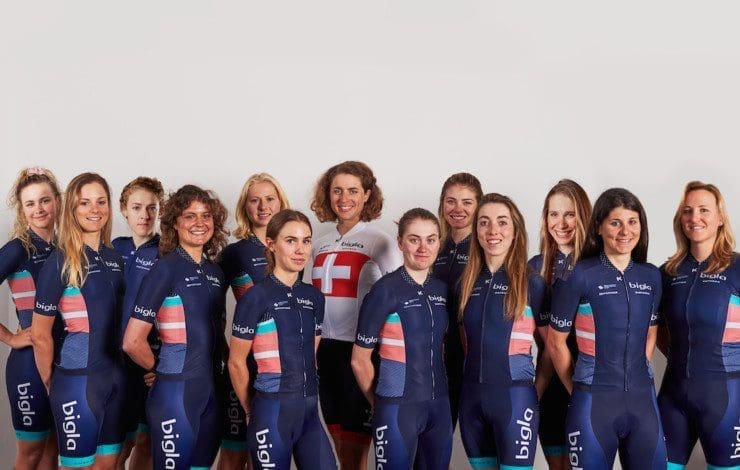
Cervelo-Bigla is easiest to remember through its most visible years, but the fuller story starts much earlier. The team began in 2005, ran through to 2020, and changed names several times along the way: Team Bigla in 2005, Bigla Cycling Team from 2006 to 2015, Cervélo-Bigla Pro Cycling from 2016 to 2018, Bigla Pro Cycling in 2019, Bigla-Katusha in early 2020, and finally Équipe Paule Ka for the team’s last months before it folded in October 2020. That long arc matters because this was not just a short-lived sponsor project. It was one of the more durable and revealing teams of women’s cycling’s professionalisation era.
Seen in that wider context, the team belongs in the same conversation as the projects that helped push the sport towards a more stable and more ambitious future. ProCyclingUK’s Women’s cycling history, races, riders and teams hub and Boels-Dolmans team history – inside the rise of a women’s cycling superteam offer a useful parallel to that broader shift.
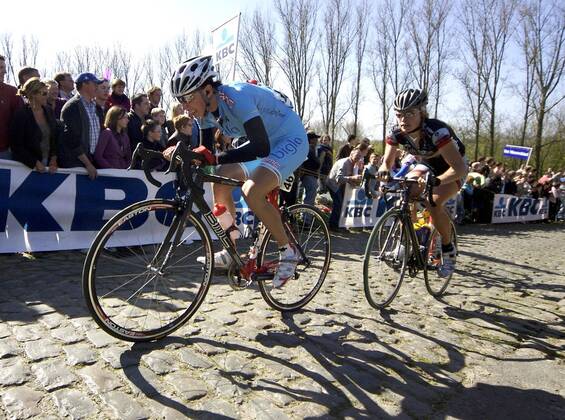 Photo Credit: Imago/Rene Schulz
The early Bigla years laid the foundations
The earliest version of the team was already significant because it showed what a serious women’s structure could look like before the market had really caught up. The 2005 and 2006 line-ups included riders such as Zulfiya Zabirova, Nicole Brändli and Noemi Cantele, which immediately gave the project weight. Those were not symbolic names. They were major riders in an era when women’s teams often had to fight much harder for visibility, resources and continuity.
That early credibility matters in hindsight. Bigla did not suddenly become ambitious when Cervélo arrived. It already had a base, a culture and a presence in the sport. Cervélo sharpened the identity later, but the project’s seriousness was older than the branding.
Bigla Cycling Team became a home for strong riders and second acts
Through the later 2000s and early 2010s, the team kept adapting rather than disappearing. Emma Pooley joined for 2013 after originally contemplating a step away from the sport, which said a lot about Bigla’s place in the peloton at the time. It could attract a rider of that stature and offer a meaningful competitive home.
By 2015, the roster had taken on a more recognisable modern shape. Bigla lined up with Annemiek van Vleuten, Ashleigh Moolman-Pasio, Iris Slappendel, Joëlle Numainville, Lotta Lepistö and Lisa Klein for the Tour of Flanders, which gives a good sense of the team’s strength and range at that moment. Results backed that up too. Van Vleuten was 2nd and Moolman-Pasio 4th at La Flèche Wallonne Féminine in 2015, underlining that Bigla was already capable of placing multiple riders near the front in the biggest races before the Cervélo title-sponsor years began.
That 2015 period is easy to overlook because it sits on the edge of the better-known Cervélo era. In reality, it was the bridge that made the next phase possible.
Why the Cervélo years changed the team’s place in the sport
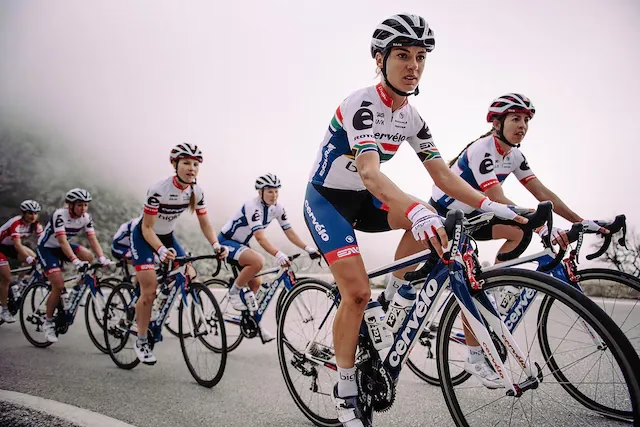
When Cervélo moved from bike supplier to title sponsor for 2016, the team gained more than a new name. It gained a much clearer place in the sport’s conversation. From then on, Cervélo-Bigla looked less like a sturdy long-term project and more like one of the teams actively helping define what a modern professional women’s team could be.
That was visible in the roster. Moolman-Pasio remained a central figure. Lepistö gave the team elite sprinting speed. Klein and Clara Koppenburg were part of a younger wave. Cecilie Uttrup Ludwig also came through the team in those years. The team mixed established names with riders who were still on the way up, which is one reason it felt important. It was not only trying to win the next race. It was also shaping careers.
On the road, the team showed real depth rather than isolated flashes. It won across different terrains and could also function collectively, shown by bronze medals in the World Championships team time trial in both 2016 and 2017. Those were not decorative results. They signalled organisation, coherence and a standard of performance that placed Cervélo-Bigla among the more serious teams in the sport.
The team helped build careers, not just results sheets
This is a big part of why the project still matters. Cervelo-Bigla and its later versions became a ladder for riders who would go on to shape the sport more broadly. Klein, Koppenburg and Uttrup Ludwig all fit that description. So do later names such as Emma Norsgaard, Leah Thomas, Elise Chabbey, Mikayla Harvey, Daria Pikulik and Marlen Reusser.
That role is easy to underrate when looking back at team history. A team does not need to dominate the sport to change it. Sometimes it changes the sport by giving ambitious riders structure, opportunity and belief at the right moment. Cervelo-Bigla did that repeatedly.
Big results, but never just a results machine
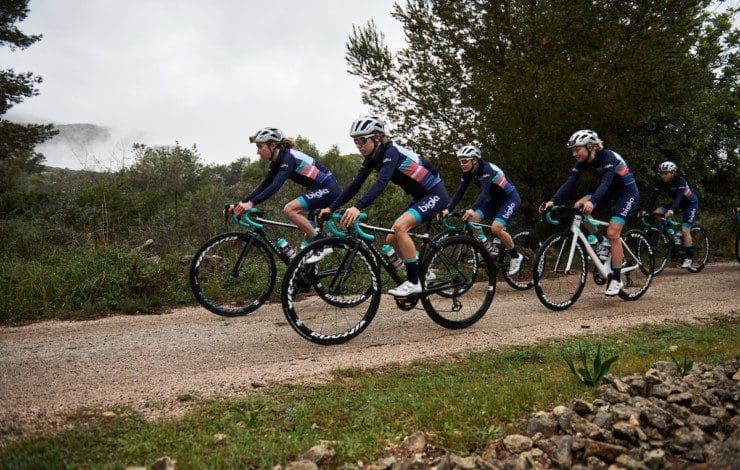
The team’s racing identity was distinctive because it was built around range. Lepistö’s Gent-Wevelgem win in 2017 remains one of the obvious highlights, but the project was rarely defined by a single type of race. It could sprint, it could climb, and it could race aggressively enough to influence one-day tactics without needing to dominate outright.
That variety helped the team punch above its budget. In the best seasons, Cervelo-Bigla felt like the sort of team other squads had to keep accounting for. It might not have controlled the whole sport, but it was very capable of altering how races were ridden.
For a wider race context from that era, ProCyclingUK’s A brief history of La Flèche Wallonne Féminine and A brief history of Liège-Bastogne-Liège Femmes help show the kind of calendar this team was trying to influence.
2019 Bigla Pro Cycling was one of the project’s most interesting years
The 2019 season deserves more attention than it usually gets. By then, the team name had become Bigla Pro Cycling, and it was still producing important stories and results. Lizzy Banks won stage 8 of the Giro Rosa, with teammate Leah Thomas finishing 2nd on the stage, a result that captured both the team’s climbing strength and its tactical reach.
That same year also produced one of the strangest and most memorable episodes in modern women’s racing. At Omloop Het Nieuwsblad, Nicole Hanselmann attacked late, built a gap, and almost caught the tail end of the earlier-started men’s race on the same roads. Organisers neutralised the women’s race and asked her to stop by the roadside to restore separation between the events. It was a bizarre moment, but also an unintentionally revealing one. Hanselmann’s move exposed the organisational assumptions that still shaped women’s racing in 2019, including the limited margin in event planning when the women’s race became more dynamic than expected.
That incident has lasted in the memory because it was absurd, but it also reflected something more serious. Women’s cycling was getting stronger, deeper and faster, yet parts of the sport’s organisation were still catching up.
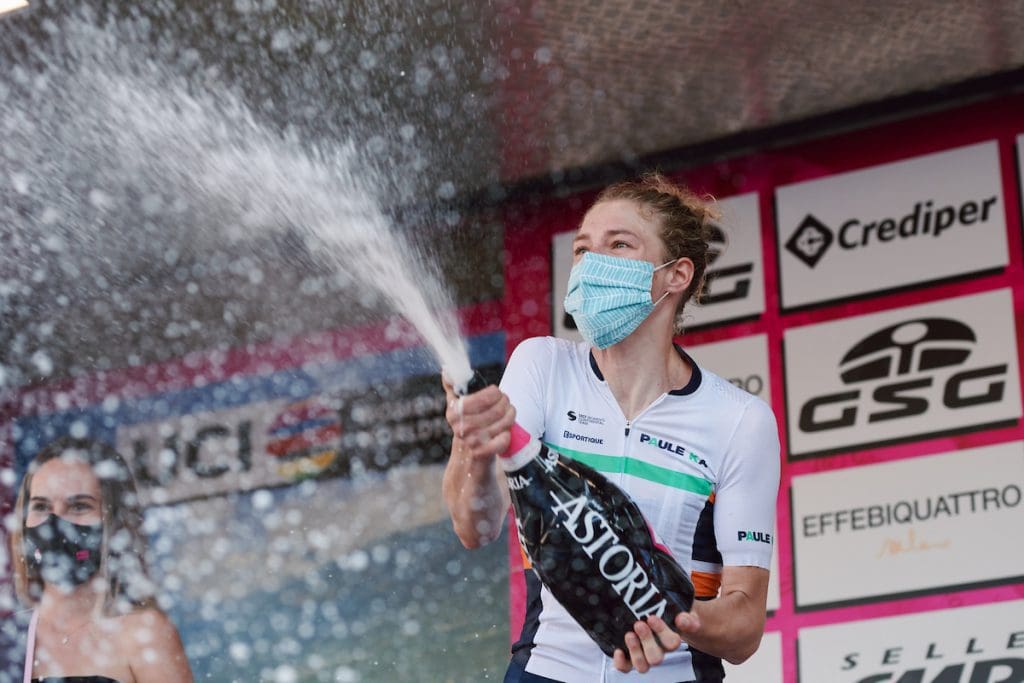
Bigla-Katusha and Équipe Paule Ka in 2020 were not footnotes, they were the final chapter
The 2020 season is often compressed into a collapse story, but it is worth separating the phases properly. The team began the year as Bigla-Katusha, then after the funding crisis and sponsor withdrawals, it was rebranded in mid-2020 as Équipe Paule Ka. That sequence matters because it shows both the project’s fragility and its resilience. Even under enormous financial pressure, it still tried to keep racing and keep itself alive.
There were still real riders and real results in that final stretch. Reusser had signed for 2020 as one of the most exciting time trial and road talents in the peloton, bringing another high-level name into the structure. Emma Norsgaard was still part of the set-up, as were Banks and other riders who would later move on to strong careers elsewhere. Banks then won stage 4 of the 2020 Giro Rosa in Équipe Paule Ka colours, giving the final version of the team a major result even as its future was disintegrating.
That is part of what makes the ending so stark. This was not a dead team limping to the line. It was still capable of attracting talent and winning races.
The contradiction at the heart of the project
Any honest history also has to deal with the abuse allegations that reshaped how many people viewed the team. In 2018, former riders accused team owner Thomas Campana of bullying, intimidation and fat-shaming. Campana denied the allegations, but the accusations altered the team’s place in the women’s cycling story. A project that had often been presented as ambitious and professional was now also caught up in the wider reckoning over rider welfare, power and the gap between image and lived experience.
That episode matters historically because it forced a broader question. What does professionalism actually mean in women’s cycling? Not just better bikes, better branding and better results, but better care, better structures and better accountability too. Cervelo-Bigla became part of that conversation for the wrong reasons, but still part of it.
Why this team helped reshape modern women’s cycling
Cervelo-Bigla, and the wider Bigla project around it, mattered because it captured so many of the sport’s shifts in one team. It began in 2005, long before the current Women’s WorldTour landscape existed. It carried important riders in its earliest years. It became a credible home for top-level names and second acts. It was professionalised further in the Cervélo period. It developed riders who would go on to shape the peloton elsewhere. It produced major moments in 2019 and still won in 2020 under Équipe Paule Ka, even as the finances collapsed beneath it. And it became part of the sport’s uncomfortable but necessary conversation about welfare and abuse.
That is why this history should be told as more than a sponsor timeline. Bigla Pro Team, Bigla Cycling Team, Cervélo-Bigla Pro Cycling, Bigla Pro Cycling, Bigla-Katusha and Équipe Paule Ka were all versions of the same underlying idea, that women’s cycling could support a serious, ambitious, internationally relevant team outside the very biggest budgets. The project did not end neatly, and it was not free of contradiction. But it helped move the sport forward anyway.
It also belongs alongside other major strands of the modern women’s cycling story, including A brief history of Paris-Roubaix Femmes, A brief history of the Tour de France Femmes and the wider Women’s cycling history, races, riders and teams hub.