
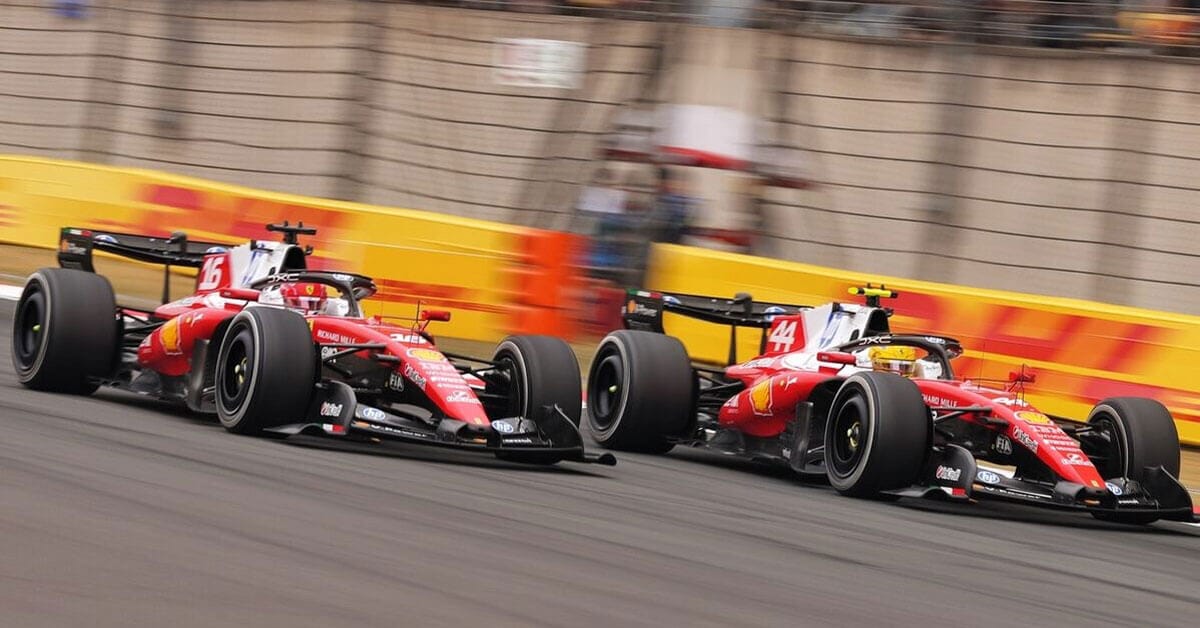
The 2026 regulations have reshaped Formula 1 in ways that go far beyond what we see on track. While the cars are obviously different, the most significant side effect is far more subtle: it concerns what drivers are no longer able to express. Between algorithms that normalize talent and energy limits that penalize those who push the boundaries, Formula 1 is entering an era where the true value of a champion no longer fully aligns with what is visible. The result is a distorted, almost misleading picture of their real level of performance.
The “false limit”: when regulations suppress talent
According to Mark Hughes, what is currently happening in Formula 1 is not just a technical evolution, but a shift in how talent is perceived. Speaking on the Motor Sport F1 Show podcast, the experienced journalist introduced a concept he describes as a “false limit”:
“It depends on the circumstances and on whether the car allows them to exploit their talent. And sometimes you are faced with a false limit being imposed.”
The principle is straightforward: a driver’s ability does not change, but what changes is how much of that ability the regulations allow them to show. It is something that has happened before. In the early stages of the 2022 and 2023 seasons, Red Bull struggled with low-speed understeer, a trait that effectively neutralized one of Max Verstappen’s greatest strengths. Hughes summarized it clearly:
“It’s not that all of a sudden Sergio Perez had become as good as Max Verstappen. It’s just that Verstappen had a kind of false limit imposed on his special qualities.”
In 2026, however, that limitation no longer originates only from the car—it is embedded directly into the regulations themselves.

Why Verstappen and Leclerc are penalized… in opposite ways
For Max Verstappen, the issue is deeply technical. His talent is most evident on corner entry, where he can rotate the car using a unique combination of braking and steering inputs that very few drivers can replicate. Hughes explained it in detail:
“Most drivers achieve a quick rotation, but they lose time due to rear-end sliding. He is able to rotate the car around an incredibly tight point.”
However, this technique comes at a cost: it consumes energy. Under the 2026 system, arriving at the end of a straight with less battery energy means being penalized precisely for doing what you do best.
“He is using energy that he then doesn’t have available on the straights, and for that he is penalized,” Hughes added.
The Red Bull chassis, which tends to suffer from understeer, only amplifies the issue. Verstappen finds himself fighting both the car and the regulations at the same time. The result is a significant gap between what he is able to achieve and what he could potentially extract under different conditions. This explains his growing frustration and even the suggestion that he could consider stepping away from the sport if the rules remain unchanged.
For Charles Leclerc, by contrast, the limitation is algorithmic rather than purely technical. His talent lies in his ability to keep the car balanced on the edge of rear grip throughout an entire corner, a skill that often shines in the final laps of Q3. However, the 2026 qualifying system does not reward improvisation:
“When he tries to do something truly spectacular… the algorithm doesn’t recognize his move,” Hughes said.
The software is calibrated based on historical patterns rather than sudden peaks of performance. As a result, exceptional moments of driving brilliance are effectively normalized and, in some cases, minimized.
Charles Leclerc’s response has been highly methodical. The Ferrari driver has assembled a group of software engineers to simulate every possible energy scenario, going beyond what is typically provided by the team in order to regain some control over performance variables.
The 2026 regulations have not just changed Formula 1—they have changed how talent is displayed and perceived. Verstappen and Leclerc, despite their very different driving styles, are facing the same paradox: they can no longer fully express what makes them unique. The limitation is no longer purely technical or human. It is written, calculated, and coded into the system itself.
And as long as this remains the case, Formula 1 risks no longer showcasing its very best drivers at their true peak.
Apr 11, 2026Elena Rossi
Let other Scuderia Fans know about us


