
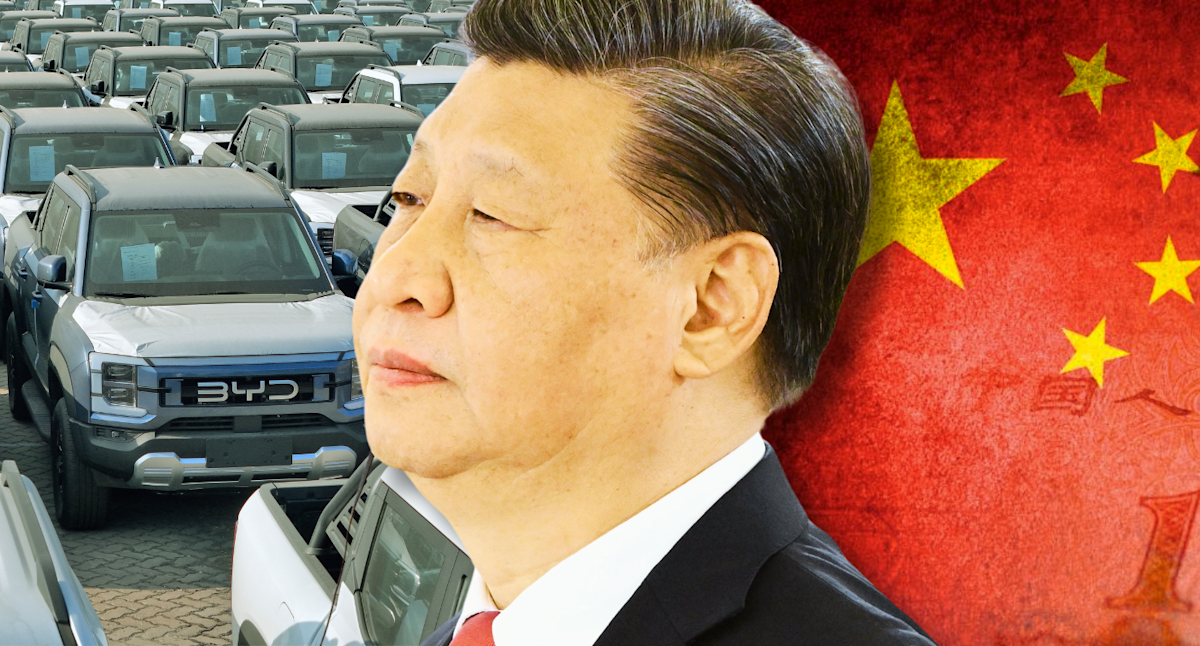
 Chinese cars like BYD and GWM are now selling more than Mitsubishi and Nissan. (Source: Getty/Yahoo Finance)
Time to update what you think you know. Chinese cars are now normal. In fact, since February 2026, the most common place for Australia’s cars to be made is now China.
Car brands were extremely stable in this country for ages: Ford, Holden, Toyota. That began to wobble in the last decade, but now it is totally shattered.
Holden is gone. Toyota sales are down by a quarter this year alone. BYD and GWM are selling more than Mitsubishi and Nissan.
RELATED
Well-known, normal brands like Peugeot, Renault and Skoda are being massively outsold by brands nobody has heard of, like Omoda Jaecoo and Geely.
As Australia goes EV-crazy, the car market is being torn apart and reassembled. And that is a clue to the global order too.
 (Source: VFACTS/Jason Murphy for Yahoo Finance)
China has spent the last five years manoeuvring itself into a leading position in electric vehicles. Which was a risk. In retrospect, however, it looks like genius.
The term “kodak moment” refers to the old film and camera company, Kodak. Once an industrial giant, it ignored the rise of digital photography and thereby engineered its own irrelevance. The legacy car makers of the west have been experiencing their own slow-burning Kodak moment.
Ford and General Motors have been mucking around, Mercedes and Honda not doing much. Some moderate efforts from VW, BMW and Hyundai might yet save those companies. But there’s been just about nothing from Toyota. All while BYD positioned itself to devour the globe.
I called it a slow-burn. And it was. Right up until Trump decided regime change was fun, easy and usually successful. His flighty, unprovoked, half-hearted war against Iran made that slow burn speed up dramatically.
Oil prices have soared and fuel prices have shot through the roof. China’s manufacturing economy is now right in the centre of the global conversation. Who cares about their failing real estate sector now? It’s all about electric vehicles.
China’s EV exports are nearly double last year, exporting a startling 670,000 EVs in just the first two months of the year. If you think that surge is over, you’re about to be surprised.
China exports well under half the cars they make, so they can always rebalance away from domestic sales to provide more exports. Plus, manufacturing so far this year has been limited by the timing of the Spring festival, which ate into working days in February. Production in March could easily be double that in February.
Chinese EV exports are nearly double last year. (Source: Getty)
Ford’s boss warned last year of just how powerful Chinese manufacturing can be:
“They have enough capacity in China with existing factories to serve the entire North American market, put us all out of business,” said CEO Jim Farley in a TV interview last October.
That manufacturing strength is a strategic choice. China pivoted to manufacturing as a way to soak up extra capacity in their economy after their real estate push ran out of oomph. It was working somewhat until 2026. Now it is working beautifully. China’s population is falling, so to grow its economy, it really needs to make something it can export. Not houses. Cars.
The rise in battery electric vehicles has caused a spike in the price of Lithium too. The soft metal that is the big input to batteries now costs more than double its 2025 price. The price is however still far lower than its crazy 2022 spike. Turns out lithium is fairly abundant – the true choke-point for battery making is rare earths like cobalt.
The irony of Trump’s strategic “leadership” here is that he not only revealed the weakness of America and empowered the Iranian Islamic Republic, but he boosted China too. (High oil prices are good for Russia as well, extra oil profits help fund their slow grind against Ukraine.)
It’s a sort of omni-shambles and I’d love it if it concluded neatly like a book closing. But instability rarely leads back to stability. Instead, it will likely create overcorrections, backlashes and surprise side-effects. Economic, military and political.
This is, arguably, China’s Detroit moment. But not Detroit 1980s, more like Detroit 1920s, where the Americans built an incredibly powerful economy around a hot new consumer product.
The idea China is going to get trapped as a “middle income country” that can’t compete with America? That is looking increasingly improbable. We will all be driving our electric Geelys into a very different future.
Get the latest Yahoo Finance news – follow us on Facebook, LinkedIn and Instagram.